---
title: "Restaurant Tech Marketing in 2026: The Content Operating System"
description: Restaurant tech marketing works as one system with positioning at the center. Here's what to build first, second, and third in 2026.
image: https://popcorngtm.com/hubfs/AI-Generated%20Media/Images/Tech%20Marketing%20Team%20Brainstorming%20in%20Modern%20Office.png
---
[Skip to content](https://popcorngtm.com/blog/restaurant-tech-marketing-content-operating-system#main-content)


[](https://popcorngtm.com)


- [About Us](https://popcorngtm.com/about-us)
- [Fractional CMO](https://popcorngtm.com/fractional-cmo)
- [Marketing & GTM](https://popcorngtm.com/restaurant-technology-marketing)
Show submenu for Marketing & GTM
- [Marketing Playbooks](https://popcorngtm.com/restaurant-technology-marketing)
- [Content Engine](https://popcorngtm.com/aircover)
- [HubSpot CRM & Websites](https://popcorngtm.com/websites)
- [Franchisee Intelligence](https://popcorngtm.com/frandata)
- Media Resources
Show submenu for Media Resources
- [Blog](https://popcorngtm.com/blog)
- [Podcast](https://popcorngtm.com/podcasts)
- [Economics](https://popcorngtm.com/restauromics)
- [Brand Archetype](https://popcorngtm.com/brand-archetype-primer)
- [About Us](https://popcorngtm.com/about-us)
- [Fractional CMO](https://popcorngtm.com/fractional-cmo)
- [Marketing & GTM](https://popcorngtm.com/restaurant-technology-marketing)
Show submenu for Marketing & GTM
- [Marketing Playbooks](https://popcorngtm.com/restaurant-technology-marketing)
- [Content Engine](https://popcorngtm.com/aircover)
- [HubSpot CRM & Websites](https://popcorngtm.com/websites)
- [Franchisee Intelligence](https://popcorngtm.com/frandata)
- Media Resources
Show submenu for Media Resources
- [Blog](https://popcorngtm.com/blog)
- [Podcast](https://popcorngtm.com/podcasts)
- [Economics](https://popcorngtm.com/restauromics)
- [Brand Archetype](https://popcorngtm.com/brand-archetype-primer)
[BOOK TIME](https://popcorngtm.com/contact)
[Marketing](https://popcorngtm.com/blog/tag/marketing)
# Restaurant Tech Marketing in 2026: The Content Operating System
[By \- Jared Castronova,](https://popcorngtm.com/blog/author/jared-castronova) Aug 26, 2026

Restaurant tech marketing works when it runs as one system: a positioning foundation at the center, every channel working off it.
Skip the hub and chase the spokes instead, and you get the pattern that wrecks marketing across this category. A LinkedIn cadence, a reviews strategy, and a loyalty content calendar, each describing a slightly different company.
The fix is a sequence.
Build the positioning first, wire each channel back to it, then add the AI-discovery layer that decides whether buyers find you at all. This post gives you that sequence and maps every play to a stage.
## Where do we start when we barely have a marketing team?
Start with positioning. It's the one asset every other play depends on, and the one you can't buy back later.
A sole marketer or a founder doing marketing on the side burns budget fastest by producing content before deciding what the content is supposed to prove.
That's how you end up with a blog, a deck, and a homepage that each pitch a different story, sometimes without anyone noticing until a prospect points it out.
The positioning foundation is the hub. It answers one question: why does a buyer pick you over the vendor with the bigger logo wall? Everything downstream is an expression of that answer.
Curbit didn't win attention by publishing more. Popcorn helped them define the "Kitchen Capacity Management" framing first, and the awareness that followed translated into measurable pipeline. That order matters more than people want it to.
Once the hub is set, the spokes have a job. Owned media becomes the place your positioning lives permanently instead of on rented platforms, which is why restaurant-tech brands[can't rent their audience](https://popcorngtm.com/blog/what-is-owned-media-and-why-you-cant-rent-reach).
Founder content on[LinkedIn](https://popcorngtm.com/blog/the-linkedin-creator-playbook-what-restaurant-tech-founders-need-to-know) carries the same message in a human voice. Each play repeats one story until the market can say it back to you, which is really the goal.
## What's different about marketing restaurant tech versus other B2B SaaS?
The buyer doesn't think of themselves as an early adopter, so novelty-first positioning falls flat. 60% of operators say their restaurants sit in the technology mainstream, and only 1 in 10 call themselves leading edge, per the[National Restaurant Association's 2026 State of the Restaurant Industry](https://restaurant.org/education-and-resources/resource-library/report-sales-to-hit-$1-55t-in-2026-despite-challenging-business-environment/). Sell "leading-edge" to a buyer who sees themselves as practical, and you've lost the room before you've said anything useful.
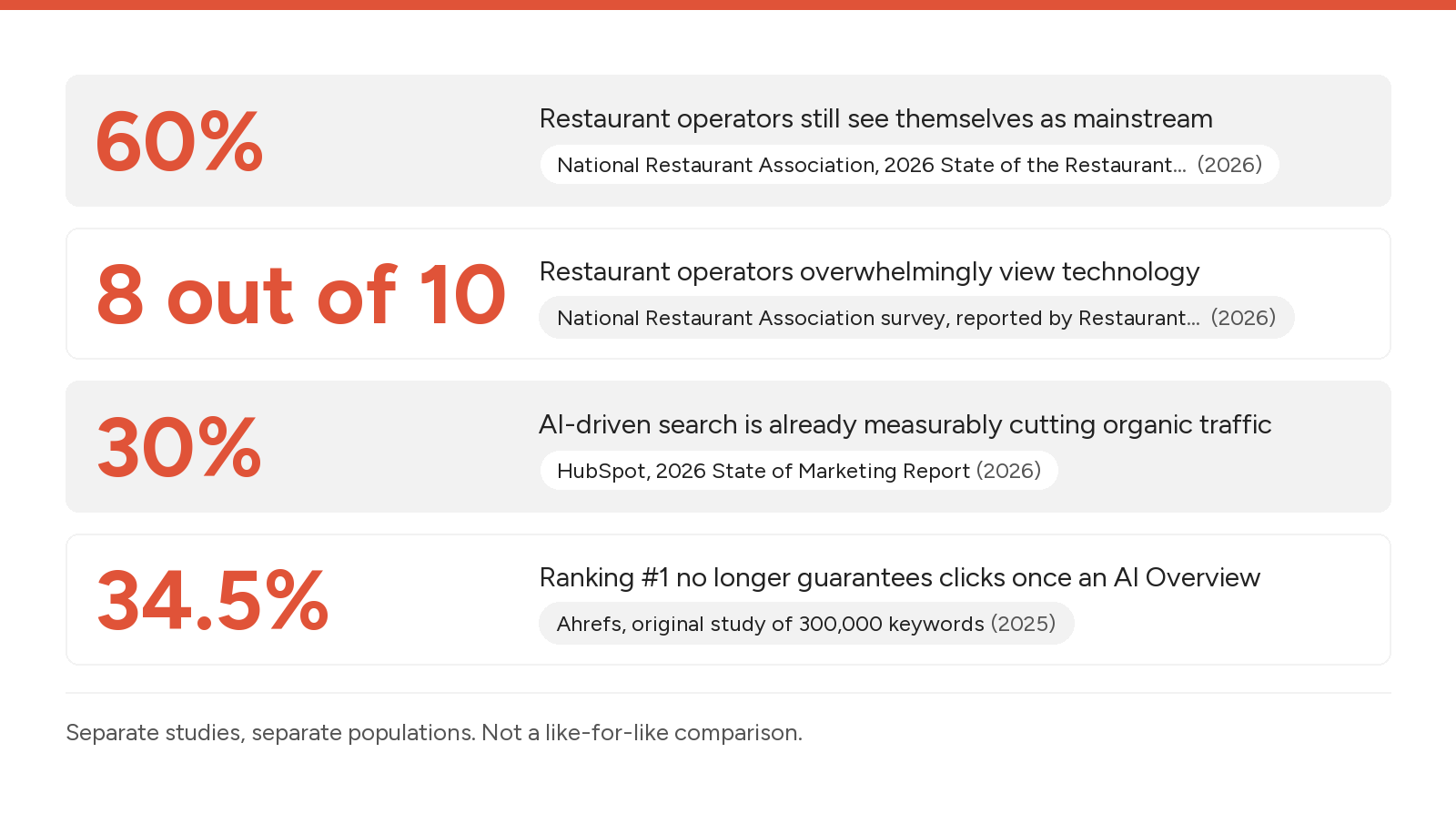
The angle that lands is competitive advantage and margin. 8 out of 10 operators say technology gives them a competitive edge, and 6 in 10 plan to invest in tech that improves the customer experience,[reported by Restaurant Business](https://www.restaurantbusinessonline.com/technology/restaurants-want-give-customers-more-tech) from the same survey. Your positioning should speak to a calmer Friday night and a better margin, not a feature list nobody asked for.
The story also has to sell the outcome an operator feels, then reach the tech buyer who signs. Miss that translation and you're feature-dumping, which is a leading reason[restaurant tech projects fail](https://popcorngtm.com/blog/why-so-many-restaurant-tech-projects-fail) to gain traction in the market.
## Do we need to worry about AEO, or is that hype for bigger companies?
Worry about it now.
AI-driven discovery already cuts traffic for small and large marketers alike, and I don't think most teams have caught up to that yet.
Nearly 30% of marketers report decreased search traffic as buyers move to AI tools, per HubSpot's[2026 State of Marketing Report](https://www.hubspot.com/marketing-statistics). This is a new top-of-funnel layer sitting above human search, and most restaurant-tech vendors have no positioning built for it. Impressive that AI can synthesize an answer this fast, and a little unsettling that it's already deciding who gets credit for it.
Ranking #1 no longer guarantees the click. When an AI Overview appears, the top-ranking page sees roughly a 34.5% lower average click-through rate, per an[Ahrefs study of 300,000 keywords](https://ahrefs.com/blog/ai-overviews-reduce-clicks/). Your buyer gets a synthesized answer before they ever reach your site, and that answer names whoever the AI decides is the authority. Not necessarily whoever built the best product.
Self-serve buyers make this worse for slow movers. 67% of B2B buyers prefer a rep-free experience and 45% used AI during a recent purchase, per the[Gartner Sales Survey](https://www.gartner.com/en/newsroom/press-releases/2026-03-09-gartner-sales-survey-finds-67-percent-of-b2b-buyers-prefer-a-rep-free-experience). Buyers research you without you in the room, and increasingly the room is an AI answer box. The vendors getting cited are publishing clear, consistent, well-structured content tied to a single position, not the ones shouting loudest.
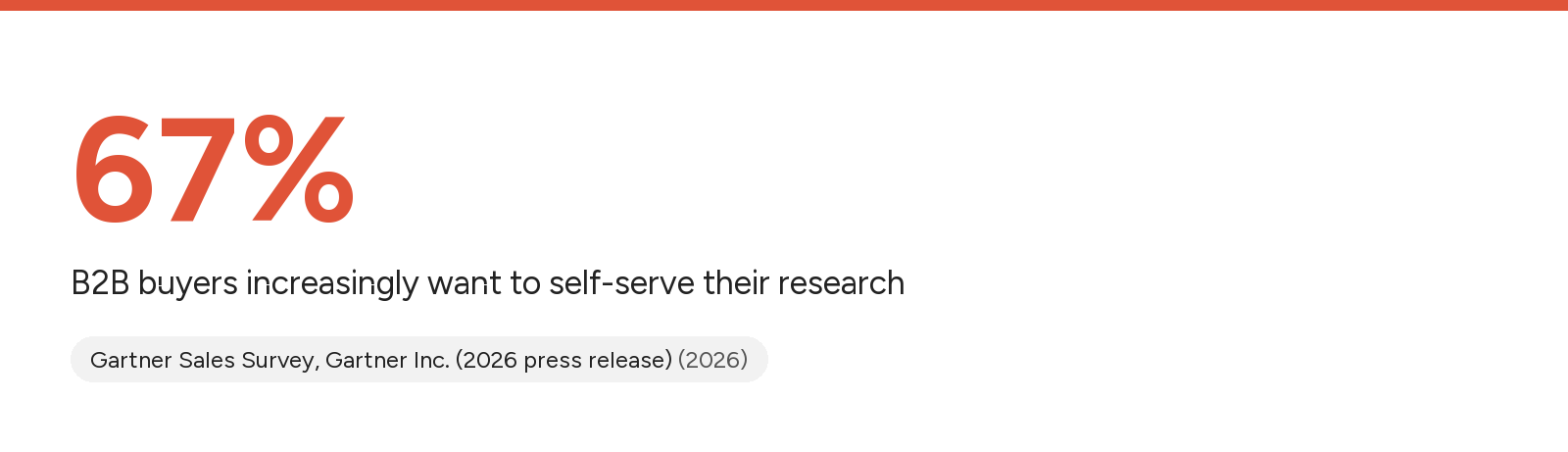
B2B buyers increasingly want to self-serve their research. Source: Gartner Sales Survey, Gartner Inc. (2026 press release) (2026).
## How do we know if content is driving pipeline, not just impressions?
You know because you built the content backward from a commercial goal, so every asset points at a stage in the buying journey. Impressions are a vanity number when the content isn't engineered to move someone from unaware to a sales conversation. Brand is the vehicle. Revenue is the destination.
Tie each play to a job, then measure the job. Here's the system and each stage:
| Stage | What it does | The play |
| --- | --- | --- |
| 1. Hub | Defines why you win | Positioning and message map |
| 2. Owned media | Home for the story | Blog, site,[owned channels](https://popcorngtm.com/blog/what-is-owned-media-and-why-you-cant-rent-reach) |
| 3. AI-discovery | Gets you cited before the click | AEO-structured content |
| 4. Human reach | Carries the story in a voice | [Founder LinkedIn](https://popcorngtm.com/blog/the-linkedin-creator-playbook-what-restaurant-tech-founders-need-to-know),[podcast](https://popcorngtm.com/podcasts) |
| 5. Proof & trust | Closes the loop | [Reviews](https://popcorngtm.com/blog/for-restaurants-the-future-is-now-and-its-written-in-online-reviews), case studies, and [loyalty data](https://popcorngtm.com/blog/2026-restaurant-loyalty-benchmark-what-it-means-for-vendors) |
Read down that table and the sequence is the point. Stage 1 makes stages 2 through 5 coherent. Start at stage 4 with a founder posting daily, and you're broadcasting a story you never agreed on in the first place.
## Should we build this in-house or run a fractional model?
Run a fractional model at pre-Series B. You need CMO-grade positioning judgment, and you can't yet justify a full-time CMO salary to get it.
86.4% of marketers now use AI tools, especially for content creation, per[HubSpot's 2026 trends report](https://blog.hubspot.com/marketing/hubspot-blog-marketing-industry-trends-report), which means a lone in-house marketer can produce volume.
Volume without a positioning foundation is exactly the trap this system exists to avoid, and I've watched it happen enough times to stop being surprised by it.
The economics favor the model built for it. The old $10K/month retainer buys hours, not judgment. The[content-as-a-service model](https://popcorngtm.com/blog/content-as-a-service-the-retainer-replacement) buys the system: a position, a sequence, and the assets to run it. A founder's time is worth roughly $500/hr, and writing content eats 2-4 hours a week you should be spending on product and fundraising.
Here's the reframe for the board worried about marketing spend: you're not funding a content habit. You're funding the one function that decides whether the market ever learns you exist.
## FAQ
What is a content operating system for restaurant tech?
- It's positioning at the center with every channel play wired back to it. The hub defines why you win. Owned media, AEO, founder content, and social proof each repeat that one story in their own format. You build the hub first, then the spokes in sequence.
Is AEO relevant for a pre-Series B restaurant tech company?
- Yes. Nearly 30% of marketers already report lost search traffic to AI tools per HubSpot, and an AI Overview drops the top page's click-through by about 34.5% per Ahrefs. Smaller companies feel it faster because they have less brand recall to fall back on.
Why can't I just start posting on LinkedIn?
- You can, and it'll carry a story you never defined. Founder LinkedIn is stage 4 of the system, and it only compounds when it's repeating a positioning the market already recognizes from your owned media.
How is restaurant tech marketing different from generic SaaS marketing?
- Your buyer sees themselves as mainstream, not leading edge, so novelty falls flat. 8 in 10 operators frame technology as a competitive advantage per the National Restaurant Association survey, so ROI and customer experience are the angle, not the newest feature.
## Where Air Cover fits
Air Cover is your automated content engine. It delivers 20+ ready-to-approve assets every week, all pointed at your positioning to get cited in the AI answer layer where 30% of search traffic is going.
We'll start by mapping your positioning and the pain points you help brands solve. [Get found by your ideal customers](https://popcorngtm.com/contact).
###### Category
- [Industry](https://popcorngtm.com/blog/tag/industry)
- [Marketing](https://popcorngtm.com/blog/tag/marketing)
- [Hot Takes](https://popcorngtm.com/blog/tag/hot-takes)
- [GTM](https://popcorngtm.com/blog/tag/gtm)
- [Artificial Intelligence](https://popcorngtm.com/blog/tag/artificial-intelligence)
- [Podcast](https://popcorngtm.com/blog/tag/podcast)
- [News](https://popcorngtm.com/blog/tag/news)
- [Systems](https://popcorngtm.com/blog/tag/systems)
- [Web 3](https://popcorngtm.com/blog/tag/web-3)
- [Online Ordering](https://popcorngtm.com/blog/tag/online-ordering)
- [Gen Z](https://popcorngtm.com/blog/tag/gen-z)
- [Industry Economics](https://popcorngtm.com/blog/tag/industry-economics)
- [Search](https://popcorngtm.com/blog/tag/search)
### Similar Blogs
#### [Why Most Restaurant-Tech Marketing Copy Falls Flat](https://popcorngtm.com/blog/why-restaurant-tech-marketing-copy-falls-flat)
By [Jared Castronova](https://popcorngtm.com/blog/author/jared-castronova) 28 June 2026
Most restaurant-tech marketing copy falls flat for one reason: it's written for the one person who...
[READ MORE](https://popcorngtm.com/blog/why-restaurant-tech-marketing-copy-falls-flat)
#### [How to Market a Restaurant-Tech Company When Operators Don't Read Marketing](https://popcorngtm.com/blog/how-to-market-restaurant-tech-when-operators-dont-read)
By [Jared Castronova](https://popcorngtm.com/blog/author/jared-castronova) 8 July 2026
This probably won’t come as a surprise, but most restaurant operators don't have time to read much...
[READ MORE](https://popcorngtm.com/blog/how-to-market-restaurant-tech-when-operators-dont-read)
#### [Marketing Is the #1 Place Restaurants Use AI. That Changes Who You Compete With](https://popcorngtm.com/blog/marketing-is-the-1-place-restaurants-use-ai.-that-changes-who-you-compete-with)
By [Jared Castronova](https://popcorngtm.com/blog/author/jared-castronova) 13 August 2026
26% of restaurant operators say they're using AI tools, per the National Restaurant Association's...
[READ MORE](https://popcorngtm.com/blog/marketing-is-the-1-place-restaurants-use-ai.-that-changes-who-you-compete-with)
[](https://popcorngtm.com)
Show Up. Every Week. Make it Pop.
---
- THE MENU
- [- Fractional CMO](https://popcorngtm.com/fractional-cmo)
- [- Marketing Playbooks](https://popcorngtm.com/restaurant-technology-marketing)
- [- Air Cover Content Marketing Engine](https://popcorngtm.com/aircover)
- [- Tech Enablement Services](https://popcorngtm.com/tech-enablement)
- [- Hot Takes, Fresh Blog](https://popcorngtm.com/blog)
- [- Restauromics Financial News](https://popcorngtm.com/restauromics)
- [- Book Time](https://popcorngtm.com/contact)
[](https://popcorngtm.com/podcasts)
COPYRIGHT © 2026 POPCORN MARKETING GROUP, LLC | POPCORN GTM IS A REGISTERED TRADEMARK, ALL RIGHTS RESERVED.
[DATA PRIVACY |](https://popcorngtm.com/privacy-policy) [TERMS & CONDITIONS](https://popcorngtm.com/privacy-policy)
```json
{
"@context" : "https://schema.org",
"@type" : "BlogPosting",
"author" : {
"@type" : "Person",
"name" : "Jared Castronova",
"url" : "https://popcorngtm.com/blog/author/jared-castronova"
},
"dateModified" : "2026-08-26T13:30:00.356Z",
"datePublished" : "2026-08-26T13:30:00.000Z",
"headline" : "Restaurant Tech Marketing in 2026: The Content Operating System",
"image" : [ "https://popcorngtm.com/hubfs/AI-Generated%20Media/Images/Tech%20Marketing%20Team%20Brainstorming%20in%20Modern%20Office.png" ],
"mainEntityOfPage" : {
"@id" : "https://popcorngtm.com/blog/restaurant-tech-marketing-content-operating-system",
"@type" : "WebPage"
},
"publisher" : {
"@type" : "Organization",
"logo" : {
"@type" : "ImageObject",
"url" : "https://popcorngtm.com/hubfs/Popcorn%20GTM%20LOGO%202026.png"
},
"name" : "Popcorn GTM "
}
}
```