At FSTEC this year, PAR's SVP of Product put one number on the screen in front of a packed room: 44 percent. The caption said that's the share of operators replacing their POS in 2026. Then he laid out where he thinks the market is going. POS platforms are splitting into two camps, open ecosystems and walled gardens, and the camp your POS ends up in will shape most of the technology decisions that come after it.
That's a big claim from a company with a stake in the answer. It deserves a closer look, both for the operators about to make this call and for the tech providers whose customers are about to make it for them.
What the 44% says
The number comes from Hospitality Technology's 2026 POS study, and the finding is a little broader than the slide. Forty-four percent of restaurants plan to replace or significantly upgrade their POS this year. Upgrades count.
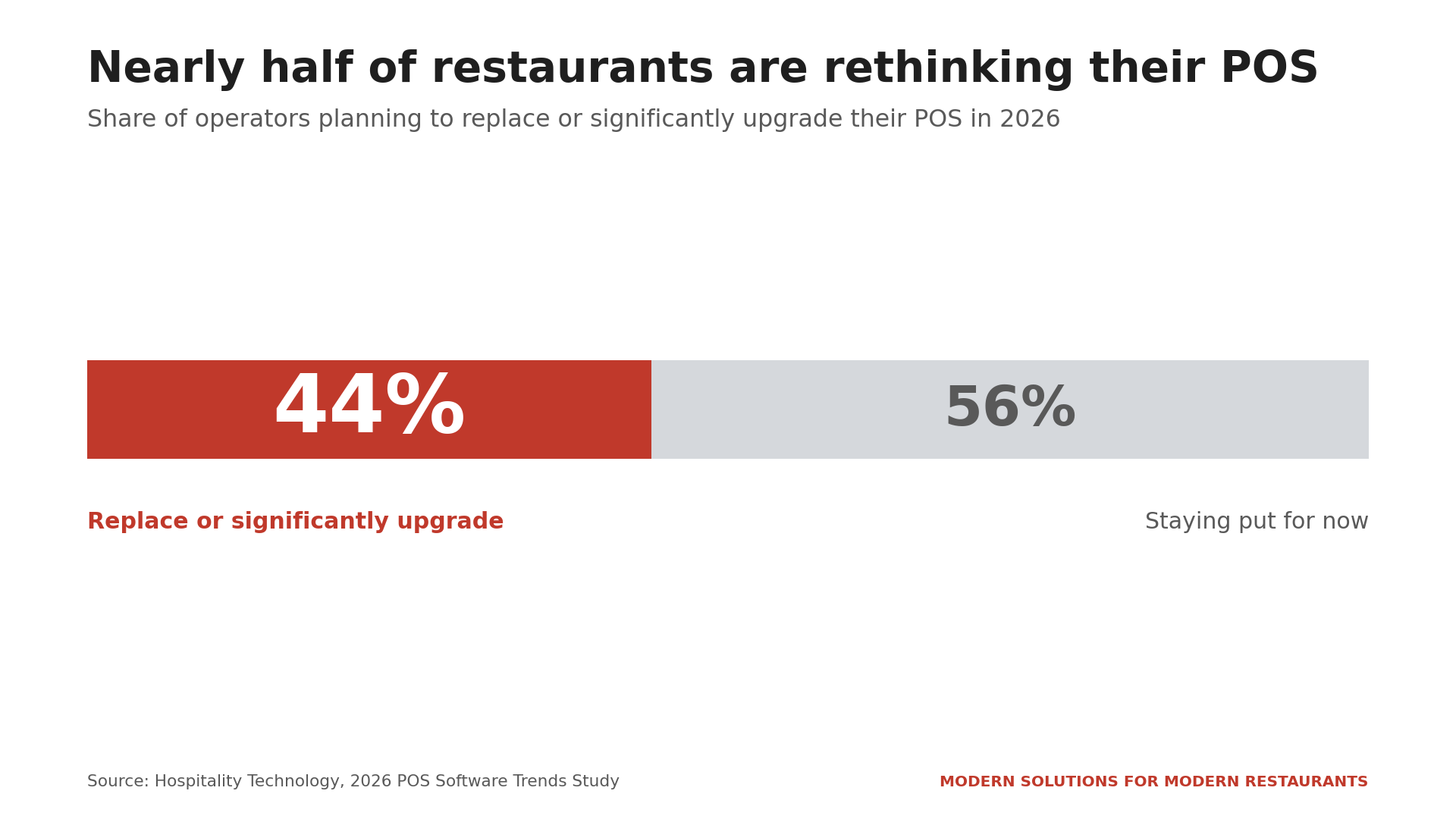
Source: Hospitality Technology, 2026 POS Software Trends Study
Even with that caveat, it's a remarkable figure. A POS usually stays in place for five to seven years, so nearly half the industry reconsidering its foundation in the same year points to pressure building across the whole category. HT's editor-in-chief described it as a tipping point, where standing still has quietly become more expensive than switching.
The same survey shows where the pressure comes from. Ninety percent of operators named stronger integration across platforms as a 2026 POS goal. Guest experience and loyalty at the point of sale came in at 80 percent, and deeper insight from data at 60 percent.
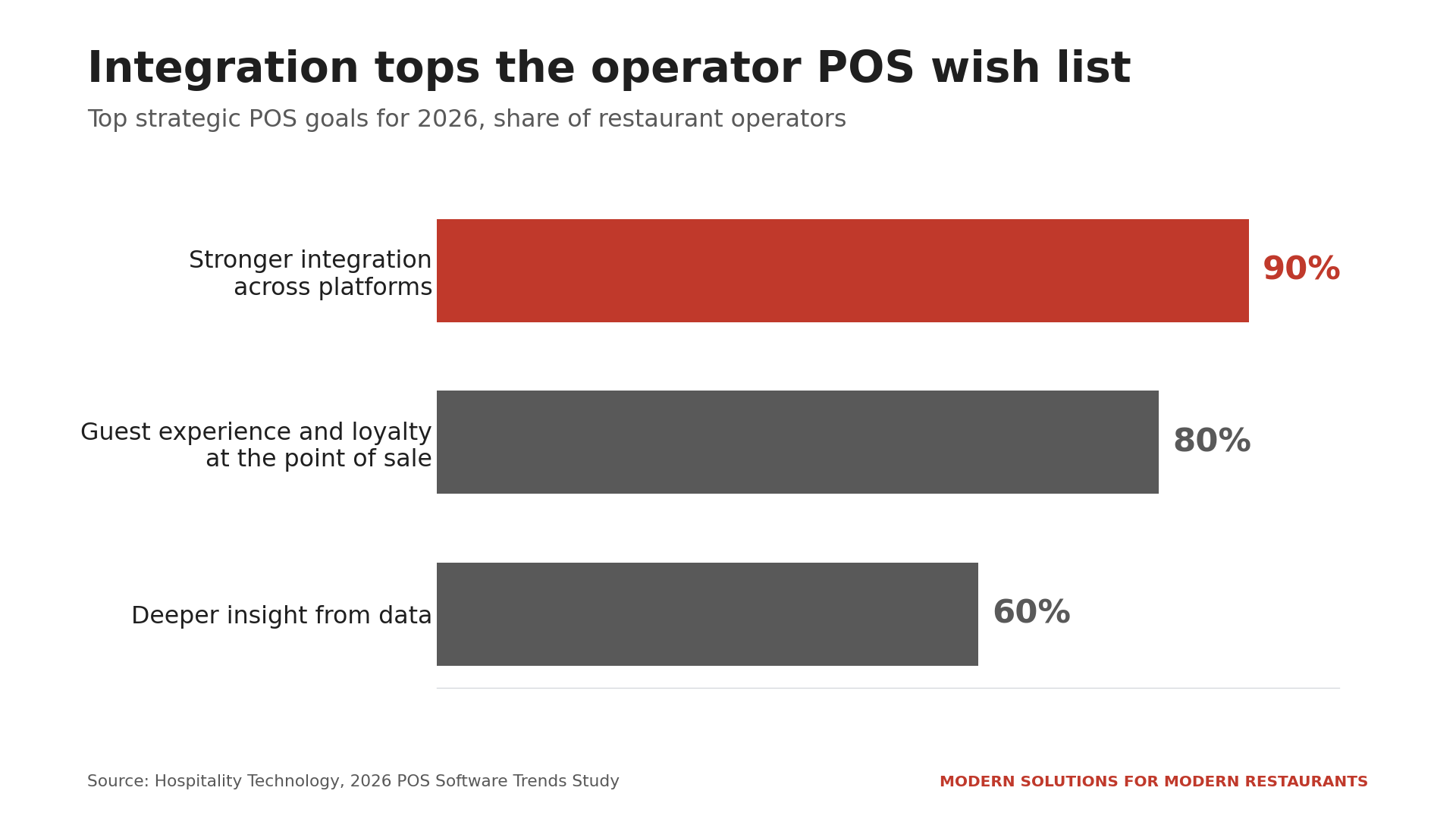
Source: Hospitality Technology, 2026 POS Software Trends Study
None of those goals is about ringing up a check faster. Each one is about how well the POS connects to everything else in the business.
How the stack outgrew the POS
PAR's second slide showed the problem in one picture. A few years ago, the POS sat at the center of a small cluster with payments, the kitchen, and reporting. Today it sits in the middle of a web that also includes delivery, kiosks, online ordering, loyalty, labor, inventory, guest data, analytics, and AI. The headline said operators added more software and the foundation did not keep up.
Most operators built that web one problem at a time. Delivery came during the pandemic, kiosks showed up when labor got tight, and loyalty became urgent once third-party apps started owning the guest relationship. Each decision made sense on its own. Together they turned the POS into a switchboard it was never designed to be.
I spent nearly a decade at CrunchTime, and the back-office side of this business depends on how cleanly the POS shares its data. When that connection is solid, operators get numbers they trust. When it breaks, managers export spreadsheets at midnight and nobody believes the dashboard.
AI raises the stakes. If sales live in one system, labor in another, and guest data in a third, and they sync once a night on a good day, any AI tool you add is working from partial data. That's why the foundation question is coming to a head now.
The two POS paths
The walled garden, often called all-in-one, puts one vendor in charge of POS, payments, ordering, loyalty, kitchen display, payroll, and a growing list of AI features. Toast is the clearest example. It describes itself as an all-in-one platform, it was powering about 140,000 locations in 2025, and that year it signed Applebee's, the largest deal in the company's history. In 2026 it added a drive-thru product pitched as replacing fragmented systems with POS-native software.
The appeal is easy to see. You get one contract, one support line, and unified data from day one. For an operator without an IT department, that simplicity is worth a lot.
The open ecosystem treats the POS as the core and connects it to best-of-breed partners through open APIs. PAR has built its identity here. By 2021 it was celebrating more than 200 integration partners for Brink POS and said the average customer used at least three of them. The pitch is choice: the best loyalty tool, the best labor tool, and the freedom to swap one without ripping out the rest. Enterprise brands with their own tech teams tend to get the most out of that model.
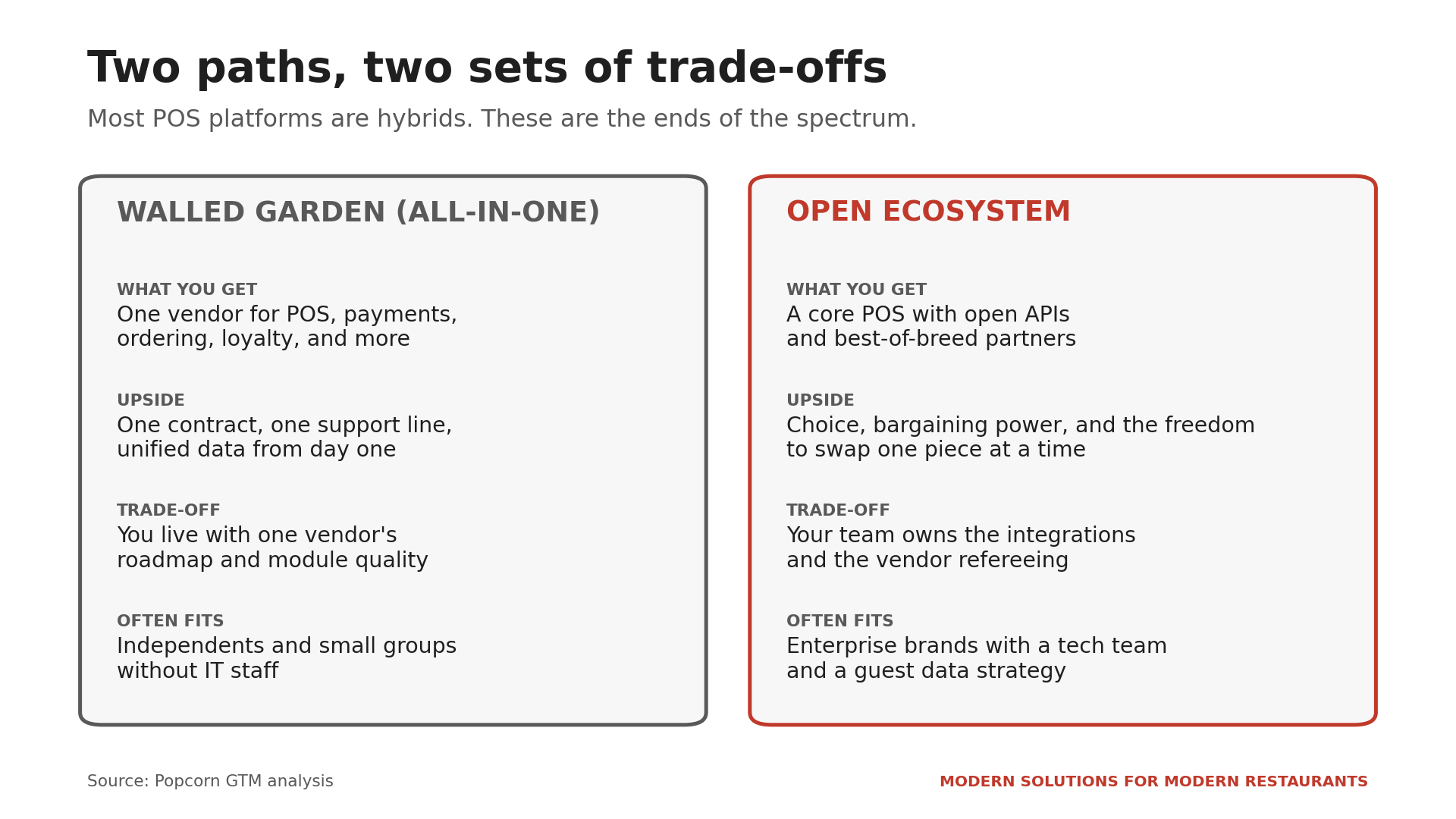
Most platforms sit somewhere between these two ends.
The line is blurrier than the slide
Start with the messenger. PAR sells the open model, so a PAR executive describing the market as open versus closed is offering analysis and positioning at the same time.
PAR also sells a suite. When it bought the loyalty platform Punchh for about $500 million in 2021, its CEO pitched the deal as a way for restaurants to stop juggling disjointed vendors and point-to-point integrations. In January 2026, Papa Johns chose PAR POS and PAR OPS for roughly 3,200 U.S. restaurants, and its tech chief framed the move around reducing complexity. That's the all-in-one argument, coming from the open camp.
It runs the other way too. Toast and Square both describe themselves as open, with partners admitted after a vetting process. Those same platforms keep building products that compete with what many of their partners sell.
So every serious POS is some kind of hybrid, and the open-versus-closed label won't tell you much on its own. These four questions will tell you more:
- Who owns the data, and can you export all of it in real time without paying a fee?
- What does an integration cost the partner, and what does it cost you?
- Does the POS compete with the partners listed in its marketplace?
- If you decide to leave, what does the exit look like?
Which path fits your brand
It depends on who you are.
Independents and small multi-unit groups without a dedicated IT team often do well with all-in-one. One system your GM already knows beats five specialized tools nobody has time to connect. The trade-off is that you're betting on one vendor's roadmap, and if its loyalty module is mediocre, you'll mostly live with it.
Enterprise brands with a technology team, a distinct operating model, and plans to own their guest data usually fit the open path better. They get choice and bargaining power in exchange for owning the integration work. When something breaks at 7 p.m. on a Friday, their team is the one refereeing between vendors.
Emerging brands sit in the middle. For them, the best fit is often a hybrid they can grow into, with a strong core suite, an open API, a working partner marketplace, and data they can export whenever they want.
Hotels offer a useful data point here. In a 2025 NYU study of hoteliers planning to change their tech stack, 30 percent of all-in-one users wanted to move to best-in-class systems, while 14 percent wanted to go the other way. Hotels aren't restaurants, so treat it as a signal. It does suggest the pull toward flexibility grows as operations get more complex.
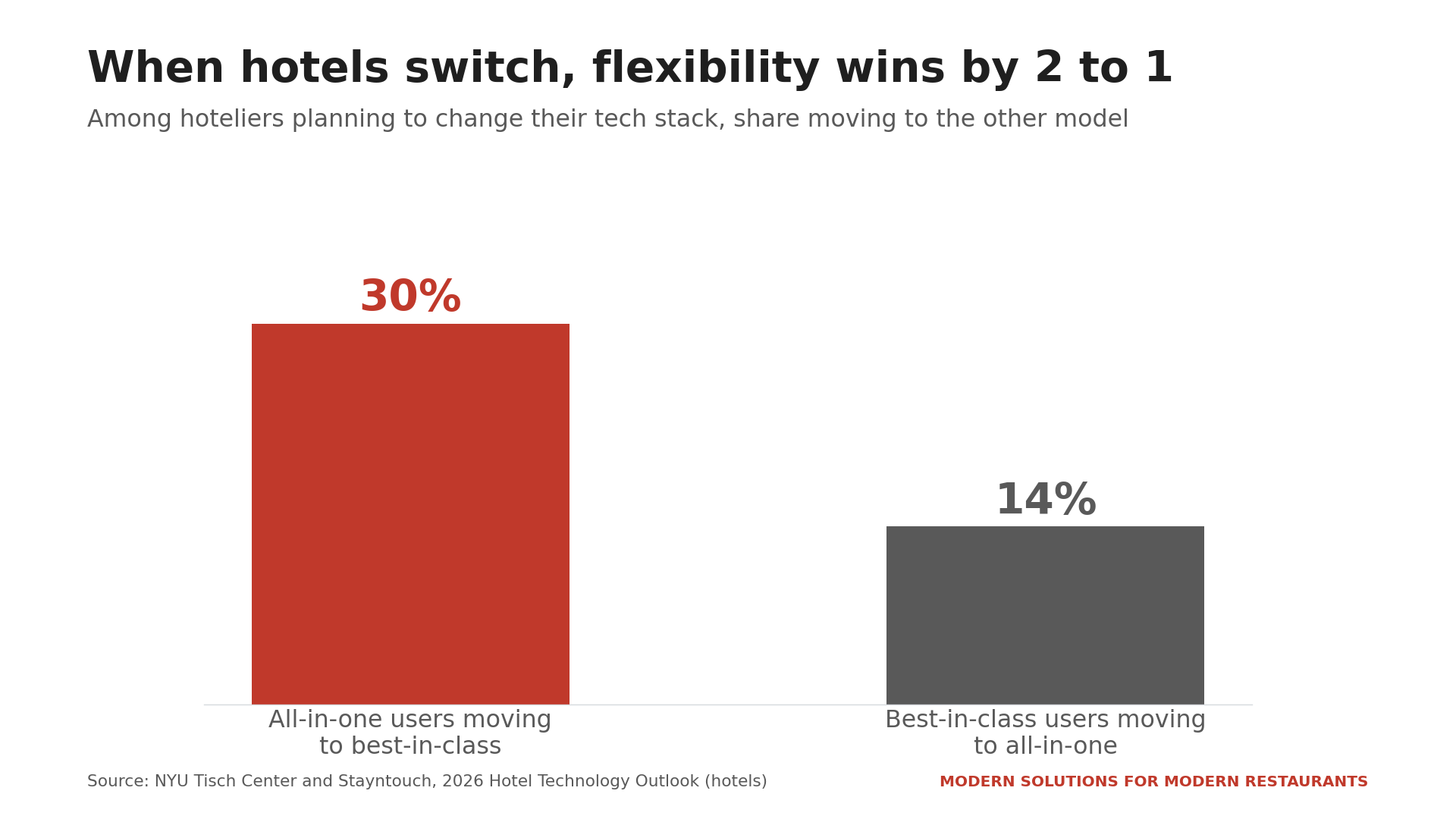
Source: NYU Tisch Center and Stayntouch, 2026 Hotel Technology Outlook. Hotel industry data.
Before you sit through a single demo, write down where your brand will be in five years. Include unit count, how much of your sales will be digital, and whether you plan to build your own guest data strategy or rent one. Choose the POS that fits that brand, even if it isn't the one that fits today.
What restaurant tech providers should do now
If 44 percent of operators are reconsidering their POS, a meaningful share of your customers could be on a different foundation soon. On an open platform, a solid integration keeps you in the account. In a garden where you aren't a partner, or where the POS offers a native version of your product, you can lose the account without doing anything wrong.
Start by mapping your customer base by POS so you know how exposed you are to each platform. Then give your integrations the same attention you give your product, with certification, documentation, and fast deployment, because the vendors that follow a customer through a POS switch are the ones that make the move easy.
The hardest question is whether your product could become a checkbox inside someone's POS. If it could, your differentiation needs to go deeper, whether that's better data, better outcomes, or a point of view on the category nobody else has. And read partner program terms closely. Fees, data access, and marketplace placement now shape your business model as much as your pricing page does.
Choose on purpose
Neither side of this fork is right for everyone. A walled garden is a good place to grow if you want someone else tending it, and the open road works well if you have a team to drive it. The mistake is choosing by default, whether that means sticking with what your last brand used or reacting to a slick demo and a big orange number on a slide.
Nearly half the industry is about to make this call. Ask the four questions, know who you are, and pick the foundation that fits the brand you're becoming.
For the full conversation, watch or listen to this week's episode of Modern Solutions for Modern Restaurants. If you're working through this decision, or trying to figure out where your company fits in it, find me on LinkedIn at linkedin.com/in/paulmolinari or at popcorngtm.com.
Keep building modern solutions for modern restaurants.
Sources:
Hospitality Technology 2026 POS study, as reported by Advantech-AURES: advantech-aures.com/us/expert-voice/tipping-point-for-hospitality/
PAR, Brink POS passes 200 integration partners (Business Wire, April 2021): businesswire.com/news/home/20210416005095/en/
PAR acquires Punchh for $500M (Nation's Restaurant News, April 2021): nrn.com/restaurant-technology/par-acquires-punchh-loyalty-platform-in-500m-deal
Papa Johns selects PAR POS and PAR OPS (Business Wire, January 2026): businesswire.com/news/home/20260112168759/en
Toast Q1 2025 results, Applebee's and ~140,000 locations (Business Wire, May 2025): businesswire.com/news/home/20250508282716/en/
Toast Q1 2026 results, Toast Drive-Thru (SEC 8-K exhibit): sec.gov/Archives/edgar/data/0001650164/000165016426000113/tost-20260331xexhibit991.htm
Toast and Square vetted partner platforms (Food On Demand): foodondemand.com/?p=13591
NYU Tisch Center and Stayntouch, 2026 Hotel Technology Outlook (November 2025): sps.nyu.edu