---
title: Web3 Didn't Die. It Went Undercover.
description: Explore how the initial hype around Web3 in the restaurant industry faded, yet innovative solutions like Blackbird emerged, reshaping loyalty and payment systems.
image: https://popcorngtm.com/hubfs/web3-nfts.jpg
---
[Skip to content](https://popcorngtm.com/blog/web3-didnt-die.-it-went-undercover#main-content)


[](https://popcorngtm.com)


- [About Us](https://popcorngtm.com/about-us)
- [Marketing & GTM](https://popcorngtm.com/restaurant-technology-marketing)
Show submenu for Marketing & GTM
- [Fractional CMO](https://popcorngtm.com/fractional-cmo)
- [Marketing Playbooks](https://popcorngtm.com/restaurant-technology-marketing)
- [HubSpot CRM & Websites](https://popcorngtm.com/websites)
- [Franchise Intelligence](https://popcorngtm.com/frandata)
- Media Resources
Show submenu for Media Resources
- [Modern Solutions for Modern Restaurants™ Podcast](https://popcorngtm.com/podcasts)
- [Hot Takes on a Fresh Blog](https://popcorngtm.com/blog)
- [Restauromics Financial News](https://popcorngtm.com/restauromics)
- [Brand Archetype Primer](https://popcorngtm.com/brand-archetype-primer)
- [Air Cover](https://popcorngtm.com/aircover)
- [About Us](https://popcorngtm.com/about-us)
- [Marketing & GTM](https://popcorngtm.com/restaurant-technology-marketing)
Show submenu for Marketing & GTM
- [Fractional CMO](https://popcorngtm.com/fractional-cmo)
- [Marketing Playbooks](https://popcorngtm.com/restaurant-technology-marketing)
- [HubSpot CRM & Websites](https://popcorngtm.com/websites)
- [Franchise Intelligence](https://popcorngtm.com/frandata)
- Media Resources
Show submenu for Media Resources
- [Modern Solutions for Modern Restaurants™ Podcast](https://popcorngtm.com/podcasts)
- [Hot Takes on a Fresh Blog](https://popcorngtm.com/blog)
- [Restauromics Financial News](https://popcorngtm.com/restauromics)
- [Brand Archetype Primer](https://popcorngtm.com/brand-archetype-primer)
- [Air Cover](https://popcorngtm.com/aircover)
[BOOK TIME](https://popcorngtm.com/contact)
[Web 3](https://popcorngtm.com/blog/tag/web-3), [Hot Takes](https://popcorngtm.com/blog/tag/hot-takes), [Podcast](https://popcorngtm.com/blog/tag/podcast)
# Web3 Didn't Die. It Went Undercover.
[By \- Paul Molinari,](https://popcorngtm.com/blog/author/paul-molinari) Aug 20, 2026
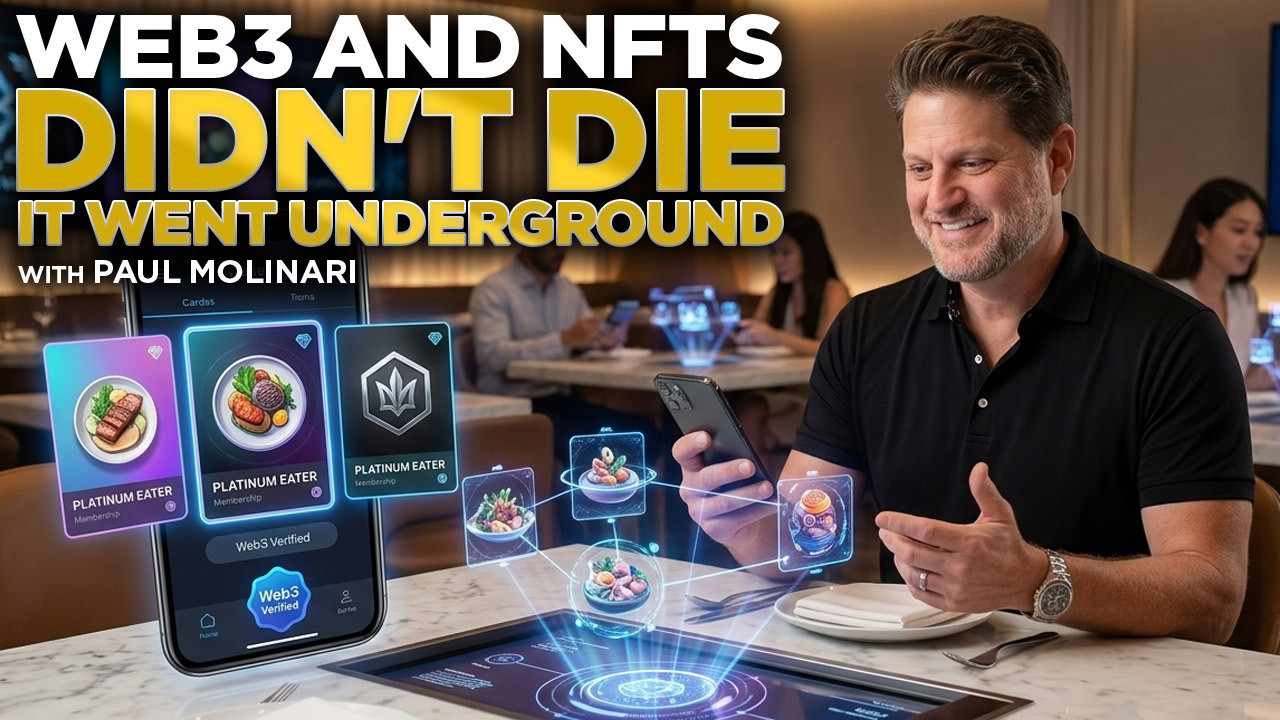
Whatever happened to blockchain in restaurants? The costume party ended, the bored apes came off the menu boards, and the one company still winning refuses to say the word.
In March 2021, Taco Bell sold five pieces of taco-themed digital art as NFTs, and they were gone in about half an hour. McDonald's minted a McRib NFT that November. Burger King hid digital collectibles in meal boxes, Applebee's launched an NFT collection, and Chipotle started taking crypto at checkout. A Long Beach burger joint called Bored & Hungry built its entire brand around a cartoon ape. Every conference keynote said the same thing: loyalty was moving to the blockchain, and your regulars would soon be token holders.
It's 2026. Time for the scoreboard.
## The NFT Graveyard
Bored & Hungry is worth a closer look before the bigger names, because it's the purest artifact of the era. The founder paid real money for the rights to brand a burger stand with Bored Ape imagery, put it on the cups, the trays, and the signage, and opened to lines around the block in April 2022. Within a few months the crypto payment option quietly disappeared, and the coverage shifted from novelty piece to cautionary tale. A burger concept lives or dies on the burger, and no amount of ape equity changes what's between the buns.
The program that counts is [Starbucks Odyssey](https://popcorngtm.com/blog/the-starbucks-odyssey-web3-loyalty-program-is-tapping-into-fundamental-human-behaviors-our-love-of-collecting), because it was a serious product from the company with arguably the best loyalty program on the planet. Members completed interactive journeys and earned collectible stamps recorded on the Polygon blockchain, some of which traded for four figures on a secondary marketplace. It launched in beta in December 2022 and shut down in March 2024, about fifteen months later. 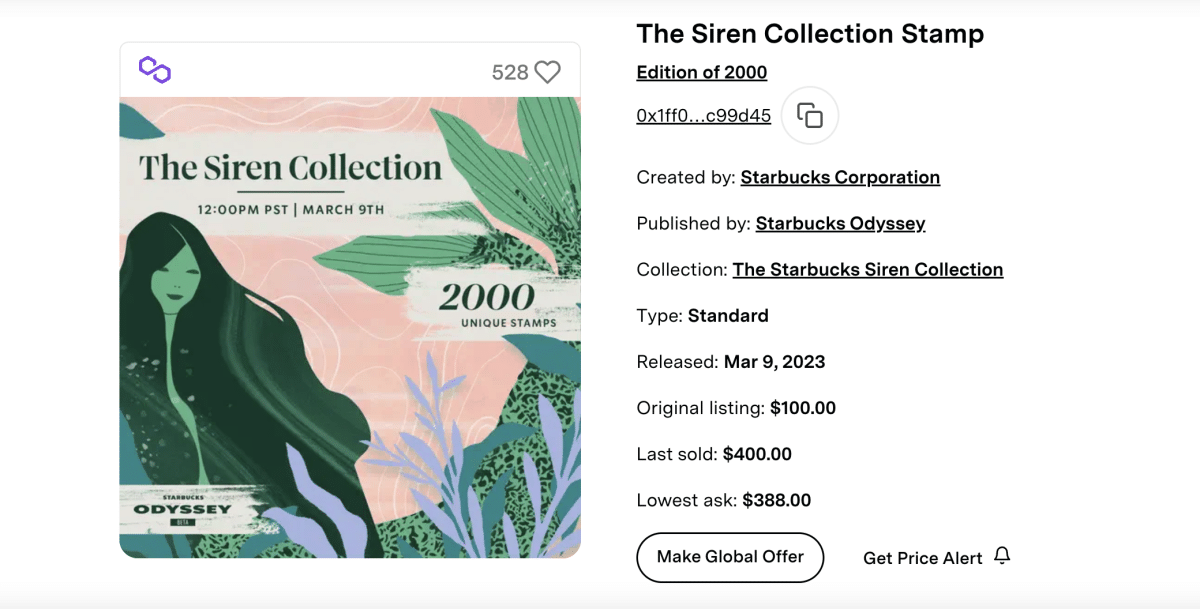Meta wound down its NFT features in under a year. Nike bought an NFT studio near the top of the market and later closed it down. When brands that sophisticated all reach the same conclusion inside two years, it stops being bad luck and starts being a verdict.
The autopsy is short. These were marketing campaigns wearing product costumes, and campaigns come with an end date baked in from day one. The rewards offered ownership without utility: a Starbucks regular wants her Gold status and her free refill, not a collectible she has to go explain to someone. A digital stamp asked guests to do homework, and the homework paid worse than the stars did. Resale markets attracted flippers instead of regulars, and the moment a reward has a price on a marketplace, you've invited a customer who has no relationship with your restaurant at all. On top of that, onboarding asked guests to set up a wallet, guard a seed phrase, and pay gas fees to claim what amounted to a coupon. Restaurant tech wins by removing steps. This added several and then charged for them.
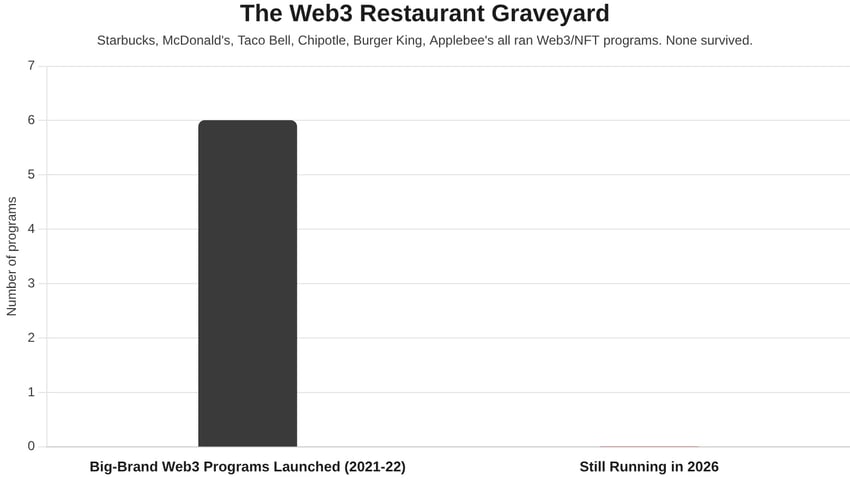
Strip it down to one sentence: nobody ever answered the guest's only real question, which is what do I get, and how fast? No table in America has ever told a server that dinner was great but asked whether the loyalty punch card was composable.
## The Survivor
Two ideas from that era refused to die anyway. Card processing takes 3 to 4 percent of every restaurant transaction in America, and new payment rails can undercut that. And an independent restaurant can never build a loyalty network alone, but a shared currency spent across many restaurants could get there. Blackbird, founded by Eater and Resy co-founder Ben Leventhal, built a company on both ideas and had the discipline never to lead with the technology underneath them.
From the guest's side, [Blackbird looks like any polished consumer app](https://www.blackbird.xyz/). Check in at a participating restaurant, earn a currency called $FLY, spend it on meals. No wallet ceremony, no gas fee popup, nothing that looks like crypto at all. Under the floorboards, $FLY is a token, memberships run on NFTs, and since early 2025 the whole system runs on Blackbird's own purpose-built network called Flynet. The 2021 class of Web3 restaurant programs would have led every press release with that paragraph. Blackbird buries it three menus deep, and the homepage sells dinner.
##### Payment Processing Fees: The Real Web3 Pitch
**Blackbird Pay charges restaurants a flat 2% per transaction, against the 3.5–4% typical of card providers.**
- Traditional cards (high end) 4.0%
- Traditional cards (low end) 3.5%
- Blackbird Pay 2.0%
For a restaurant doing $3 million a year in card volume, the gap between 4 percent and 2 percent works out to roughly sixty thousand dollars, close to a manager's salary recovered from the interchange machine. That's the least glamorous pitch in fintech and one of the most persuasive, because operators feel that line item on the statement every single month. It's the same math our [Restauromics financial briefing](https://popcorngtm.com/restauromics) keeps landing on: swipe fees are the line item regulators keep promising to fix and never quite do, which is exactly the gap Blackbird is pricing itself into.
The network is the more interesting strategic bet. Chains have loyalty programs because chains have scale; a single neighborhood restaurant can't fund a points system that moves the needle on its own. A shared currency across a thousand independents changes that math. Earn at the wine bar on Friday, spend it at the ramen shop on Tuesday, and every restaurant in the network gets a little stronger every time another one gets busy. That's a real answer to a coordination problem independents have never solved on their own, and it takes some kind of shared, portable ledger to make it work. Whether that ledger had to be a blockchain is a fair question, and one worth sitting with rather than answering too quickly.
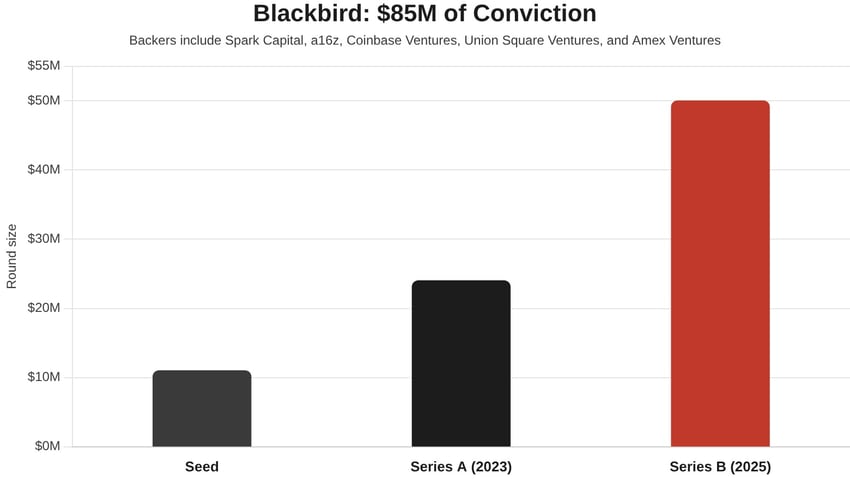
Investors have made their read clear. Blackbird has raised roughly $85 million across three rounds, including a $50 million Series B in 2025 led by Spark Capital, with Andreessen Horowitz, Coinbase Ventures, Union Square Ventures, and Amex Ventures all participating. Amex owns Resy, Leventhal's last company, so that last name on the cap table isn't a coincidence.
Blackbird: $85M of Conviction
The network now covers more than 1,000 restaurants across New York, San Francisco, Charleston, and, as of late 2025, Los Angeles, with a fifty-plus-restaurant beachhead across Santa Monica and Venice. The 2026 refresh of Blackbird Club raised the earn multipliers in every tier, including 10X on coffee. A company sweetening its rates across the board is a company playing offense, not one propping up a program on life support. Whether the model travels past coastal food cities is the open question worth watching; Charleston was the first real test outside New York and San Francisco, and it has to work in a market like Kansas City to become an industry story instead of a coastal one.
## The Lesson for Restaurant Tech Brands
A fair skeptic will point out, as TechCrunch did when the Series B news broke, that Punchh, Toast, and Lightspeed all run loyalty on conventional databases, and no guest anywhere is demanding on-chain verification of a free appetizer. It's possible Blackbird wins on network design and fee structure alone, and the blockchain is just how they chose to build the plumbing underneath it. From the operator's chair, that's the whole point: you shouldn't have to care either way.
The machinery of Web3 held up fine the entire time. What collapsed was the story wrapped around it, because that story led with the technology and asked the customer to care about it, and customers have never once cared about machinery. Blackbird's smartest move wasn't the token design or the custom network. It was narrative discipline: sell dinner, sell the fee savings, sell the busy Tuesday night, and let the chain stay a footnote in the terms of service. A homepage that leads with architecture is [marketing to its own engineers](https://popcorngtm.com/restaurant-technology-marketing), not to the guest deciding where to eat tonight.
Positioning, at its core, is deciding which of your true stories goes first. The technology that survives in this industry is the technology that stops introducing itself.
> *"What collapsed? The story wrapped around it. Because that story led with the technology and asked the customer to care about it, and customers have never once cared about machinery."*
### Is Your Story Leading with the Machinery?
Popcorn GTM helps restaurant technology brands figure out which story goes first, and how to tell it to operators, buyers, and partners.
[Talk to a Fractional CMO](https://popcorngtm.com/fractional-cmo)
Paul Molinari is Founder and Principal Consultant of Popcorn GTM, a fractional CMO and brand strategy consultancy for restaurant technology and hospitality. He hosts [Modern Solutions for Modern Restaurants on the Savor Network](https://popcorngtm.com/podcasts).
###### Category
- [Industry](https://popcorngtm.com/blog/tag/industry)
- [Marketing](https://popcorngtm.com/blog/tag/marketing)
- [Hot Takes](https://popcorngtm.com/blog/tag/hot-takes)
- [GTM](https://popcorngtm.com/blog/tag/gtm)
- [Artificial Intelligence](https://popcorngtm.com/blog/tag/artificial-intelligence)
- [Podcast](https://popcorngtm.com/blog/tag/podcast)
- [News](https://popcorngtm.com/blog/tag/news)
- [Systems](https://popcorngtm.com/blog/tag/systems)
- [Web 3](https://popcorngtm.com/blog/tag/web-3)
- [Online Ordering](https://popcorngtm.com/blog/tag/online-ordering)
- [Industry Economics](https://popcorngtm.com/blog/tag/industry-economics)
- [Search](https://popcorngtm.com/blog/tag/search)
### Similar Blogs
#### [Federated Savor FM Network Welcomes Their First Syndicated Partner: Modern Solutions for Modern Restaurants](https://popcorngtm.com/blog/modern-solutions-for-modern-restaurants-show-joins-the-popular-savor-fm-network-on-youtube)
By [Popcorn GTM News](https://popcorngtm.com/blog/author/popcorn-gtm-news) 11 March 2026
The restaurant industry has reached a turning point. As thin margins collide with rapid digital...
[READ MORE](https://popcorngtm.com/blog/modern-solutions-for-modern-restaurants-show-joins-the-popular-savor-fm-network-on-youtube)

#### [How Will Web3 Revolutionize the Restaurant Experience? Video Games](https://popcorngtm.com/blog/web3-will-revolutionize-the-restaurant-experience-video-games)
By [Paul Molinari](https://popcorngtm.com/blog/author/paul-molinari) 3 November 2023
### A New Spice in the Restaurant Biz
The restaurant industry has always been about innovation and web3...
[READ MORE](https://popcorngtm.com/blog/web3-will-revolutionize-the-restaurant-experience-video-games)

#### [Why Restaurant Tech Companies Keep Getting Marketing Wrong](https://popcorngtm.com/blog/why-restaurant-tech-companies-keep-getting-marketing-wrong)
By [Paul Molinari](https://popcorngtm.com/blog/author/paul-molinari) 30 March 2026
The Fractional CMO Advantage — Part 1 of 3
**You built something real.** The product works. Operators...
[READ MORE](https://popcorngtm.com/blog/why-restaurant-tech-companies-keep-getting-marketing-wrong)
[](https://popcorngtm.com)
Show Up. Every Week. Make it Pop.
---
- THE MENU
- [- Fractional CMO](https://popcorngtm.com/fractional-cmo)
- [- Marketing Playbooks](https://popcorngtm.com/restaurant-technology-marketing)
- [- Air Cover Content Marketing Engine](https://popcorngtm.com/aircover)
- [- Tech Enablement Services](https://popcorngtm.com/tech-enablement)
- [- Hot Takes, Fresh Blog](https://popcorngtm.com/blog)
- [- Restauromics Financial News](https://popcorngtm.com/restauromics)
- [- Book Time](https://popcorngtm.com/contact)
[](https://popcorngtm.com/podcasts)
COPYRIGHT © 2026 POPCORN MARKETING GROUP, LLC | POPCORN GTM IS A REGISTERED TRADEMARK, ALL RIGHTS RESERVED.
[DATA PRIVACY |](https://popcorngtm.com/privacy-policy) [TERMS & CONDITIONS](https://popcorngtm.com/privacy-policy)
```json
{
"@context" : "https://schema.org",
"@type" : "BlogPosting",
"author" : {
"@type" : "Person",
"name" : "Paul Molinari",
"url" : "https://popcorngtm.com/blog/author/paul-molinari"
},
"dateModified" : "2026-08-20T14:35:18.163Z",
"datePublished" : "2026-08-20T14:17:47.000Z",
"headline" : "Web3 Didn't Die. It Went Undercover.",
"image" : [ "https://popcorngtm.com/hubfs/web3-nfts.jpg" ],
"mainEntityOfPage" : {
"@id" : "https://popcorngtm.com/blog/web3-didnt-die.-it-went-undercover",
"@type" : "WebPage"
},
"publisher" : {
"@type" : "Organization",
"logo" : {
"@type" : "ImageObject",
"url" : "https://popcorngtm.com/hubfs/Popcorn%20GTM%20LOGO%202026.png"
},
"name" : "Popcorn GTM "
}
}
```