
Skip to content
Common Cents:

"The government just recounted restaurant sales and found the industry is $190 billion smaller than everyone thought, which makes it the first inventory count in history to come up short without anybody blaming the line cooks."

$190B

CUT FROM THE 2026 INDUSTRY SALES ESTIMATE

NRA's forecast fell from $1.55 trillion to $1.36 trillion after Census benchmarking.

30%

TOP MARKETPLACE COMMISSION PER ORDER

Versus a 5% consumer fee on Olo's new direct ordering app, per CEO Noah Glass.

+8.7%

USDA'S 2026 FORECAST FOR BEEF PRICES

Food away from home is up 3.5% over the past year. Released October 23.


The Industry Just Got $190 Billion SmallerNRA 2026 restaurant sales projection, before and after the Census revisionOld ForecastBefore benchmarking$1.55TNew ForecastAfter benchmarking$1.36T

On October 19 the National Restaurant Association rewrote its own math. The Census Bureau benchmarked its monthly restaurant sales survey to a new, more complete annual survey for the first time, and the numbers came down hard. The Association's 2026 sales projection dropped from $1.55 trillion to $1.36 trillion. That is roughly $190 billion, or about 12%, that never actually existed.

The revision reaches all the way back. Sales in 2021 were first reported at $1.06 trillion, a 24% jump over 2020. The revised number is $940 billion, an 11% gain. And the gap between the old and new figures widened every year after that. Translation: the post-pandemic recovery everyone celebrated was a lot slower than the headlines said.

The growth rate did not change. The Association still projects 4.3% nominal growth in 2026, which works out to just 0.8% once you take inflation out. Census also reported that eating and drinking place sales rose for an eighth straight month in September. So the industry is growing. It is just smaller, and growing slower, than the benchmarks you have been measuring yourself against.

What This Means For You:

If you have spent three years wondering why your numbers lag the industry headlines, part of the answer just arrived: the headlines were too high. Stop benchmarking against national sales growth and start benchmarking against yourself. Pull same-month sales for 2023, 2024, and 2025, adjust for your own price increases, and find your real traffic trend. Then build next year's budget on 1% real growth, not the rosy number your landlord or lender quotes back at you. Planning for a slow grind beats getting surprised by one.

Read the NRA revision analysis →


30% vs. 5%: The Fee GapTop marketplace commission vs. Olo's flat network fee, per orderMarketplaceCommission, restaurant paysUp to 30%Olo Direct AppNetwork fee, guest pays5%

Olo CEO Noah Glass is launching a consumer app for delivery and takeout, and he is aiming it straight at the marketplaces. His pitch: aggregator commissions can hit 30% per order, so restaurants mark up their marketplace menus, so guests pay 15% to 30% more than they would ordering direct. Olo's app charges the guest a flat 5% network fee instead, shown at the top of the menu and at checkout.

About 20,000 locations across 250 brands already use it, out of roughly 90,000 Olo locations total. Orders land at the restaurant as if they came through its own channel, so the operator keeps the customer data. Delivery still runs through drivers from DoorDash, Uber Eats, and others via white-label services that charge a set fee per trip instead of a commission.

Glass wants the app to hit one billion orders a year by around 2030. He also admitted it is unlikely to change industry economics right away. For now it serves Olo's existing customers, which skews toward chains, with plans to open it to the wider industry later. No timeline yet.

What This Means For You:

You do not need Olo to steal the playbook. The real story is that a major tech company is telling guests out loud that marketplace prices are inflated. Use that. Print it on your bag stuffers and your table tents: "Order direct and save." Price your direct online menu below your marketplace menu and say so. Then check what white-label delivery costs in your market. DoorDash Drive and Uber Direct charge a flat fee per trip, and on a $40 order a flat fee usually beats a 30% cut by a wide margin.

Read about Olo's delivery app →


A Third of Franchisees Skipped the DiscountMcDonald's franchisees and the national "$3 and Under" menuRan ItAs planned~67%Skipped ItAbout a third~33%

For two years the big burger chains tried to discount their way back to traffic. It did not work. "The deep value war is over, and all have lost," BTIG analyst Peter Saleh wrote this month. Chains got thinner margins and lower stock prices, not the crowds they paid for.

The retreat is everywhere. McDonald's pulled national advertising for its "$3 and Under" menu after about a third of franchisees did not run it as planned, and it spent its September investor day talking about food quality instead. Wendy's is backing away from Biggie Bags, which its own CEO called "value diluting." Domino's grew orders in Q3, but average tickets fell, and its CEO signaled fewer deals ahead.

Meanwhile, the chains that won did it with better food. Burger King posted record Q2 comps on the back of an improved Whopper, and Cava has priced below inflation since 2019 while its sales kept climbing. The new competitive weapon is quality, not coupons.

What This Means For You:

When the chains were giving away $5 meals, you could not win on price and you should not have tried. That pressure is easing. This is your window to stop apologizing for your prices and start explaining them. Put the quality story on the menu: where the beef comes from, what you make in-house, why the portion is what it is. If you have been running a discount you hate, test pulling it at one daypart for two weeks and watch the check average. Guests are being trained to care about what is on the plate again. That is your home turf.

Read the value war analysis →


Your Allergen Clock Is 6 to 12 MonthsSteritech's recommended window to get a disclosure program in placeStart HereEarly end of the window6 monthsBe Done ByLate end of the window12 months

California's SB 68 already requires chains with 20 or more U.S. locations to tell guests in writing which of the nine major allergens are in every menu item served in the state. It is the first law of its kind. If you run one or two locations, it sounds like somebody else's problem. It is not, for long.

The FDA Food Code also requires operators to notify guests in writing about major allergens in unpackaged food. The Food Code is not law on its own, but most states adopt it into their health regulations, and the FDA's guidance says that notice should name the allergens in each specific item. The new 2026 Food Code, released September 17, keeps those requirements. Some states already go further.

Steritech food safety VP Chris Boyles, writing in Restaurant Dive on October 23, warns that operators and health inspectors may read the Food Code language differently, and he recommends getting a program in place within six to 12 months. The hard part is not the menu printout. It is keeping it accurate every time a supplier swaps a product or a cook tweaks a recipe.

What This Means For You:

Start with your top 20 sellers. For each one, list every ingredient, check the spec sheet or label for the nine major allergens (milk, eggs, fish, shellfish, tree nuts, peanuts, wheat, soy, sesame), and build one simple matrix. Then make a rule: any substitution from your distributor triggers a re-check before it hits the line. Call your local health department and ask which Food Code version your state uses. A one-page allergen chart is cheap. A guest reaction, a lawsuit, or a failed inspection is not.

Read the allergen labeling analysis →

  • Beef is still climbing. Eggs are not. USDA's October 23 food price outlook forecasts beef and veal prices up 8.7% for 2026, while eggs are down 20.6% over the past year and on track for a 29.3% drop. Food at home is up just 1.8%, about half the 3.5% rise in food away from home. If beef is a margin killer on your menu, lean on egg-forward brunch and breakfast specials while that spread lasts. Read the USDA food price outlook →
  • A $500 counting mistake moves your food cost two-thirds of a point. Genius Food Purchasing founder Jim Lange broke down why small restaurants botch inventory counts in Restaurant Dive. His fixes are free: one counting unit per item printed on the sheet, count in the order things sit on the shelf, count at the same time every period, and count proteins weekly instead of monthly. Your food cost percentage is only as honest as your count. Read the inventory counting tips →
GEN Z HOUSE EDITORIAL

JasonJason Molinari
Research Analyst, Popcorn GTM
Economics and Business Studies Student at New York University
Connect on Linkedin
pumpkin-vs-latte

Skipping the Pumpkins, Keeping the Lattes

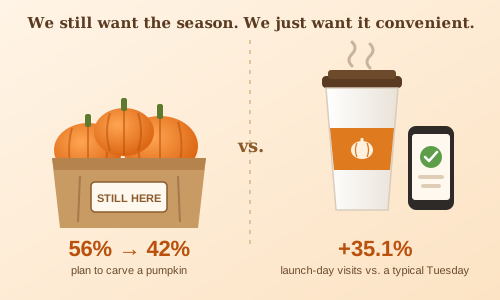
I wrote about the pumpkin spice tax, and Halloween week shows how far it goes. Walking through New York City over the past few weeks, I’ve seen more and more untouched pumpkins sitting in big cardboard displays with nobody buying them. At first I figured stores were just restocking fast, but the numbers say I’m not imagining it. Finder’s analysis of National Retail Federation figures says only about 42% of Americans plan to buy a pumpkin to carve this year, down from 56% in 2025. That’s a 14-point drop, and you can see it on the sidewalk. Total pumpkin spending is projected to fall about 7%, to around $771 million. Who would have guessed the real thing would get overshadowed by a latte?

Not surprisingly, the lattes are doing just fine. Starbucks said its fall launch on Tuesday, August 25, was its biggest ever in the U.S. and Canada, and foot traffic data showed visits that day were up 35.1% over a typical Tuesday. Starbucks isn’t helping the real pumpkin’s case, either. It expanded the fall lineup this year with three new pumpkin drinks. A real pumpkin takes a trip to the store, a carving knife, a messy kitchen, and most importantly, time. The latte takes a few minutes and a mobile order, and it works whether or not it feels like fall yet. To me, this is an unfortunate trend: we still want the season, but we want it convenient.

The takeaway is that people keep choosing ease and skipping the time and effort this season used to ask for. A seasonal item that sells the feeling instead of the physical ingredient has a big advantage right now, especially when that ingredient has to be carved, cleaned up, and thrown out. For restaurants, that means a hyped limited-time menu doesn’t need a rare product, just something that lets a guest feel the moment without the work. Starbucks hasn’t released its fiscal fourth-quarter results yet, but I’m curious to see them, and I’d bet the full-year numbers come in at an all-time high.

- Jason

+ + +

Restauromics LOGO final
  • October 19, 2026: Gasoline is up 34% while restaurant card spending went flat, record diesel is landing on distributor invoices as fuel surcharges, the Sysco and Restaurant Depot deal is still under FTC review, and a $201 million fund wants profitable founder-led concepts.
  • October 12, 2026: Starbucks reportedly explored buying Chipotle, Uber Eats agreed to buy ezCater for $2.3 billion, McDonald's franchisees balked at an $800,000 remodel bill while its pricing AI drew fire, and True Food Kitchen filed for Chapter 11.
  • October 5, 2026: New SBA rules made restaurant buyouts harder to finance, diners are spending $100 a week and asking ChatGPT where to eat, September restaurant hiring cooled to just 10,800 jobs, and small-business health premiums are up 31% since 2022.
  • September 28, 2026: One in three operators ran at a loss in the first half of 2026 as guests split into big spenders and deal hunters, USDA forecast restaurant prices outrunning groceries 3.5% to 2.4%, independents made up 68% of all summer openings, and fewer operators plan to raise menu prices while more tighten up the walk-in instead.
  • September 21, 2026: The Fed raised rates for the first time since 2023, 380 independents told James Beard that wage growth slowed while AI interest climbed, USDA forecast egg prices to fall 30.7% in 2026, and OpenTable data showed diners chasing happy hour deals and last-minute tables.
  • September 14, 2026: A merchant cash advance's effective annual rate can hit 100%, ground beef hit $6.89 a pound with more increases forecast, operators are holding headcount steady instead of hiring or cutting, and New York eliminated its seasonal outdoor dining teardown rule for good.
  • September 7, 2026: Independent restaurants and bars outgrew chains on summer sales growth, casual dining reclaimed value from fast casual as QSR prices caught up, Canada's retaliatory tariffs hit coffee, cocoa, and seafood imports, and most operators believe AI gives them an edge but few can prove it improved profit.
  • August 31, 2026: Florida's minimum wage hit its final scheduled step toward $15, a bipartisan swipe fee bill picked up an unlikely presidential endorsement, 2026 data put real numbers behind restaurant insurance costs, and delivery apps' advertised commission rates turned out to understate the real number by 10 to 15 points.
  • August 24, 2026: Whataburger's $4 value menu escalated the QSR price war, a 38-store Moe's franchisee filed Chapter 11 on five-year-old COVID debt, Grubhub's FTC settlement is paying out $23.8 million to 640,038 drivers and diners, and tightening SBA lending met compressing franchise valuations in a new 1H26 report.
  • August 17, 2026: A cyclospora outbreak crashed lettuce prices 16.4% in a month, the average restaurant is now short five workers, Cava grew same-store sales 9.7% by underpricing inflation on purpose, and a wave of immigration legislation is reshaping the labor pool in real time.
  • August 10, 2026: A Salmonella outbreak tied to one jalapeño grower hit Chipotle, Qdoba, and Sweetgreen, Salad and Go closed all 70 stores overnight under bankruptcy, 71% of operators are raising prices even as low-income households absorb the most pressure, and diners are showing up for happy hour and spontaneity again.
  • August 3, 2026: A 13-week cash flow forecast beats a monthly close, a major food traceability deadline moved to 2028 but the underlying risk did not, 4 in 10 guests say they are dining out less while fast casual keeps winning traffic, and Taco Bell's loyalty playbook outran a lettuce recall.
  • July 27, 2026: A $38 billion swipe fee settlement barely moves the needle, avocado prices jumped 89%, a lettuce recall triggered nationwide lawsuits, and No Tax on Tips is finally final.
  • July 20, 2026: Beef prices hit a record high as screwworm shut down Texas ports, independents need 29% more sales than 2019 just to break even, GLP-1 users are ordering smaller and spending less, and third-party delivery's true cost runs 30 to 40% of order revenue.
  • July 13, 2026: Ground beef hit a record $6.90/lb, delivery apps' true cost is closer to 40%, a second Hardee's franchisee filed bankruptcy, and 256 independents split $1.28M in grants.
  • July 8, 2026: 42% of operators not profitable, Jersey Mike's IPO economics, drive-thru AI, and 40 independent restaurants win $25K grants.