
Restauromics Weekly Update
A Weekly Economics & Finance Briefing for Restaurant People. Issue: Monday, November 16, 2026
"The government can't tell you how much menu prices rose this year, half the people who buy restaurants have left the room, and operators are still sizing up the robots, so this is a great week to know your own numbers."
Prime Numbers
Financial trends that caught our attention:
-21%
INDUSTRY TRAFFIC SINCE 2018, PER BLACK BOX
Same-store sales are tracking up 1.7% this year, with average check doing the work.
+0.5%
MENU PRICES IN OCTOBER ALONE
Food away from home, per BLS. The 12-month number was not published.
-7,200
RESTAURANT JOBS LOST IN OCTOBER
The economy added 165,000. Preliminary and subject to revision.
Half the Buyers Left the Restaurant Deal Room. Traffic Is Down 21% Since 2018.
Story 01 · NRN / Restaurant Business
At the Restaurant Finance & Development Conference in Las Vegas, the mood on deals was grim. Bank of America's restaurant chief, Cristin O'Hara, said fewer private-equity firms want restaurants because they can earn "outsized gains in other areas." Ashish Seth of Harrington Park Advisors put numbers on it: "50%, 60% of the buyer base has just evaporated." He named Savory Fund and Garnett Station Partners among the buyers still active.
The sales picture explains the caution. Black Box Intelligence's Victor Fernandez said industry same-store sales are tracking up 1.7% this year, but traffic is down 21% since 2018. Average check is doing the work. Baird analyst Chris O'Cull studied 335 million visits across 1,260 restaurants and eight chains and found that visit frequency barely varies by concept, so traffic mostly follows the size of your customer base. Chili's grew its customer count about 17% since 2017, and its visits grew by the same amount.
There was good news for independents. Placer.ai's R.J. Hottovy said independent restaurant sales are up, thanks to better value and perceived quality. Revenue Management Solutions' Jana Zschieschang said beverages and snacks are the biggest traffic drivers, and that pricing by market or even by location protects margins. The article describes a restricted credit environment and rising bankruptcies, and says sellers have to be realistic about valuations.
What This Means For You:
Count customers, not just sales. Pull your unique guests or loyalty members from the last 12 months and compare them with the year before. That is the number that predicts traffic. Then add something that brings people in at a lower price point: a drink, a snack, a small plate. If you ever plan to sell, borrow, or bring in a partner, assume the room is tougher than it was two years ago. Get three years of clean monthly financials and a realistic view of what your restaurant is worth before you need either. And check your prices by daypart or location instead of applying one increase to everything.
Menu Prices Jumped 0.5% in October. The Government Cannot Give You the Yearly Number.
Story 02 · Bureau of Labor Statistics
The October Consumer Price Index, released November 10, shows food away from home rose 0.5% for the month. Full-service meals rose 0.7% and limited-service meals rose 0.4%. Food at home rose 0.4%, and overall prices rose 0.4%. BLS notes that the food away from home figure is not seasonally adjusted.
Here is the catch. BLS says it cannot publish 12-month changes for October 2026 for many indexes, because October 2025 data were never collected during a lapse in appropriations. So the usual headline, how much menu prices are up over the past year, is missing this month. The last number we have is September, when NRN reported food away from home was up 3.5% over the past year, faster than wages, which were up 3%.
The next CPI report, with November data, is scheduled for December 10. Until then, the national yearly number for your menu does not exist, and anyone quoting you one for October is estimating.
What This Means For You:
Do not wait for the government to tell you how you did. Pull your menu from this time last year and your current menu, and calculate your own average price change for your top 20 items. Compare it with how much your food and labor costs changed over the same year. Full-service menu prices rose faster than limited-service in October, so if you run a sit-down place, check that you are not falling behind your peers. Remember that one month is one month, and the headline number is unadjusted. Raise where guests will not notice, and protect your entry-level items.
Restaurants Lost 7,200 Jobs in October While the Economy Added 165,000.
Story 03 · NRN / National Restaurant Association
Eating and drinking places lost a net 7,200 jobs in October, after adding 11,000 in September, according to preliminary BLS data. Total foodservice and drinking place employment stands at 12,383,700. Over the same month, total nonfarm payrolls rose 165,000 and the national unemployment rate dipped from 4.2% to 4.1%.
Zoom out and the picture is steadier. Restaurant employment is up about 57,000 from a year ago, just under 0.5%, and the first ten months of 2026 added roughly 40,000 jobs. Employment is 98,700, or 0.8%, above February 2020. The National Restaurant Association's read: "Restaurant employment held relatively steady in recent months, despite a downtick in October." The monthly numbers are preliminary and subject to sizable revisions.
The gap is in full service. Quick-service and fast-casual employment is 2% above pre-pandemic levels, but full-service employment was 165,000, or 3%, below it as of September. Sit-down restaurants, where many independents compete, have the most ground to make up.
What This Means For You:
One soft month is not a labor surplus. Keep the people you have. Talk to your best servers and line cooks before the holidays: a schedule they can plan around and a clear shot at the best sections will do more than a hiring ad. If you are adding holiday staff, hire now and train early so they are useful by Thanksgiving week. Track your own turnover every month instead of the national headline, and cross-train two people on every key station so one resignation does not slow down your Friday night.
Four in 10 Operators Are "Cautious" About AI. The Ones Using It Start With Marketing.
Story 04 · NRN / National Restaurant Association
A National Restaurant Association survey of 212 operators finds most are still sizing up AI. About 42% describe their approach as cautious, 26% say they are excited, 18% are skeptical, 7% are not interested, and 4% are not sure. Nearly a third, 31%, have no plans yet. Another 20% are running small pilots, and just 3% are implementing it company-wide.
About 39% already use AI in some form, and what they use it for is practical. Among those users, 58% use it for personalized marketing and outreach, 48% for analyzing customer feedback, 37% for recruiting, scheduling, or labor management, and 34% for demand forecasting. Only about 2 in 10 use it for order-taking and payments, the area where McDonald's is pushing hardest.
The barriers are the ones you would expect: complexity (46%), cost (43%), customer acceptance (42%), and data security and privacy (35%). Operators said what would help most is more training (56.5%), followed by financial assistance or incentives (45%) and case studies (42%). The sample is small and self-reported, and the article does not split independents from chains.
What This Means For You:
Start where the early adopters start: marketing and the back office, not the guest-facing front of house. Pick one job, such as summarizing your Google and Yelp reviews every week or drafting your email and social posts, and give it a trial month with a simple goal like saving two hours a week. Never feed it guest data you would not put in an email to a stranger, and keep a human checking anything a guest will see. If it does not save time or money in 30 days, drop it. Cautious is a fine strategy as long as you keep learning.
Quick Hits
Also Worth Watching:
- Claim your restaurant on ChatGPT. OpenAI launched Businesses in ChatGPT, a beta storefront listing similar to a Google Business Profile. To claim one, sign in to ChatGPT, open Business Hub, and search for your restaurant, then check your website, hours, location, and description. OpenAI says a profile does not guarantee better ranking, and it was unclear whether menus can be listed. It is a short job, and it gets the basics right for when someone asks ChatGPT where to eat. Read about ChatGPT business profiles →
- Portillo's growth is coming from price, not people. Third-quarter comps were up 1.4%, but traffic fell 0.7%. The chain is closing a mid-to-high single-digit number of underperforming restaurants outside Chicagoland, and says rapid infill in new markets, especially Texas, split sales across units. If you are eyeing a second location near your first, underwrite it on net new guests, not on what the first one does today. Read about the Portillo's closures →
- Topgolf asked guests why they do not visit more, and the answer was cost. After six months of surveys, it cut gameplay prices by an average of 20% across its 100-plus U.S. venues. CEO David McKillips said "Our guests told us our prices were too high." No traffic results yet, and prices vary by market. Ask your regulars the same question this month, with a QR code and three questions, before you guess. Read about the Topgolf price cut →
GEN Z HOUSE EDITORIAL
 Jason Molinari
Research Analyst, Popcorn GTM
Economics and Business Studies Student at New York University
Connect on Linkedin
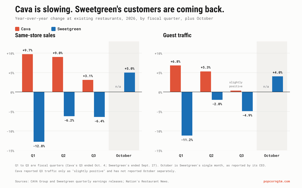
Cava vs. Sweetgreen - What's the difference?
Last week I was walking down University Place at lunch, deciding where to eat, as a typical NYU student does. Sweetgreen and Cava sit a short walk apart on the same street, practically facing each other. I picked Cava, mostly out of habit, but while I waited for my bowl I started to wonder how either of them stays in business. They sell nearly the same thing to nearly the same people: a fresh, build-your-own bowl for a quick lunch, at about the same price, from a few doors apart. One of them had to be losing that fight, I thought, so I decided to investigate.
- Jason
+ + +

Restaurant Economics & Financial News Stories Delivered Weekly
The weekly economics briefing for independent restaurant operators, straight to your inbox. Free.
Previous Issues
Every week, archived.
- November 9, 2026: One fake Facebook post took Texas Roadhouse from 6.8% growth to 1%, two franchisees filed for bankruptcy with one carrying $320 million of secured debt, Outback stopped raising prices as guests under $75,000 pulled back, and McDonald's pushed AI drive-thru ordering over franchisee fee concerns.
- November 2, 2026: The FTC and eight states sued Toast over fees, DoorDash agreed to buy Instacart for $17 billion, the midterms put wages, tariffs and tip credits on the ballot, and Chili's grew traffic 28% by spending more on labor.
- October 26, 2026: Census benchmarking cut $190 billion from the NRA's 2026 sales estimate, Olo launched a direct ordering app with a 5% fee to take on 30% marketplace commissions, BTIG declared the fast food value war over with no winners, and allergen disclosure rules are spreading from the chains to everyone.
- October 19, 2026: Gasoline is up 34% while restaurant card spending went flat, record diesel is landing on distributor invoices as fuel surcharges, the Sysco and Restaurant Depot deal is still under FTC review, and a $201 million fund wants profitable founder-led concepts.
- October 12, 2026: Starbucks reportedly explored buying Chipotle, Uber Eats agreed to buy ezCater for $2.3 billion, McDonald's franchisees balked at an $800,000 remodel bill while its pricing AI drew fire, and True Food Kitchen filed for Chapter 11.
- October 5, 2026: New SBA rules made restaurant buyouts harder to finance, diners are spending $100 a week and asking ChatGPT where to eat, September restaurant hiring cooled to just 10,800 jobs, and small-business health premiums are up 31% since 2022.
- September 28, 2026: One in three operators ran at a loss in the first half of 2026 as guests split into big spenders and deal hunters, USDA forecast restaurant prices outrunning groceries 3.5% to 2.4%, independents made up 68% of all summer openings, and fewer operators plan to raise menu prices while more tighten up the walk-in instead.
- September 21, 2026: The Fed raised rates for the first time since 2023, 380 independents told James Beard that wage growth slowed while AI interest climbed, USDA forecast egg prices to fall 30.7% in 2026, and OpenTable data showed diners chasing happy hour deals and last-minute tables.
- September 14, 2026: A merchant cash advance's effective annual rate can hit 100%, ground beef hit $6.89 a pound with more increases forecast, operators are holding headcount steady instead of hiring or cutting, and New York eliminated its seasonal outdoor dining teardown rule for good.
- September 7, 2026: Independent restaurants and bars outgrew chains on summer sales growth, casual dining reclaimed value from fast casual as QSR prices caught up, Canada's retaliatory tariffs hit coffee, cocoa, and seafood imports, and most operators believe AI gives them an edge but few can prove it improved profit.
- August 31, 2026: Florida's minimum wage hit its final scheduled step toward $15, a bipartisan swipe fee bill picked up an unlikely presidential endorsement, 2026 data put real numbers behind restaurant insurance costs, and delivery apps' advertised commission rates turned out to understate the real number by 10 to 15 points.
- August 24, 2026: Whataburger's $4 value menu escalated the QSR price war, a 38-store Moe's franchisee filed Chapter 11 on five-year-old COVID debt, Grubhub's FTC settlement is paying out $23.8 million to 640,038 drivers and diners, and tightening SBA lending met compressing franchise valuations in a new 1H26 report.
- August 17, 2026: A cyclospora outbreak crashed lettuce prices 16.4% in a month, the average restaurant is now short five workers, Cava grew same-store sales 9.7% by underpricing inflation on purpose, and a wave of immigration legislation is reshaping the labor pool in real time.
- August 10, 2026: A Salmonella outbreak tied to one jalapeño grower hit Chipotle, Qdoba, and Sweetgreen, Salad and Go closed all 70 stores overnight under bankruptcy, 71% of operators are raising prices even as low-income households absorb the most pressure, and diners are showing up for happy hour and spontaneity again.
- August 3, 2026: A 13-week cash flow forecast beats a monthly close, a major food traceability deadline moved to 2028 but the underlying risk did not, 4 in 10 guests say they are dining out less while fast casual keeps winning traffic, and Taco Bell's loyalty playbook outran a lettuce recall.
- July 27, 2026: A $38 billion swipe fee settlement barely moves the needle, avocado prices jumped 89%, a lettuce recall triggered nationwide lawsuits, and No Tax on Tips is finally final.
- July 20, 2026: Beef prices hit a record high as screwworm shut down Texas ports, independents need 29% more sales than 2019 just to break even, GLP-1 users are ordering smaller and spending less, and third-party delivery's true cost runs 30 to 40% of order revenue.
- July 13, 2026: Ground beef hit a record $6.90/lb, delivery apps' true cost is closer to 40%, a second Hardee's franchisee filed bankruptcy, and 256 independents split $1.28M in grants.
- July 8, 2026: 42% of operators not profitable, Jersey Mike's IPO economics, drive-thru AI, and 40 independent restaurants win $25K grants.