

Restaurant operators have more data than at any point in the history of the industry. They also have less clarity about what to do with it than ever before. That gap is at the heart of a category that has been quietly taking shape over the past few years, and one that is about to become a standard line item in every serious multi-unit operator’s technology budget.
AI data intelligence platforms for restaurants are purpose-built systems that do something general-purpose AI tools fundamentally cannot: they connect every operational system a restaurant runs, clean and unify the data, apply restaurant-specific intelligence on top of it, and deliver actionable answers to the people who need them. Not dashboards. Not exports. Not another BI tool to learn. Answers.
In this episode of Modern Solutions for Modern Restaurants, I sat down with Eric Lehto, CEO of OpSage by CONVX, to unpack why this category exists, what makes it different from everything operators have tried before, and what it actually looks like when it is working. Here is what I took away from the conversation, and what I think every operator considering AI right now needs to understand.
The Data Problem Is Bigger Than Anyone Talks About Publicly
Eric opened with something that landed for me: most operators already know they have a data problem. What they do not fully grasp is the scale of it. He described a strategy workshop with a restaurant customer that had two POS systems mid-migration, soft drink flavors that only existed in inventory data, monthly franchisee P&Ls arriving as manual spreadsheets, and multiple disconnected customer experience systems. By the time the session was over, they had counted more than ten systems that needed to talk to each other.
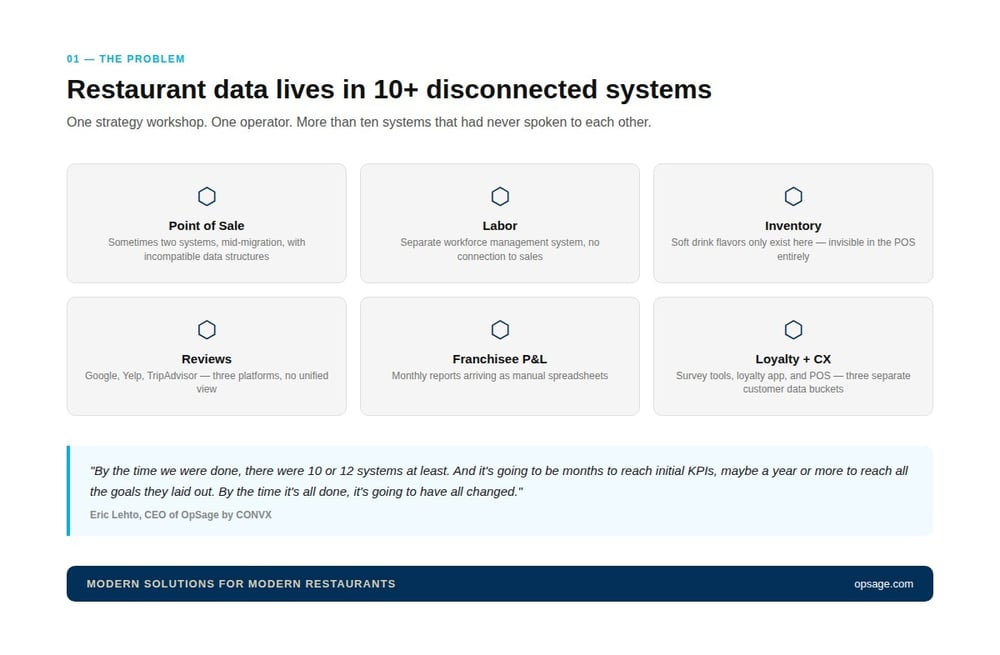
Building a custom data platform to connect all of that? Eric’s estimate: months to get to initial KPIs, a year or more to reach the original goals, and by that point the business had changed and the requirements had shifted. “It’s unattainable for most restaurants because of the cost and the time,” he said. “Unless you’re one of the largest chains, how can you possibly afford it on a restaurant budget?”
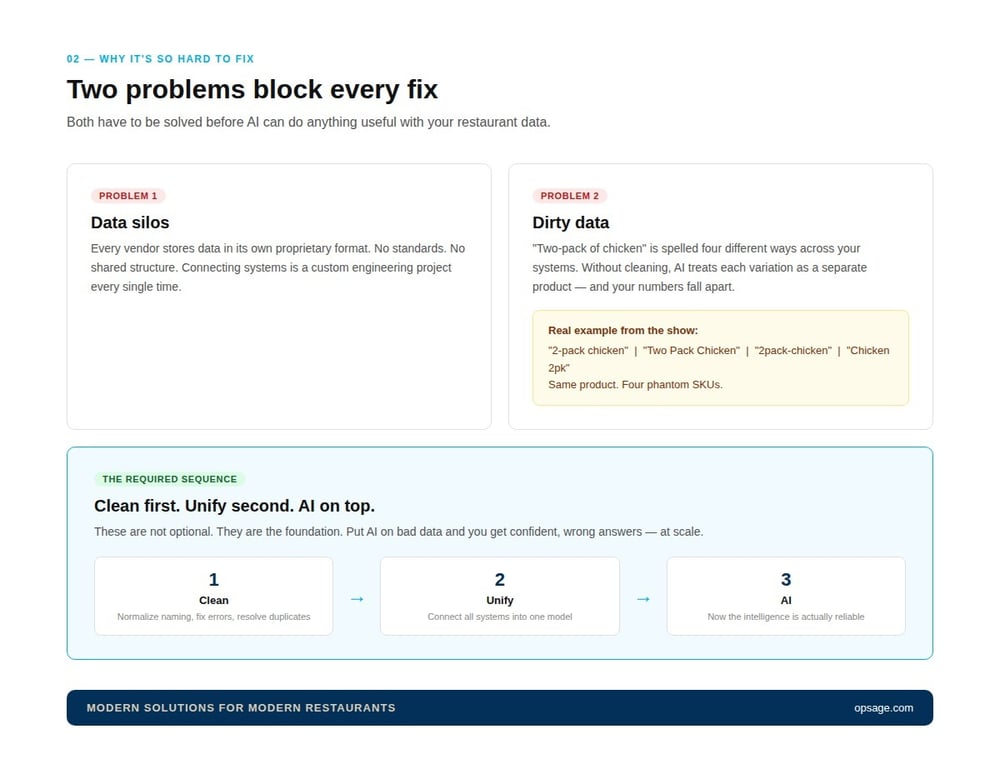
This is the founding problem the AI data intelligence category is built to solve. Not analytics for analytics’ sake. The infrastructure cost and the silo problem, addressed together in a single managed platform.
Why “Just Use ChatGPT” Is Not the Answer
One of the most useful moments in the conversation came when Eric addressed something I hear from operators constantly: “We’re already using ChatGPT or Claude for some of this stuff. Why do I need anything else?”
His answer was direct. General-purpose AI is brilliant but blind. Ask it which of your stores is underperforming on labor and it might reference Walmart. It does not know you are a fast casual concept. It does not know your day parts, your menu, your regional benchmarks, or the fact that your Omaha locations run a structurally different labor model than your Chicago stores. Eric put it plainly: “It’s like a drunken genius. Really smart, but they just don’t know your restaurant.”
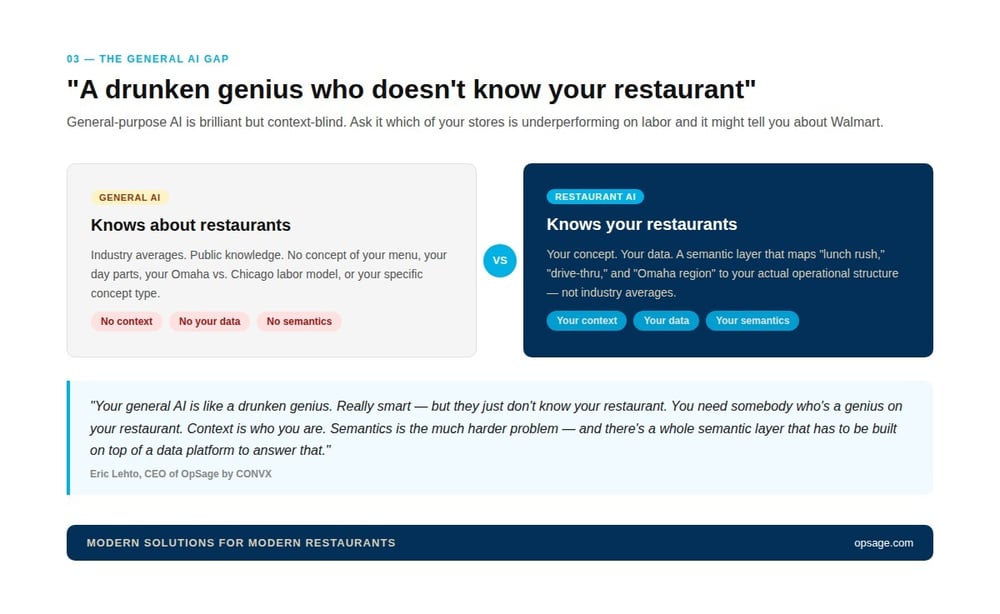
What closes that gap is two things: context (who you are as a restaurant concept) and semantics (what your questions actually mean translated into the structure of your own data). Building that layer on top of a unified, cleaned data foundation is what separates AI that knows your restaurants from AI that knows about restaurants in general.
This distinction is what defines the category. AI data intelligence platforms for restaurants are not wrappers around a large language model. They are the substrate: the connected data, the restaurant-specific context, the permissions model, and the semantic layer that makes the AI’s answers actually relevant to your operation. The OpSage AI Assistant is built on exactly that kind of foundation.
Security Is Not a Feature. It Is an Architecture Decision.
We spent a meaningful chunk of the conversation on security, and I am glad we did, because this is where I see the most confusion in the market right now.
The concern operators voice is understandable: sales data, labor costs, and margins flowing through an AI platform feels risky. But Eric reframed the question in a way that every operator should internalize. The risk is not whether your data flows through AI. The risk is whether the security model was built for AI, or whether it is a legacy application architecture that AI has quietly broken.
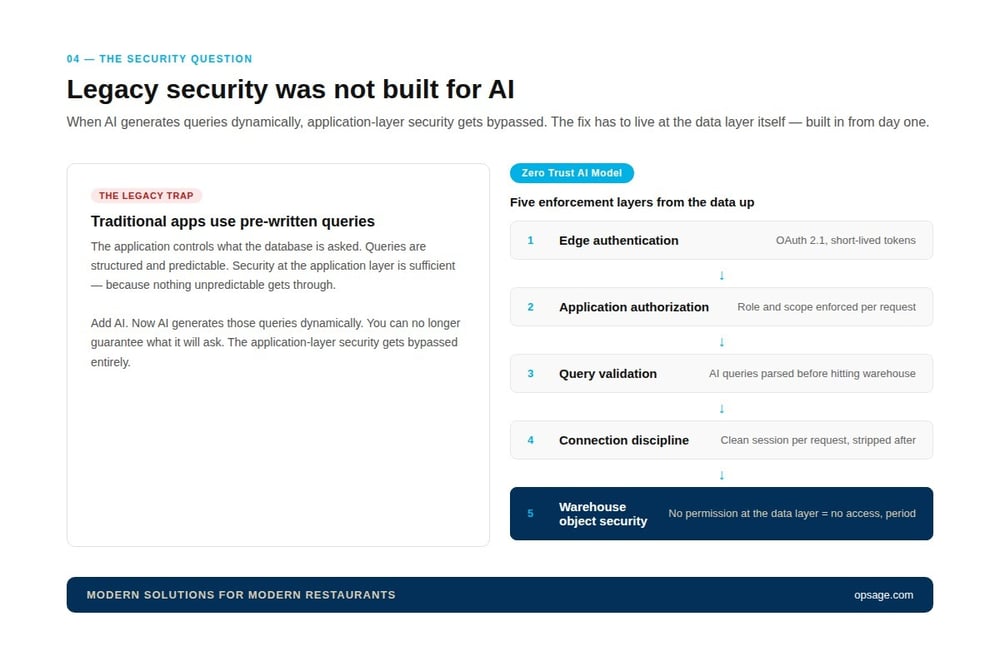
Traditional SaaS applications control data access through structured, predetermined queries. The application asks for exactly what it is designed to ask for. When you layer AI on top of that architecture, AI starts generating those queries dynamically, and suddenly no one can guarantee what it is going to request. The application-level security layer gets bypassed.
The right answer, Eric explained, is a zero trust AI model: security enforced at the data layer itself, not just the application layer. No matter what AI asks, if it does not have permission at the database object level, it cannot access the data. That architecture has to be built in from day one. It cannot be retrofitted onto a legacy system.
When evaluating any AI data platform, operators should ask specifically: where does your security model live? Application layer or data layer? The answer tells you a great deal about how seriously the vendor thought about AI when they built the product. The OpSage platform architecture enforces security at all five layers, from edge authentication down to the warehouse itself.
What Monday Morning Actually Looks Like
I asked Eric to paint a picture of the day-to-day experience for a VP of Operations once the data foundation is right and the AI is actually working. His answer was the clearest articulation of the category’s value proposition I have heard.
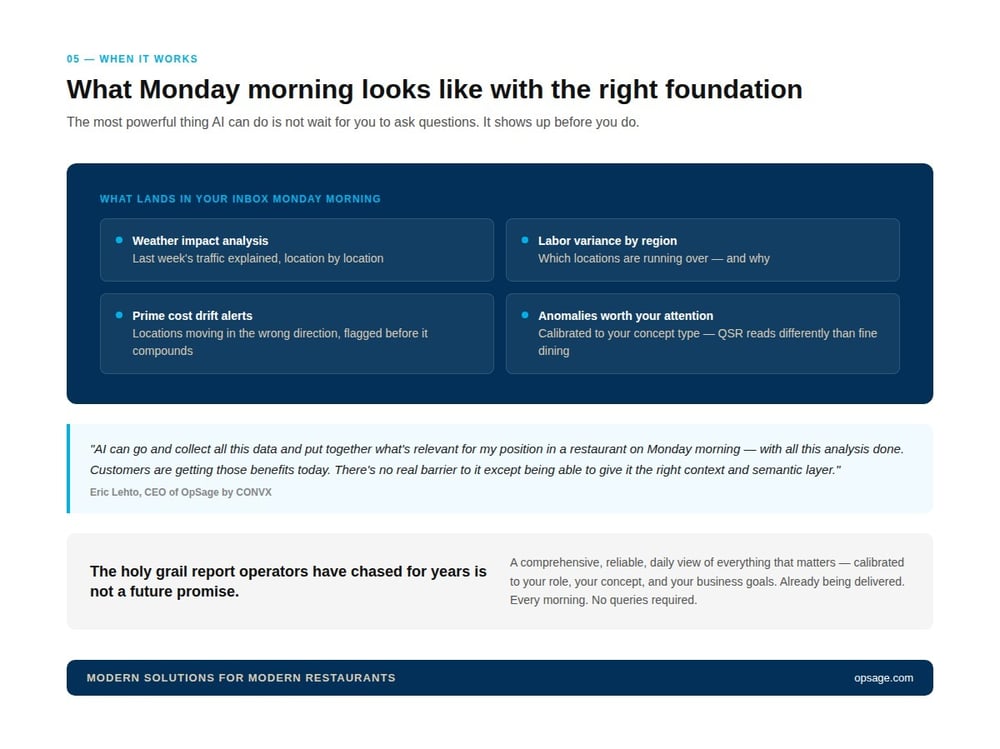
The most powerful thing AI can do, he said, is not wait for you to ask it questions. It collects everything that happened across your operation, surfaces what is relevant to your role and your priorities, and puts it in front of you with the analysis already done. Weather impact on last week’s traffic. Labor variances by region. Which locations are drifting on prime cost. Anomalies that warrant attention before they become problems. All of it, calibrated to your concept type and your business goals, waiting in your inbox Monday morning.
OpSage is an analyst who never sleeps, knows every location, and shows up before you do.
For years, operators talked about the holy grail report: one comprehensive, reliable, daily view of everything that matters. AI data intelligence platforms are not promising that someday. Operators are receiving it today.
Advice for Operators Getting Started
I closed the conversation by asking Eric what he would want a restaurant operator to walk away understanding if they are thinking seriously about AI data intelligence in the next several months. Two things, he said.
First, get started.
Regardless of size or how many systems you are running, there are ways to leverage AI right now. You do not have to solve the whole infrastructure problem on day one to get value. Start somewhere and build from there.
Second, do it safely.
Understand whether the AI you are using is a consumer model that may be training on your data or an enterprise model that keeps your information private. Ask vendors where their security lives. Make sure you are comfortable with the answer before your operational data is in the pipeline.
And when selecting a partner, choose one that is genuinely a data expert, not a software company that bolted AI onto an existing product. The foundation matters more than the AI features. If the foundation is not right, the features will not be either. If you have questions about what that looks like in practice, the OpSage FAQ is a good starting point.
Up next...
Eric and I are planning a part two as this category continues to evolve. The conversation above is the right starting point for any operator who wants to understand what restaurant AI data intelligence actually is, what it takes to do it right, and why the window to get ahead of it is open right now.
Request an OpSage DemoPaul Molinari is the Founder of Popcorn GTM, a marketing and go-to-market consultancy focused on restaurant technology and hospitality innovation. He is the creator and host of Modern Solutions for Modern Restaurants.