---
title: Why Older, Colder Cities Like Boston May Never Embrace Robotic Food Delivery
description: Boston's unique challenges make robotic food delivery impractical. Here's a hot take why this technology may struggle in older, colder cities like Boston.
image: https://media.licdn.com/dms/image/v2/D4E12AQELujd7OtvI4g/article-inline_image-shrink_400_744/B4EZwlhO0uGkAY-/0/1770155997479?e=2147483647&v=beta&t=Kp7FTF96BA1y7uHpEP7NOn63OWmUbwR2WQbmvbWAVF0
---
[Skip to content](https://popcorngtm.com/blog/why-older-colder-cities-like-boston-may-never-robotic-food-delivery...-and-thats-ok#main-content)


[](https://popcorngtm.com)


- [About Us](https://popcorngtm.com/about-us)
- [Marketing & GTM](https://popcorngtm.com/restaurant-technology-marketing)
Show submenu for Marketing & GTM
- [Fractional CMO](https://popcorngtm.com/fractional-cmo)
- [Marketing Playbooks](https://popcorngtm.com/restaurant-technology-marketing)
- [HubSpot CRM & Websites](https://popcorngtm.com/websites)
- [Franchise Intelligence](https://popcorngtm.com/frandata)
- Media Resources
Show submenu for Media Resources
- [Modern Solutions for Modern Restaurants™ Podcast](https://popcorngtm.com/podcasts)
- [Hot Takes on a Fresh Blog](https://popcorngtm.com/blog)
- [Restauromics Financial News](https://popcorngtm.com/restauromics)
- [Brand Archetype Primer](https://popcorngtm.com/brand-archetype-primer)
- [Air Cover](https://popcorngtm.com/aircover)
- [About Us](https://popcorngtm.com/about-us)
- [Marketing & GTM](https://popcorngtm.com/restaurant-technology-marketing)
Show submenu for Marketing & GTM
- [Fractional CMO](https://popcorngtm.com/fractional-cmo)
- [Marketing Playbooks](https://popcorngtm.com/restaurant-technology-marketing)
- [HubSpot CRM & Websites](https://popcorngtm.com/websites)
- [Franchise Intelligence](https://popcorngtm.com/frandata)
- Media Resources
Show submenu for Media Resources
- [Modern Solutions for Modern Restaurants™ Podcast](https://popcorngtm.com/podcasts)
- [Hot Takes on a Fresh Blog](https://popcorngtm.com/blog)
- [Restauromics Financial News](https://popcorngtm.com/restauromics)
- [Brand Archetype Primer](https://popcorngtm.com/brand-archetype-primer)
- [Air Cover](https://popcorngtm.com/aircover)
[BOOK TIME](https://popcorngtm.com/contact)
[Hot Takes](https://popcorngtm.com/blog/tag/hot-takes)
# Why Older, Colder Cities Like Boston May Never Embrace Robotic Food Delivery
[By \- Paul Molinari,](https://popcorngtm.com/blog/author/paul-molinari) May 05, 2026

**The future of food delivery may be autonomous. Boston's sidewalks have other plans.**
Every few months, someone in restaurant technology gets very excited about delivery robots. The pitch is always the same: no drivers, no tips, no scheduling headaches, no labor drama. Just a cute little cooler on wheels bringing pad thai and lukewarm fries to hungry humans while investors nod like they've just discovered fire.
And look — in the right environment, robotic delivery can make sense. A college campus. A corporate park. A hospital system. Somewhere clean, mapped, controlled, and relatively insulated from the full range of human nonsense.
But Boston? Come on.
Boston is a 400-year-old obstacle course with weather, attitude, tourists, students, cobblestones, delivery scooters, snowbanks, bad parking decisions, and crosswalks that appear to have been designed during a bar fight. It's essentially a boss level.

## The Sidewalk Is Already Full
The most immediate problem with robotic delivery in Boston isn't regulatory or meteorological, it's physical. The sidewalks are already spoken for.
Pedestrians, wheelchair users, parents with strollers, office workers, tourists staring at maps, students staring at phones, dogs with strong opinions about which direction to go. Now add a fleet of slow-moving, camera-covered, corporate-owned delivery robots to the mix. That's not innovation. That's sidewalk clutter with a seed round.
Boston does have a public page explaining [personal delivery devices](https://www.boston.gov/departments/transportation/sidewalk-delivery-robots), which at least tells us the city is aware the category exists. But awareness is not adoption. These devices use cameras and sensors, may be self-driving or remotely operated, and are designed to move through public space, which means every single trip depends on the robot successfully navigating the same sidewalks humans already find exhausting. And humans, for what it's worth, can step over a snowbank, dodge a traffic cone, and mutter profanity with genuine purpose.
## Boston Weather Is Not a Software Problem
Delivery robots look great in sunny demo videos. Boston gives you January.
Snow. Slush. Black ice. Potholes. Sidewalks that vanish under plow piles. Curb cuts blocked by frozen mystery walls. Brick sidewalks that have personally declared war on wheels. Rain blowing sideways off the harbor. This isn't a hypothetical, it's the actual operating environment, and it's punishing even for people who grew up here.
Earlier this year, WBUR reported that Boston received more than 6,000 snow-related complaints after a major storm, with sidewalks, intersections, and crosswalks still difficult or inaccessible for people using wheelchairs, walkers, or strollers. [That's the real-world operating environment](https://www.wbur.org/news/2026/02/06/boston-snow-accessibility-mbta-bus) — not a rendered animation, not a suburban pilot, not a campus map with perfect pavement. A human courier improvises. A robot gets confused, blocked, stuck, rerouted, or turned into street furniture.
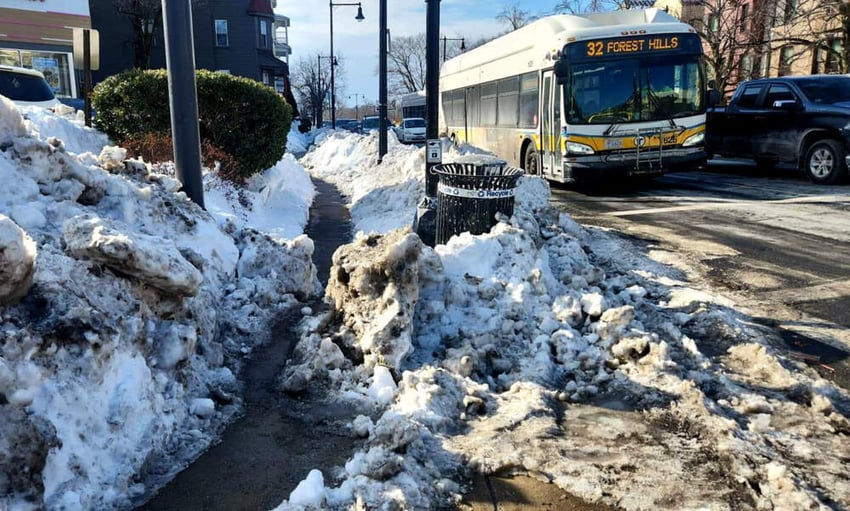
And once you factor in rescue teams, remote monitors, fleet maintenance, charging infrastructure, customer support, insurance, and a plan for when the robot gets wedged between a stroller and a Bluebike station in the North End, the economics stop looking like disruption and start looking like a very expensive Roomba with liability exposure.
## The Economics Are Not Magic
The promise of delivery robots is lower labor costs. That sounds appealing until you remember that restaurants don't just need cheaper delivery — they need *reliable* delivery.
Food has a clock on it. Fries die fast. Coffee spills. Soup is chaos with a lid. Ice cream has trust issues. Pizza does not want to spend an extra twelve minutes in a robot locker while the robot negotiates a curb cut outside South Station.
For operators, the question has never been "Is the delivery method cool?" It's "Does the food arrive on time, in good shape, with minimal friction, without generating refunds and one-star reviews?" If the honest answer is *probably*, the real answer is no. Especially in a city where the last mile is less about distance and more about density, weather, curb management, and human behavior that no algorithm has fully solved.
## Boston Is Already Tightening the Screws on Delivery
Here's the part that gets interesting. Boston is not moving toward a looser delivery environment. It's moving toward more accountability.
The city's [Road Safety and Accountability for Delivery Providers Ordinance](https://www.boston.gov/departments/transportation/road-safety-and-accountability-delivery-providers-ordinance) requires major delivery apps to hold permits to operate in Boston. NBC10 Boston reported that the ordinance requires delivery companies to register with the city, mandate driver permits, provide proof of insurance, and share delivery data with the Boston Transportation Department. [The rules are already in effect.](https://www.nbcboston.com/news/local/boston-puts-new-food-delivery-safety-ordinance-into-effect/3933099/)
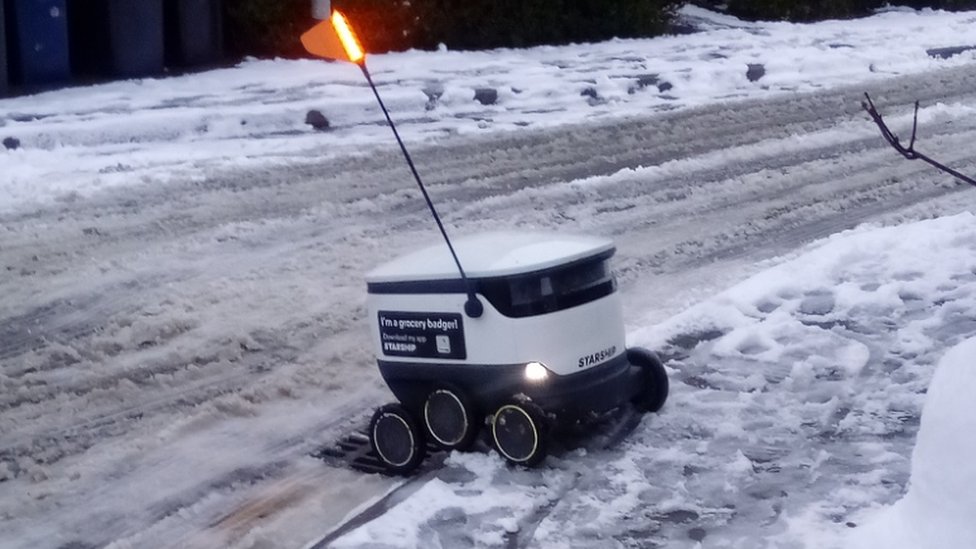
That's a signal worth taking seriously. The city is saying: if you're going to profit from moving food through Boston's streets and neighborhoods, you're going to be accountable for the impact. Now imagine autonomous robot fleets operating under that framework. Who's responsible when a robot blocks a wheelchair ramp? Who pays when it clips a pedestrian? Who handles insurance, retrieves the robot from the snowbank, or answers to City Hall when the data questions start? Those aren't cute hypotheticals. They're the questions where robot economics start falling apart.
## Accessibility Is the Real Dealbreaker
Sidewalks aren't empty lanes waiting to be filled with delivery infrastructure. They're essential public space and that matters most to people who depend on them most.
Delivery robots introduce new friction into an environment that already has too much of it. A device that blocks a curb cut, narrows a pathway, or forces someone using a wheelchair to maneuver around it isn't a minor inconvenience. It's an accessibility failure. And Boston already struggles with this during winter — when snow accumulates, the city becomes measurably harder to navigate for anyone using mobility devices or accessible transit routes.
Adding robots to that environment isn't exactly a commitment to inclusive design. It's more like saying: what if the sidewalk had a new obstacle, but this one had a logo and a camera?
## People Will Absolutely Mess with Them
This is going to happen, and it's worth being honest about it.
Someone will sit on one. Someone will block one for sport. Someone will film the whole thing with a Bruins hat on it. Someone will put a traffic cone on top of it. Someone will yell at it like it works for the MBTA. It's a reasonable read of how people interact with unfamiliar objects in public space, especially when those objects are slow, autonomous, and operated by a company they've never heard of.
Other cities are already dealing with this. Fast Company recently covered neighborhood resistance to sidewalk delivery robots in Chicago, where residents raised concerns about safety, blocked walkways, and whether cities are remotely prepared to regulate this category. [That resistance is real and already organized.](https://www.fastcompany.com/91486773/sidewalk-delivery-robots-coco-serve-chicago-backlash) Boston will not be more patient with it.
## The Better Use Case Is Controlled Environments
To be fair, robotic delivery isn't a bad idea across the board. There are environments where it can actually work — campuses, hospitals, airports, corporate parks, stadium districts, master-planned communities, suburban delivery zones with manageable road conditions and predictable customer patterns. In those places, the robot has a fighting chance. Routes are more consistent, surfaces are better, operating rules are clearer, and the whole thing is closer to a designed system than a daily improvisation.
Open-city restaurant delivery in Boston is the opposite of a designed system. That's the core problem, and it doesn't go away because the hardware got better.
## Restaurants Should Be Careful About the Shiny Object
Restaurant technology has a habit of falling in love with the future before checking whether the present can support it. Robotic delivery looks great on conference slides. It photographs well. It lets tech companies use the phrase "autonomous last mile" with a straight face.
But operators don't run on vibes. They run on throughput, margin, guest experience, labor realities, and whether the food gets where it needs to go without becoming a customer service incident. If a technology adds complexity to an already complex operation, the right response isn't excitement — it's skepticism. Not cynicism. Skepticism. There's a meaningful difference between the two.
## A Hot Take?
Boston may allow robotic delivery pilots. It may let companies test small zones under strict conditions. That's fine. But broad adoption? Not happening anytime soon.
Not because Boston hates innovation — it doesn't. Boston has plenty of it. We're the [home of MIT](https://www.mit.edu/) for crying out loud. But Boston also has reality. And reality is undefeated.
Robotic food delivery needs clean geometry, predictable conditions, supportive regulation, low public friction, and a business model that still works after the pilot money runs out. Boston offers narrow sidewalks, brutal weather, genuine accessibility challenges, dense neighborhoods, tightening regulatory oversight, and a population that will absolutely roast a delivery robot if it gets between them and Dunkin'.
The robot can bring the burrito. Boston will bring the chaos.
###### Category
- [Industry](https://popcorngtm.com/blog/tag/industry)
- [Marketing](https://popcorngtm.com/blog/tag/marketing)
- [Hot Takes](https://popcorngtm.com/blog/tag/hot-takes)
- [GTM](https://popcorngtm.com/blog/tag/gtm)
- [Artificial Intelligence](https://popcorngtm.com/blog/tag/artificial-intelligence)
- [Podcast](https://popcorngtm.com/blog/tag/podcast)
- [News](https://popcorngtm.com/blog/tag/news)
- [Systems](https://popcorngtm.com/blog/tag/systems)
- [Web 3](https://popcorngtm.com/blog/tag/web-3)
- [Online Ordering](https://popcorngtm.com/blog/tag/online-ordering)
- [Search](https://popcorngtm.com/blog/tag/search)
### Similar Blogs
.png?width=352&name=LinkedIn%20Blog%20(1).png)
#### [The LinkedIn Creator Playbook—What Restaurant Tech Founders Need to Know](https://popcorngtm.com/blog/the-linkedin-creator-playbook-what-restaurant-tech-founders-need-to-know)
By [Paul Molinari](https://popcorngtm.com/blog/author/paul-molinari) 27 June 2025
[A new article by Search Engine Land says that LinkedIn just released a Creator Playbook](https://searchengineland.com/linkedin-playbook-creators-b2b-marketing-456518) for B2B...
[READ MORE](https://popcorngtm.com/blog/the-linkedin-creator-playbook-what-restaurant-tech-founders-need-to-know)

#### [Beyond the Bots: Why Investing in Your People Solves Hospitality's Biggest Challenges](https://popcorngtm.com/blog/beyond-the-bots-why-investing-in-your-people-solves-hospitalitys-biggest-challenges)
By [Paul Molinari](https://popcorngtm.com/blog/author/paul-molinari) 13 August 2025
**Imagine this: Restaurant Tech That Actually Fixes Turnover.**
[READ MORE](https://popcorngtm.com/blog/beyond-the-bots-why-investing-in-your-people-solves-hospitalitys-biggest-challenges)
.png?width=352&name=Popcorn%20SOCIAL%20MEDIA%20CHEAT%20SHEET%20(1).png)
#### [A Social Media GTM Cheat Sheet for Restaurant Industry People](https://popcorngtm.com/blog/a-social-media-gtm-cheat-sheet-for-restaurant-industry-people)
By [Paul Molinari](https://popcorngtm.com/blog/author/paul-molinari) 13 March 2025
{% module\_block module "widget\_4586789e-3f07-47f5-b4cf-14353d7471b9" %}{% module\_attribute...
[READ MORE](https://popcorngtm.com/blog/a-social-media-gtm-cheat-sheet-for-restaurant-industry-people)
[](https://popcorngtm.com)
Show Up. Every Week. Make it Pop.
---
- THE MENU
- [- Fractional CMO](https://popcorngtm.com/fractional-cmo)
- [- Marketing Playbooks](https://popcorngtm.com/restaurant-technology-marketing)
- [- Air Cover Content Marketing Engine](https://popcorngtm.com/aircover)
- [- Tech Enablement Services](https://popcorngtm.com/tech-enablement)
- [- Hot Takes, Fresh Blog](https://popcorngtm.com/blog)
- [- Restauromics Financial News](https://popcorngtm.com/restauromics)
- [- Book Time](https://popcorngtm.com/contact)
[](https://popcorngtm.com/podcasts)
COPYRIGHT © 2026 POPCORN MARKETING GROUP, LLC | POPCORN GTM IS A REGISTERED TRADEMARK, ALL RIGHTS RESERVED.
[DATA PRIVACY |](https://popcorngtm.com/privacy-policy) [TERMS & CONDITIONS](https://popcorngtm.com/privacy-policy)
```json
{
"@context" : "https://schema.org",
"@type" : "BlogPosting",
"author" : {
"@type" : "Person",
"name" : "Paul Molinari",
"url" : "https://popcorngtm.com/blog/author/paul-molinari"
},
"dateModified" : "2026-05-05T14:28:11.298Z",
"datePublished" : "2026-05-05T13:42:22.000Z",
"headline" : "Why Older, Colder Cities Like Boston May Never Embrace Robotic Food Delivery",
"image" : [ "https://media.licdn.com/dms/image/v2/D4E12AQELujd7OtvI4g/article-inline_image-shrink_400_744/B4EZwlhO0uGkAY-/0/1770155997479?e=2147483647&v=beta&t=Kp7FTF96BA1y7uHpEP7NOn63OWmUbwR2WQbmvbWAVF0" ],
"mainEntityOfPage" : {
"@id" : "https://popcorngtm.com/blog/why-older-colder-cities-like-boston-may-never-robotic-food-delivery...-and-thats-ok",
"@type" : "WebPage"
},
"publisher" : {
"@type" : "Organization",
"logo" : {
"@type" : "ImageObject",
"url" : "https://popcorngtm.com/hubfs/Popcorn%20GTM%20LOGO%202026.png"
},
"name" : "Popcorn GTM "
}
}
```