
You built something real. The product works. Operators love the demo. You've got a handful of marquee customers and a deck that checks every box. And yet the pipeline feels thinner than it should. The category recognition isn't there. The brand feels a little... invisible.
Sound familiar? Here's the uncomfortable truth: most restaurant technology companies don't have a product problem. They have a marketing problem. And it's costing them more than they realize.

The Industry Is Exploding. So Is the Noise.
Restaurant technology is not a niche play anymore. The global restaurant tech market hit $59.3 billion in 2024 and is projected to reach $314.85 billion by 2033. That's a 16% compound annual growth rate. Capital is flowing, acqui-hires are happening, and new entrants are stacking up every quarter.

- $59B Global restaurant tech market size, 2024
- $314B Projected market size by 2033
- 16.4% CAGR 2023–2033
- 76% Operators say tech gives a competitive edge
Sources: Restroworks, National Restaurant Association Technology Landscape Report 2024
That growth sounds great if you're already positioned. But most restaurant tech companies aren't. They're fighting for attention in an increasingly crowded space using the exact same playbook as everyone else: feature lists, efficiency claims, and ROI calculators that all say roughly the same thing.
The operators you're selling to? They're not buying features. They're buying outcomes. They're buying trust. And increasingly, they're buying identity.
The Feature Trap: Safe, Rational, and Slowly Self-Defeating
Here's how it usually goes. A restaurant tech founder, brilliant at their craft, builds a product that solves a real problem. The sales process validates the product. Customers love using it. And so the natural instinct is to market what you know: the capabilities, the integrations, the uptime, the specs.
The problem isn't that features are wrong to talk about. The problem is when features are all you talk about.
"When every product looks and sounds the same, leading with specs triggers a race to the bottom. Differentiation erodes, and the buyer stops caring who made what. They just pick what's cheapest." - NRA Tech Report 2024
Think about Zoom and Microsoft Teams. Functionally, those products are nearly identical. Both do video calls, screen sharing, and chat at enterprise scale. But Zoom became the verb. Why? Not because of superior specs. Because it told a simpler, more human story. That story built category gravity before the sales team ever picked up the phone.
Restaurant tech is full of Zooms waiting to happen. Products with genuine differentiation that are marketing themselves into invisibility by sounding exactly like the competition.
What Operators Actually Buy
Here's a stat worth sitting with: 76% of restaurant operators say technology gives them a competitive edge. But only 13% are satisfied with their current tech stack. That's not a product gap. That's a trust gap. A narrative gap. A "help me understand why you" gap.
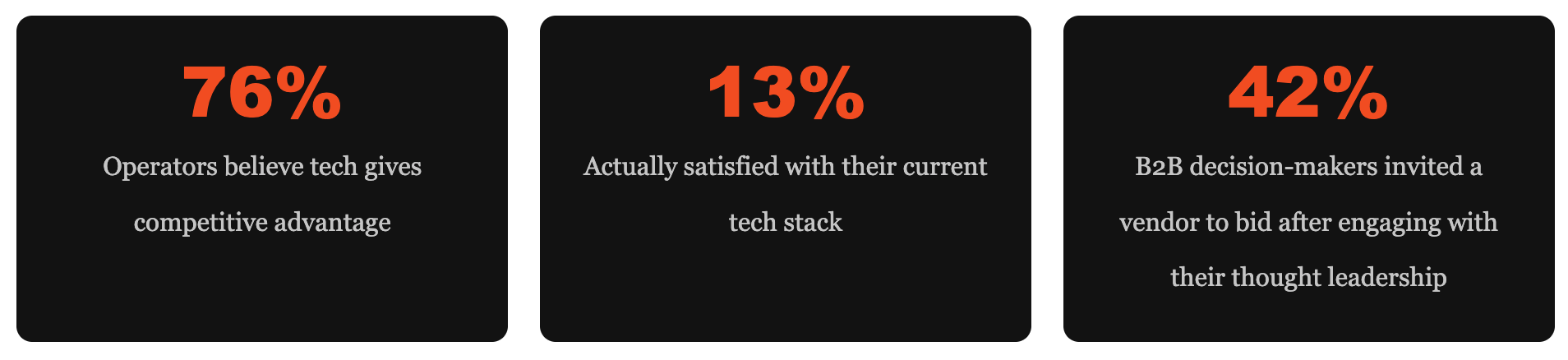
- 76% Operators believe tech gives competitive advantage
- 13% Actually satisfied with their current tech stack
- 42% B2B decision-makers invited a vendor to bid after engaging with their thought leadership
Sources: National Restaurant Association 2024; Understory B2B SaaS Marketing Benchmarks 2025
Operators are buying into futures. They're betting on partners they can trust through multiple upgrade cycles, evolving workflows, and the inevitable support escalation at 11 PM on a Saturday. That's not a feature decision. That's a brand decision.
The brands that win in restaurant tech are the ones that make operators feel something. That make founders feel seen. That show up with a point of view, not just a product update.
The Real Cost of Invisible Positioning
When your positioning is weak, the symptoms are everywhere. Sales cycles drag out because there's no category pull working in your favor. Deals get stuck in evaluation because the prospect can't articulate internally why your solution beats the alternative. Churn increases because customers never emotionally connected with the brand in the first place. And recruitment suffers because the best talent wants to work for brands with a story, not just a SaaS dashboard.
The cost isn't just revenue. It's momentum. And in a market growing at 16% annually, lost momentum is compounding against you every quarter.
Take the work we've done at Popcorn GTM with clients like Curbit, the queue intelligence platform changing how restaurants manage speed of service, and OpSage by CONVX, which is redefining how restaurant groups think about their operational data. These aren't products that needed a better spec sheet. They needed a story. A position in the market that was distinctly, unmistakably theirs.
That's the work. And it's not optional anymore.
The Moment Something Has to Change
Most restaurant tech companies hit one of three moments before they start taking marketing seriously:
-
The funding moment. New capital means new pressure. Investors want category leadership, not just product traction. The slide deck that closed the round won't build the brand that wins the market.
-
The competitive moment. A well-funded competitor shows up, and suddenly the product advantage feels thinner than expected. The ones who survive this moment are the ones with brand gravity already built.
-
The plateau moment. Growth stalls not because the product got worse, but because the market can't find a compelling reason to choose you over the next option in their demo queue.
In every one of these scenarios, the answer isn't more features. It's better positioning, sharper messaging, and a brand story worth telling.
The market is growing fast. The question is whether your brand is growing with it, or just along for the ride.
There's a better way to think about marketing at this stage, and it doesn't require a full-time CMO, a giant team, or a nine-month brand redesign. It requires the right strategic leadership, applied at exactly the right moment.
COMING SOON: Read Article 2: What a Fractional CMO Actually Does (And Why Restaurant Tech Is Built for It)
Popcorn GTM serves as Fractional CMO for restaurant tech companies ready to build brands that win. If any of this landed, let's talk.
Start the Conversation