
Your product works. Your pilot customers like it. Your demo gets nods. And yet the pipeline looks the same in month nine as it did in month three.
I see this pattern constantly in restaurant tech. A founder builds something useful for operators, raises a seed round, hires a couple of sellers, and then runs into a wall nobody warned them about. That wall is almost always go-to-market.
The good news: GTM gaps are diagnosable. They show up as specific symptoms, and each symptom points to a specific fix. This guide walks you through the four gaps that stall most restaurant technology startups, how to tell which one you have, and what to do about it before your next board meeting.
Why 2027 raises the stakes. Operators are tired. They've been pitched AI everything for two years. Their tech stacks are crowded, their margins are thin, and their patience for tools that don't pay for themselves inside a quarter is gone. Investors have noticed too. The bar for showing real market traction before the next round keeps climbing. A fuzzy restaurant tech go-to-market strategy that might have coasted in 2021 will get exposed in 2027.
The four GTM gaps that stall restaurant tech traction
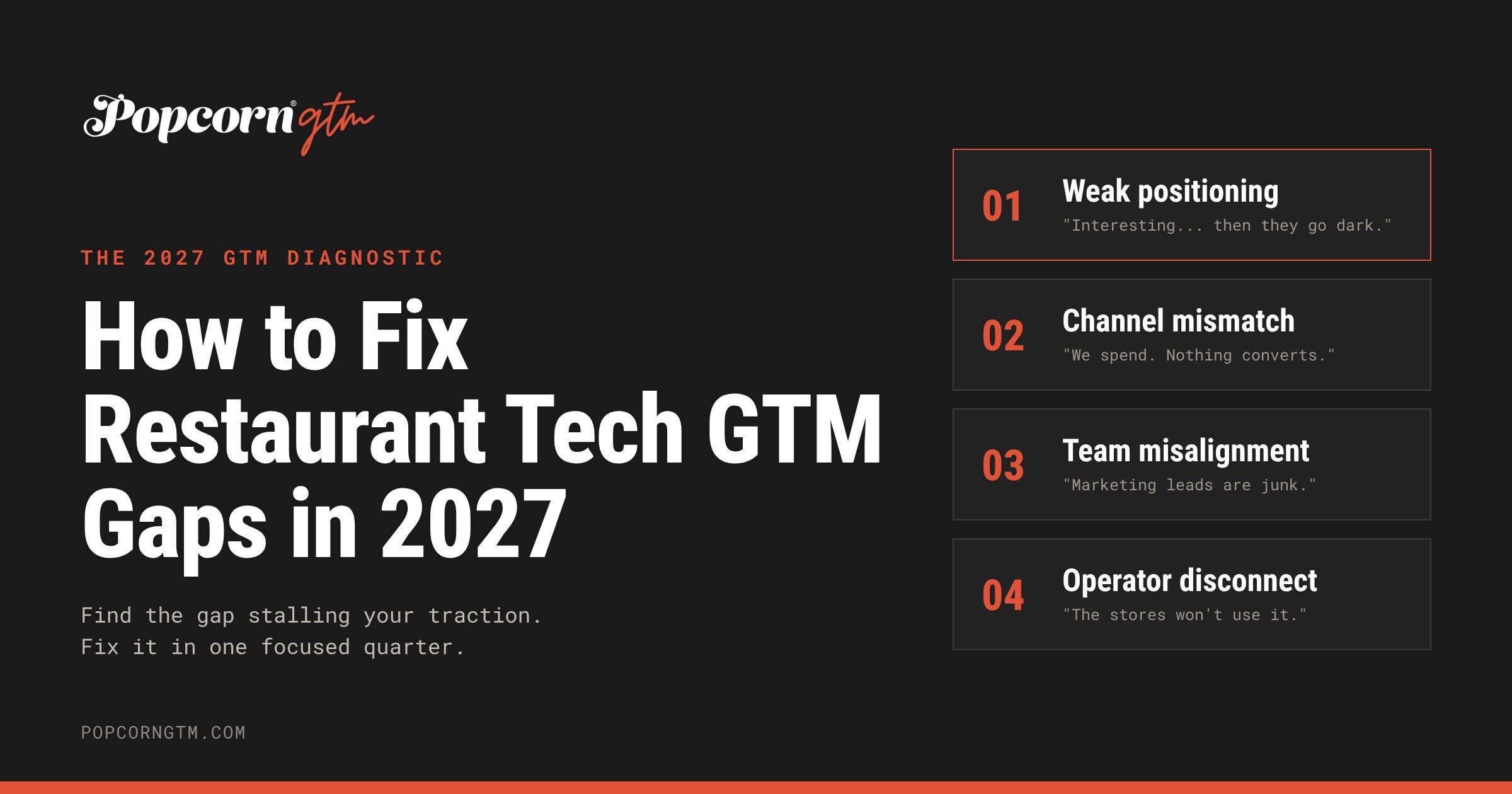
Most stalled go-to-market programs trace back to one of four gaps. Founders usually misread the symptom and fix the wrong thing. They hire another seller when the real issue is positioning. They redesign the website when the real issue is channel. Use this chart to match what you're feeling to what's actually broken.
Four gaps stall most restaurant tech go-to-market: 01 weak positioning, 02 channel mismatch, 03 team misalignment, 04 operator disconnect, each with the symptom you hear and what is broken
You might have more than one. Most early-stage teams do. Start with the gap closest to the top of this list, because positioning problems poison everything below them.
Gap 1: Weak positioning
If a buyer can't repeat your value in one sentence to their boss, what you have is a feature list.
Restaurant tech is crowded. Scheduling, inventory, guest engagement, ordering, back office, AI agents for all of the above. When ten vendors claim to "save labor" and "boost margins," those words stop meaning anything. Operators tune them out.
How to diagnose it
Run these four tests this week:
- The five-customer test. Ask five current customers why they bought. Write down their exact words. If their answers don't match your homepage, your homepage is wrong.
- The swap test. Put a competitor's logo on your hero headline. If it still reads fine, your message isn't yours.
- The lost-deal test. Review your last ten lost deals. If most went to "no decision" instead of a competitor, buyers didn't feel enough urgency. That's a positioning problem.
- The seller test. Ask three people on your team to pitch the company in 30 seconds. Three different pitches means zero positioning.
How to fix it
- Pick the enemy. Name the operator problem you exist to kill. Ghost shifts. Food cost creep. Training that never sticks. A specific problem beats a broad promise every time.
- Narrow the segment. "Restaurants" is a census category. "Multi-unit fast casual brands with 20 to 200 locations" is a market. Pick the segment where you win fastest and own it first.
- Translate it into operator math. Put your value in the numbers an operator watches: labor percentage, prime cost, ticket times, turnover. If you can't connect to one of those, keep working.
- Write it down once. Build a message map with one core statement, three supporting pillars, and the evidence behind each. Every deck, page and email pulls from it. If you're not sure what personality your brand should bring to that map, start with our brand archetype primer.
Gap 2: Channel mismatch
Restaurant operators are some of the hardest buyers to reach. They aren't at their desks. They're on the line, in the office counting cash, or driving between stores. The channels that work for horizontal SaaS often fall flat here.
A lot of startup growth strategies get copied from playbooks built for software engineers and finance teams. Paid LinkedIn to a director of operations who checks the app twice a month. Cold email sequences to an inbox nobody reads until Sunday night. Big booth spend at a show where your buyer never walks your aisle.
How to diagnose it
- Trace your best customers back. Where did your top ten accounts first hear about you? If the answer is "a referral" or "the founder knew someone," your scalable channels aren't working yet.
- Check cost per qualified opportunity by channel. Count opportunities that reach a real demo with a decision-maker. Lead volume tells you very little.
- Look at time to first meeting. If one channel books meetings in days and another takes months, believe the data over the plan.
How to fix it
- Go where operators already trust. Peer communities, franchise associations, industry podcasts, operator newsletters and regional restaurant associations. Restaurant people buy from people other restaurant people vouch for.
- Treat partners as a channel. POS marketplaces, distributors, consultants and complementary vendors already have the relationship you want. A good integration partnership can outperform a year of ads.
- Make events earn their keep. Fewer shows, smaller rooms, more pre-booked meetings. A dinner for twelve operators can beat a 10x10 booth.
- Publish the expertise. Content that teaches operators something useful builds trust before the first sales call. Thought leadership works when it's specific. (More on that in how to market restaurant tech when operators don't read.)
Gap 3: Team misalignment
Early-stage team growth creates its own GTM problems. The founder used to hold the whole story in their head. Now there's a marketer, two sellers, a customer success lead and maybe a product manager. Each one tells the story a little differently. Each one has a different idea of who the ideal customer is.
The result is predictable. Marketing celebrates lead volume. Sales complains about lead quality. Customer success inherits accounts that were never a good fit. Everyone is working hard and the numbers barely move.
How to diagnose it
- Ask each leader to describe the ideal customer. Segment, size, role of the buyer, trigger event. If the answers differ, your go-to-market programs are pulling in different directions.
- Ask for the definition of a qualified lead. If marketing and sales give different answers, that's your problem in one question.
- Review handoffs. Watch what happens between first touch and closed deal. Count how many times context gets lost.
How to fix it
- Write one ICP document. One page. Firmographics, buyer roles, pain points, disqualifiers. Sales, marketing and success all sign off.
- Agree on stage definitions. What counts as a lead, an opportunity and a win. Put it in the CRM so the system enforces it.
- Share one scoreboard. Marketing and sales own pipeline together. When both teams are measured on qualified opportunities and revenue, the blame game stops.
- Hold a weekly GTM huddle. Thirty minutes. What did buyers say this week? What objections came up? What content would have helped? Feed it all back into the message map from Gap 1.
Gap 4: Operator disconnect
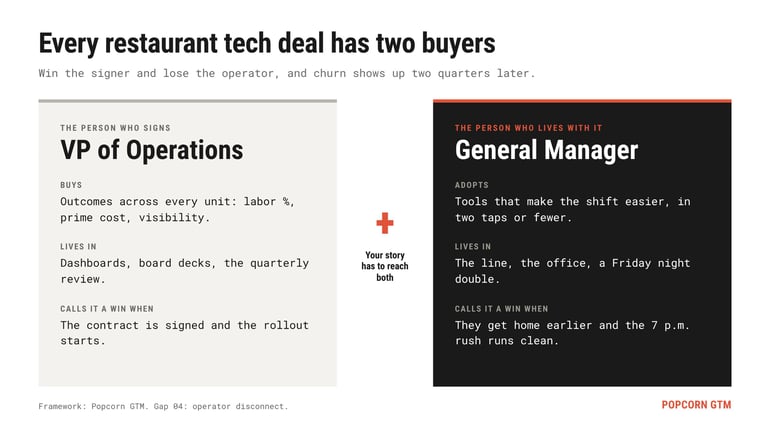
This is the gap that quietly kills renewals. The deal gets signed at corporate. The VP of Operations loves the dashboard. Then the tool rolls out to stores and the general managers ignore it. Usage drops. Champions go quiet. Churn shows up two quarters later.
Restaurant tech has two buyers in every deal: the person who signs and the person who lives with it on a Friday night. If your story only speaks to the first one, you'll win deals and lose accounts.
How to diagnose it
- Check usage at the store level. Logins per location per week. If corporate users are active and store users aren't, you have a disconnect.
- Listen to the GM. Spend a shift in a customer's restaurant. Watch how your product fits into the real workflow, or doesn't.
- Read support tickets for tone. Frustration from frontline users is an early warning that your positioning promised something the store doesn't feel.
How to fix it
- Make the operator the hero. Your marketing should show a GM getting home earlier, a kitchen manager catching a cost spike, a shift lead covering a call-out in two taps. Executives buy outcomes. Operators adopt tools that make their shift easier.
- Build rollout into the sale. Training, store champions and a 30-day adoption plan belong in the proposal. Treat adoption as part of the product.
- Collect operator stories. Quotes, short videos and case studies from GMs carry more weight with other operators than any executive testimonial.
- Close the loop with product. Feed store-level feedback into your roadmap and tell operators what changed because of them.
A 90-day plan to close the gaps
Give it one focused quarter. Here's the sequence I recommend to founders and marketing leaders.
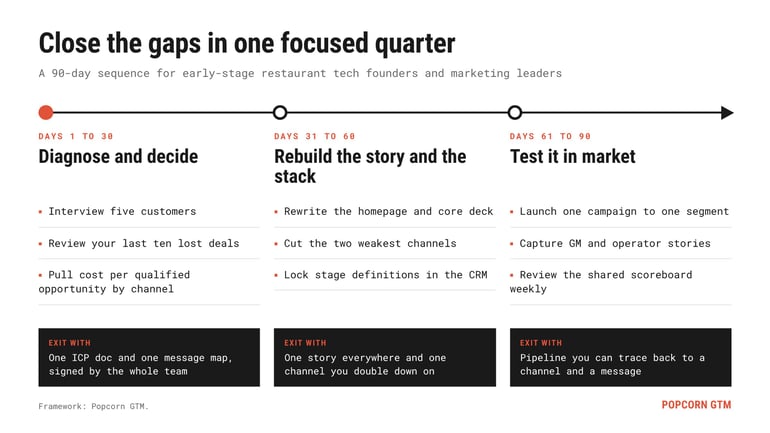
A 90-day plan: days 1 to 30 diagnose and decide, days 31 to 60 rebuild the story and the stack, days 61 to 90 test it in market
- Days 1 to 30: Diagnose and decide. Run the tests from each gap above. Interview customers, review lost deals, pull channel data. Finish the month with one ICP document and one message map the whole team has signed.
- Days 31 to 60: Rebuild the story and the stack. Update the homepage, the core deck and the sales one-pager from the message map. Cut the two weakest channels. Double down on the one that books meetings fastest. Lock stage definitions in the CRM.
- Days 61 to 90: Test it in market. Launch one focused campaign to one segment. Capture operator stories from your best accounts. Review the shared scoreboard weekly and adjust.
Quick self-diagnostic
Check every statement that's true today, then count. Zero to four means real GTM gaps: fix the story before you add spend. Five or six means you're close, so tighten the weakest gap. Seven or eight means you're ready to scale what works.
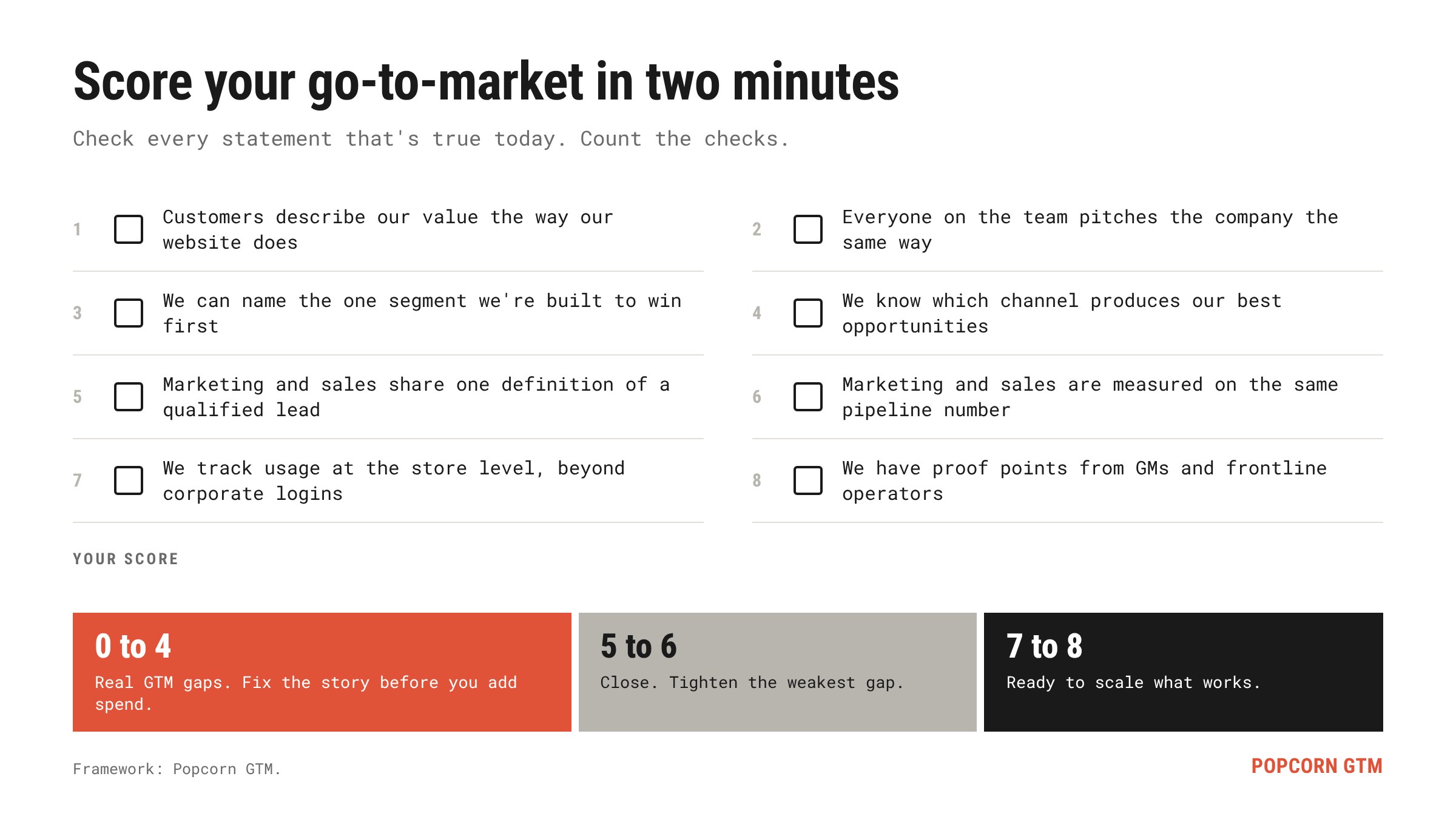
GTM self-diagnostic scorecard with eight statements to check and score bands: 0 to 4 real gaps, 5 to 6 close, 7 to 8 ready to scale
- Our customers describe our value the same way our website does
- Every person on our team pitches the company the same way
- We can name the one segment we're built to win first
- We know which channel produces our most qualified opportunities
- Marketing and sales share one definition of a qualified lead
- Marketing and sales are measured on the same pipeline number
- We track product usage at the store level, beyond corporate logins
- We have proof points from GMs and frontline operators
FAQ
What is a restaurant tech go-to-market strategy?
It's the plan for how a restaurant technology company reaches, convinces and keeps its customers. It covers positioning, target segment, channels, pricing, sales motion and the handoff to customer success.
Why do restaurant technology startups struggle with GTM?
Restaurant buyers are busy, skeptical and hard to reach. Most deals involve both a corporate decision-maker and frontline operators who must adopt the tool. Startups that copy generic SaaS playbooks often miss both realities.
How do I know if my startup has a positioning problem?
Watch your lost deals. If most end in "no decision" rather than a competitor win, buyers didn't see enough urgency or difference. Inconsistent pitches across your team point the same way.
When should an early-stage restaurant tech company bring in outside GTM help?
When the founder can no longer tell the story alone, when pipeline stalls despite more spend, or before a fundraise that depends on showing market traction. A fractional CMO can build the foundation without the cost of a full-time executive hire. If you're weighing that hire, read CMO or marketing director: most founders hire the wrong one first.
Fix the gap before you scale the spend
Adding budget to a broken go-to-market only makes the problem more expensive. The restaurant tech companies that break out in 2027 will be the ones that get specific: a sharp story, the right channels, one aligned team and a product message that respects the operator on the floor.
That's the work we do every day at Popcorn GTM. We help restaurant technology startups find their story, make it matter to operators and build the marketing engine behind it. If any of these gaps sound familiar, let's talk.
Paul Molinari is Founder and Principal Consultant of Popcorn GTM and host of the Modern Solutions for Modern Restaurants podcast.