---
title: Why Most Restaurant-Tech Marketing Copy Falls Flat
description: Most restaurant tech marketing copy fails because it talks to one buyer, not the six-to-ten-person buying committee. Here's what operators trust instead.
image: https://popcorngtm.com/hubfs/AI-Generated%20Media/Images/Restaurant%20Kitchen%20Team%20Collaboration.png
---
[Skip to content](https://popcorngtm.com/blog/why-restaurant-tech-marketing-copy-falls-flat#main-content)


[](https://popcorngtm.com)


- [About Us](https://popcorngtm.com/about-us)
- [Fractional CMO](https://popcorngtm.com/fractional-cmo)
- [Marketing & GTM](https://popcorngtm.com/restaurant-technology-marketing)
Show submenu for Marketing & GTM
- [Marketing Playbooks](https://popcorngtm.com/restaurant-technology-marketing)
- [Content Engine](https://popcorngtm.com/aircover)
- [HubSpot CRM & Websites](https://popcorngtm.com/websites)
- [Franchisee Intelligence](https://popcorngtm.com/frandata)
- Media Resources
Show submenu for Media Resources
- [Blog](https://popcorngtm.com/blog)
- [Podcast](https://popcorngtm.com/podcasts)
- [Economics](https://popcorngtm.com/restauromics)
- [Brand Archetype](https://popcorngtm.com/brand-archetype-primer)
- [About Us](https://popcorngtm.com/about-us)
- [Fractional CMO](https://popcorngtm.com/fractional-cmo)
- [Marketing & GTM](https://popcorngtm.com/restaurant-technology-marketing)
Show submenu for Marketing & GTM
- [Marketing Playbooks](https://popcorngtm.com/restaurant-technology-marketing)
- [Content Engine](https://popcorngtm.com/aircover)
- [HubSpot CRM & Websites](https://popcorngtm.com/websites)
- [Franchisee Intelligence](https://popcorngtm.com/frandata)
- Media Resources
Show submenu for Media Resources
- [Blog](https://popcorngtm.com/blog)
- [Podcast](https://popcorngtm.com/podcasts)
- [Economics](https://popcorngtm.com/restauromics)
- [Brand Archetype](https://popcorngtm.com/brand-archetype-primer)
[BOOK TIME](https://popcorngtm.com/contact)
[Marketing](https://popcorngtm.com/blog/tag/marketing)
# Why Most Restaurant-Tech Marketing Copy Falls Flat
[By \- Jared Castronova,](https://popcorngtm.com/blog/author/jared-castronova) Jun 28, 2026
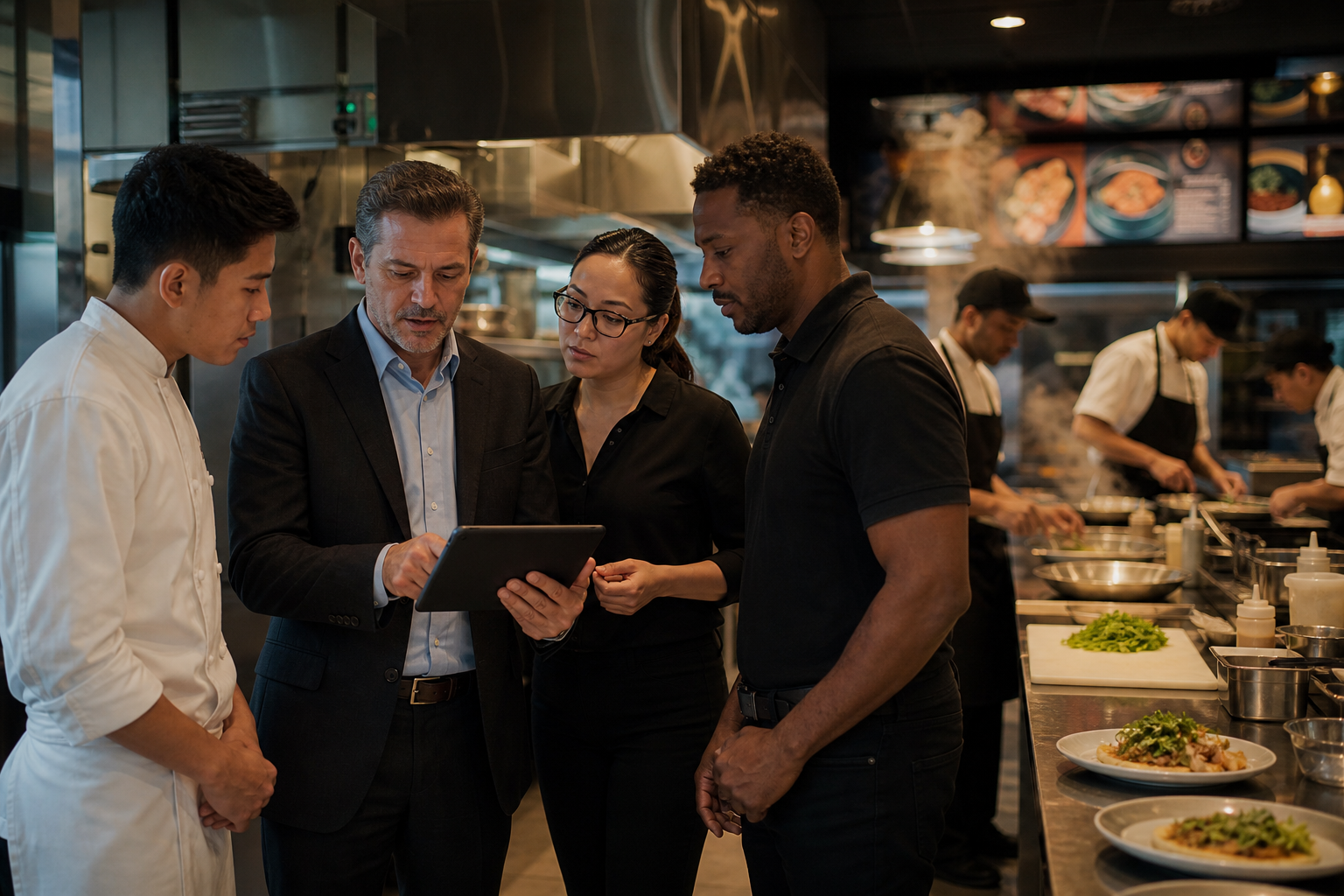
Most restaurant-tech marketing copy falls flat for one reason: it's written for the one person who already wants to buy, and it ignores the 5 other people who decide whether the deal closes. Restaurant technology purchases run through a buying committee of 6 to 10 people, and most one-pagers speak to exactly one. This isn't a skill problem. Good marketers write circles around generic copy the moment they have the operator's POV. The fix is proximity to the operator's world, then writing for the whole table.
## Why doesn't restaurant-tech marketing resonate with operators?
It doesn't resonate because it's written from inside the category instead of from behind the pass. Operators don't sit and read positioning language about "unifying the restaurant operating stack." They scan between shifts, and if the first line doesn't tell them what changes for their business, they're gone.
The view from a marketing meeting is a long way from the view in the kitchen. Copy might sound good to the team that wrote it, but none of that survives contact with a GM about to prep for a Friday rush.
A strong marketer who has spent real time around operators nails this every time. The further you sit from the people using the tech every day, the easier it is to write lines that say nothing.
Operators trust specifics. "Cut your Sunday close from 40 minutes to 12" lands. "Streamline back-of-house operations" doesn't. Write the way your best customers talk, not the way your category does. The KDS, the labor scheduler, the inventory tool, the online-ordering integration: each one earns trust by naming the exact friction it removes, not the workflow it "optimizes."
## Who is in the restaurant-tech buying committee?
The restaurant-tech buying committee runs 6 to 10 people, per [Gartner's research on the B2B buying journey](https://www.gartner.com/en/sales/insights/b2b-buying-journey). The core seats are the champion, the CFO or finance lead, the ops lead, the franchisee in franchise systems, and the GM who has to use the product. Each cares about something different. Most copy speaks only to the champion, so the deal stalls when the other 4 seats find nothing aimed at them.
Here's the table in restaurant tech:
- **The champion.** Found you, wants this to happen, cares about looking smart and killing the pain that brought them in. Almost all copy speaks to this person.
- **The CFO or finance lead.** Cares about payback period, total cost, and whether this replaces a line item or adds one. Wants numbers, not vision.
- **The ops lead.** Cares about rollout risk across locations, training time, and what breaks during the switch. Has watched 3 "transformations" fail and is the hardest to win.
- **The franchisee.** In a franchise system, half customer, half partner. Cares about their own P&L and whether corporate is about to push cost down onto them. ([Franchisees are an untapped audience](https://popcorngtm.com/blog/franchisees-the-untapped-goldmine-for-restaurant-technology-companies) most restaurant-tech brands underserve.)
- **The GM who has to use it.** Cares about one thing: does this make the shift easier or harder. If it's harder, they'll quietly kill adoption no matter who signed.
Reread your homepage. It's written for the champion. It assumes the reader already believes the category matters and just needs to pick a brand. The other 5 people get nothing, the deal sits in "we're still evaluating," and you never learn it died in a hallway conversation with the GM.
Good restaurant-tech content hands every seat something to grab: a finance angle, an ops-rollout angle, a "your GMs will thank you" angle. You don't need 5 separate documents. You need a body of content, published over time, that covers the committee instead of one corner of it.
## What do restaurant operators trust?
[Operators trust evidence and follow-through](https://popcorngtm.com/blog/leveraging-customer-feedback-insights-a-guide-for-restaurants), not polish. They trust outcomes tied to a real workflow, proof that sounds operational, and a brand that keeps showing up. They distrust feature lists, "great partnership" testimonials, and the company that runs one campaign, goes quiet for 2 months, then reappears asking for a demo. Earn trust on those 3 fronts, and a 3-location operator starts treating you as a partner instead of a cost.
This section uses "brand," not "vendor," on purpose. Operators feel the difference. A vendor sends an invoice and a support-ticket queue. A brand is the company they recommend to the operator 2 towns over. The framing isn't cosmetic. It decides whether they see you as a cost line or a partner.
3 things earn that trust.
**Outcomes over features.** Operators don't buy a unified platform. They buy their Friday night back. They buy a close that doesn't keep the manager until midnight. They buy fewer 11 PM panic calls. Lead with the outcome, then show the feature that delivers it. Most restaurant-tech marketing runs this backwards.
**Proof that sounds operational.** A number tied to a real workflow beats a testimonial about "great partnership." "Reduced comps by 18% in 90 days" tells an operator you understand the job. Vague praise tells them you understand marketing.
**Showing up like you live there.** Operators trust the brand that lands in their feed with something useful week after week, not the one that disappears between quarterly campaigns.
## How do you fix restaurant-tech content?
Fix it with 4 moves, in order of impact: write operator-native, cover the whole committee, sell outcomes instead of dashboards, and publish on a schedule you can hold. The first 3 are a single afternoon of work. The 4th is where almost every restaurant-tech brand falls down, and it's the one that separates a brand operators trust from a logo they forgot.
1. **Write operator-native.** Strip the category jargon. Read every line out loud and ask whether a GM coming off a rush would get it in 3 seconds. If not, cut it. Short sentences. Concrete nouns. The voice of someone who's been in the weeds.
2. **Cover the whole committee.** Map your next quarter of content against the 5 roles above. If everything you published this month spoke to the champion, that gap is costing you deals. Write for the CFO and the ops lead on purpose.
3. **Sell outcomes, not dashboards.** Audit your last 10 posts. Count how many lead with a product screenshot versus a change in the operator's day. Flip the ratio. Nobody screenshots a dashboard to send their boss. They screenshot a result.
4. **Be consistent.** A great post once a quarter loses to a good post every week. Operators build trust through repetition, not 1 brilliant asset.
## Why is consistency the hard part?
Consistency is the hard part because weekly publishing across 5 social channels plus blogs and newsletters is a real media operation, and most teams can't hold the line. They start strong, a product launch eats the calendar, the founder gets pulled into sales, and the feed goes dark for 6 weeks. The plan was never the problem. The follow-through is.
It's the same execution gap that explains [why so many restaurant-tech projects fail](https://popcorngtm.com/blog/why-so-many-restaurant-tech-projects-fail): the plan is sound, the follow-through breaks. There are 500-plus restaurant-tech startups right now, by Specter's count, and most can't staff an in-house media arm. With restaurant-tech M&A up roughly 45% in the first half of 2025, the brands that stay visible and trusted are the ones that get acquired well or keep growing. Differentiation runs through consistency.
There's a second reason consistency pays a premium right now: trust. ["AI slop" was Macquarie Dictionary's 2025 Word of the Year](https://www.macquariedictionary.com.au/macquarie-dictionary-word-of-the-year-for-2025/), and the feed is flooded with it. Yet [82% of the content cited by ChatGPT and Perplexity is human-written](https://graphite.io/five-percent/more-articles-are-now-created-by-ai-than-humans), and [B2B buyers trust human thought leadership 64% more than marketing collateral, per Edelman and LinkedIn's research](https://www.edelman.com/expertise/Business-Marketing/2025-b2b-thought-leadership-report). In a market drowning in generated filler, content that reads like a real person in a real voice is what earns attention from operators and from the AI engines now summarizing your category.
So the bar is high: operator-native voice, written for the whole committee, in real outcomes, published every week, reviewed by humans who know the industry. That's the standard, and it's a lot to carry alone.
### FAQ
**Why doesn't restaurant-tech marketing resonate with operators?**
Because most of it is written from inside the category, in positioning language, and assumes the reader will sit and read. Operators scan between shifts. The fix is proximity, not better prose. Copy grounded in what operators deal with, leading with a concrete outcome in their own words, resonates. Copy that leads with platform positioning doesn't.
**Who is in the restaurant-tech buying committee?**
Typically 6 to 10 people, per Gartner's B2B buying-group research. In restaurant tech the core roles are the champion, the CFO or finance lead, the ops lead, the franchisee (in franchise systems), and the GM who has to use the product day to day. Each cares about something different, and most marketing speaks only to the champion.
**How often should a restaurant-tech brand publish?**
Weekly, at minimum, across the channels your operators use. Trust is built through repetition. One excellent post a quarter loses to a good post every week, because operators learn to expect you in the feed.
**What's the difference between "brand" and "vendor" framing?**
A vendor sends invoices and support tickets. A brand is the company an operator recommends to a peer. The shift comes from consistently useful content in a real voice, focused on the operator's outcomes rather than your feature list.
### Where Air Cover fits
Air Cover runs a full content engine built for restaurant-tech brands, in your voice, every week. AI drafts the work, then experienced restaurant-tech marketers review and shape every piece, so nothing ships without a human looking at it. The output is 20-plus branded assets a week across LinkedIn, X, Facebook, Threads, and Instagram, plus blogs and newsletters, for $2,000 a month.
If consistency is the thing your team keeps losing, that's the gap [Air Cover](https://popcorngtm.com/aircover) is built to close. If you'd rather not build the media operation yourself, [done-for-you content marketing](https://popcorngtm.com/blog/done-for-you-content-marketing) is the version of this that runs without eating your team's calendar.
###### Category
- [Industry](https://popcorngtm.com/blog/tag/industry)
- [Marketing](https://popcorngtm.com/blog/tag/marketing)
- [Hot Takes](https://popcorngtm.com/blog/tag/hot-takes)
- [GTM](https://popcorngtm.com/blog/tag/gtm)
- [Artificial Intelligence](https://popcorngtm.com/blog/tag/artificial-intelligence)
- [Podcast](https://popcorngtm.com/blog/tag/podcast)
- [News](https://popcorngtm.com/blog/tag/news)
- [Systems](https://popcorngtm.com/blog/tag/systems)
- [Web 3](https://popcorngtm.com/blog/tag/web-3)
- [Online Ordering](https://popcorngtm.com/blog/tag/online-ordering)
- [Gen Z](https://popcorngtm.com/blog/tag/gen-z)
- [Industry Economics](https://popcorngtm.com/blog/tag/industry-economics)
- [Search](https://popcorngtm.com/blog/tag/search)
### Similar Blogs
#### [How to Market a Restaurant-Tech Company When Operators Don't Read Marketing](https://popcorngtm.com/blog/how-to-market-restaurant-tech-when-operators-dont-read)
By [Jared Castronova](https://popcorngtm.com/blog/author/jared-castronova) 8 July 2026
This probably won’t come as a surprise, but most restaurant operators don't have time to read much...
[READ MORE](https://popcorngtm.com/blog/how-to-market-restaurant-tech-when-operators-dont-read)

#### [Done-For-You Content Marketing: What It Is, What It Costs, and When It Beats an Agency](https://popcorngtm.com/blog/done-for-you-content-marketing)
By [Jared Castronova](https://popcorngtm.com/blog/author/jared-castronova) 28 June 2026
Done-for-you content marketing is a service model where an outside team plans, produces, and...
[READ MORE](https://popcorngtm.com/blog/done-for-you-content-marketing)

#### [Restaurant Tech Marketing in 2026: The Content Operating System](https://popcorngtm.com/blog/restaurant-tech-marketing-content-operating-system)
By [Jared Castronova](https://popcorngtm.com/blog/author/jared-castronova) 26 August 2026
Restaurant tech marketing works when it runs as one system: a positioning foundation at the center,...
[READ MORE](https://popcorngtm.com/blog/restaurant-tech-marketing-content-operating-system)
[](https://popcorngtm.com)
Show Up. Every Week. Make it Pop.
---
- THE MENU
- [- Fractional CMO](https://popcorngtm.com/fractional-cmo)
- [- Marketing Playbooks](https://popcorngtm.com/restaurant-technology-marketing)
- [- Air Cover Content Marketing Engine](https://popcorngtm.com/aircover)
- [- Tech Enablement Services](https://popcorngtm.com/tech-enablement)
- [- Hot Takes, Fresh Blog](https://popcorngtm.com/blog)
- [- Restauromics Financial News](https://popcorngtm.com/restauromics)
- [- Book Time](https://popcorngtm.com/contact)
[](https://popcorngtm.com/podcasts)
COPYRIGHT © 2026 POPCORN MARKETING GROUP, LLC | POPCORN GTM IS A REGISTERED TRADEMARK, ALL RIGHTS RESERVED.
[DATA PRIVACY |](https://popcorngtm.com/privacy-policy) [TERMS & CONDITIONS](https://popcorngtm.com/privacy-policy)
```json
{
"@context" : "https://schema.org",
"@type" : "BlogPosting",
"author" : {
"@type" : "Person",
"name" : "Jared Castronova",
"url" : "https://popcorngtm.com/blog/author/jared-castronova"
},
"dateModified" : "2026-06-29T15:45:55.160Z",
"datePublished" : "2026-06-28T18:37:27.000Z",
"headline" : "Why Most Restaurant-Tech Marketing Copy Falls Flat",
"image" : [ "https://popcorngtm.com/hubfs/AI-Generated%20Media/Images/Restaurant%20Kitchen%20Team%20Collaboration.png" ],
"mainEntityOfPage" : {
"@id" : "https://popcorngtm.com/blog/why-restaurant-tech-marketing-copy-falls-flat",
"@type" : "WebPage"
},
"publisher" : {
"@type" : "Organization",
"logo" : {
"@type" : "ImageObject",
"url" : "https://popcorngtm.com/hubfs/Popcorn%20GTM%20LOGO%202026.png"
},
"name" : "Popcorn GTM "
}
}
```