If you run a restaurant technology company, you've probably had this thought: "If they just saw our demo, they'd get it."
Maybe they would. But that's not the problem.
The problem is they haven't seen anything from you at all. Not the demo, not the case study, not the LinkedIn post you spent three hours on.
Restaurant tech doesn't have a product problem. It has a recognition problem. And recognition isn't won with one great post. It's won with quality + volume.
Understand the Math
Here's the part most marketing plans skip: the buyer's path to a B2B purchase is long, and it's loud. Research on B2B buying behavior puts the average number of touchpoints before a deal closes somewhere north of 60, spanning at least three different channels. Separate research on buyer content consumption finds the typical B2B buyer works through roughly 13 pieces of content during that journey, most of it from the vendor, the rest from third parties like reviews and peer recommendations.
Read that again.
13 pieces of content.60+ touchpoints.3+ channels.
Not one.
Most marketing teams are only producing one good thing every few weeks: a blog post, maybe a case study, or a report. That's not a content strategy. That's a content event. And events don't build the kind of memory that shows up when a buyer finally starts shopping.
The 95% Problem
Research from the Ehrenberg-Bass Institute, conducted for LinkedIn's B2B Institute, found that at any given moment, roughly 95% of B2B buyers are not in the market for what you sell.
They're not ignoring you. They're simply not buying anything right now, from you or anyone else. The other 5%? They're shopping today, and they'll pick whichever brand they know and trust.
You're not really marketing to the operator who's evaluating vendors this week. You're marketing to the operator who'll start evaluating vendors eight months from now, and the only thing that gets you on that shortlist is whether your name already feels familiar when they open the search. Familiarity isn't built in a single campaign. It's built by showing up on LinkedIn, in their inbox, and in their feed, over and over, long before they're ready to buy.
If your content plan only speaks to people who are ready right now, you're fighting over 5% of the market and ignoring the other 95%.

Why Most Teams Can't Hit the Volume They Need
Typically, it's a capacity limitation. Content Marketing Institute's recent B2B benchmark study found that 87% of marketers say content marketing has helped build brand awareness over the past year. But the same study found that only one in three B2B marketers say they have a model for content creation that can scale. 58% rate their own content strategy as "moderately effective." The top reason cited, by a wide margin: not enough hands.
Meanwhile, the bloggers who publish more often report meaningfully stronger results than those who post sporadically, and that gap widens among teams publishing several times a month, according to an annual survey of B2B bloggers. The brands willing to show up that often are the ones building the trust that wins deals months later.
So the people who agree volume matters and the people who can produce it are two very different groups. One marketer, one freelancer, or one overworked founder writing posts between sales calls cannot output enough content, on enough channels, consistently, to close that gap. Not because they're not good at their jobs. Because the math doesn't work.
How Do Restaurant Technology Companies Build Brand Awareness?
By showing up consistently, across the channels where buyers spend time (LinkedIn, Meta, and beyond), with a clear point of view repeated enough that it sticks.
Awareness in this category isn't built through one campaign. It's built the same way Ehrenberg-Bass describes brand memory getting built: repetition, distinctiveness, and reach.
Volume Without a Story It's Just Noise
None of this is a license to flood the feed with filler.
Posting often only works if what you're posting actually says something.
We've seen this firsthand with one of our own clients, Curbit: helping them frame their category, Kitchen Capacity Management, gave their content a spine. Once the story was sharp, repeating it across channels is what turned awareness into measurable pipeline. Story is the spark. Volume is what keeps it lit long enough for the right buyer to notice.
That's also the thinking behind Modern Solutions for Modern Restaurants, our podcast. We don't just tell clients to show up everywhere. We do it ourselves, every week.
Built for the Math
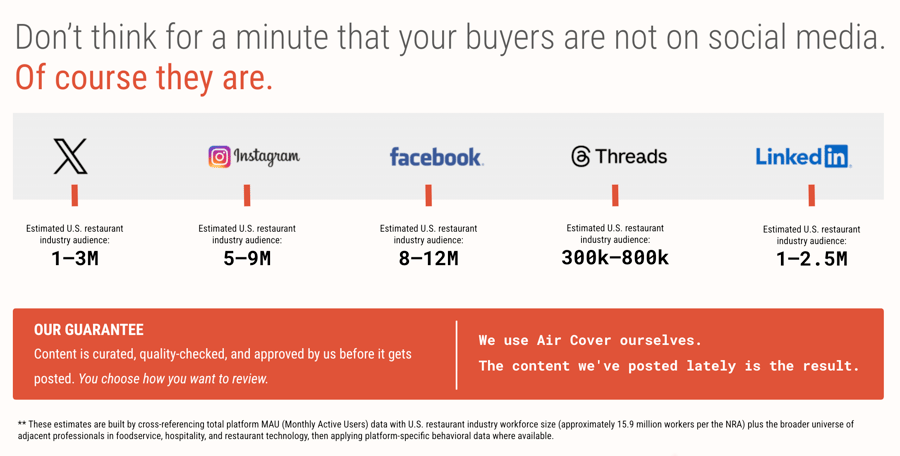
This is why we built Air Cover: an autonomous content engine made for restaurant technology brands. Every Monday, brands get all the content for the week, built to reach potential buyers and build trust. Every asset runs through multi-layer quality control and a human review before it reaches your feed.
It's not a scheduler. It's not a prompt you babysit. It's the volume engine marketing teams have never had the headcount to build themselves, paired with the story discipline that keeps volume from turning into noise.
If your team wants to build awareness but doesn't have the manpower, let's talk.
Make it Pop.