
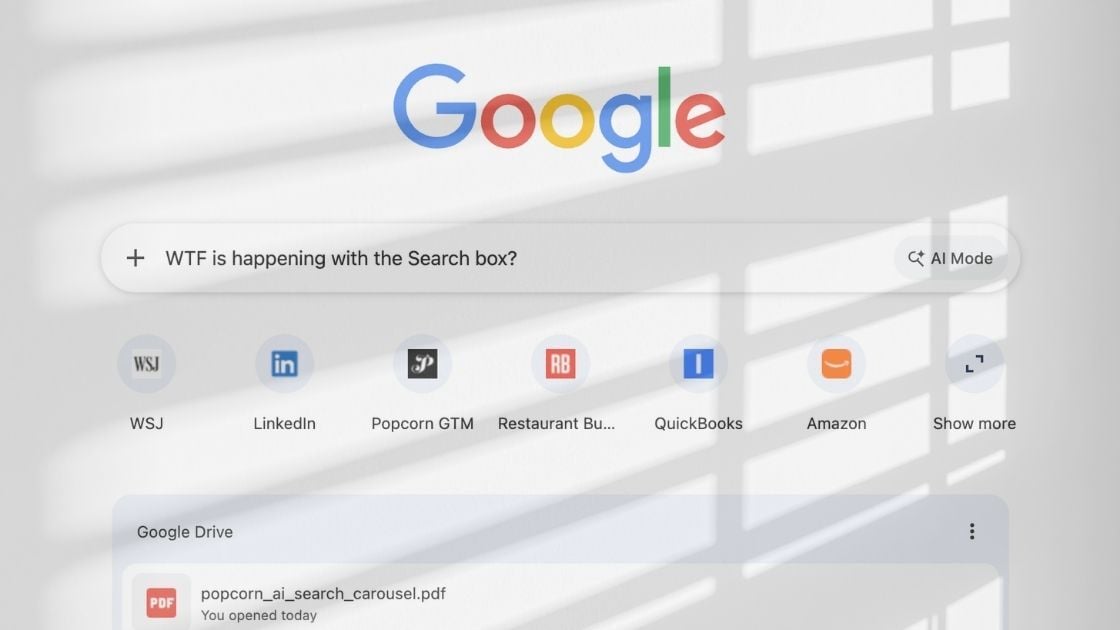
Not overnight. But every marketer I talk to is quietly rethinking what "discoverability" means once AI answers the question instead of sending anyone to a results page.
Here's the number that should stop you: 68% of Google searches in the U.S. now end without a click. When an AI Overview shows up, that number jumps to 83%. Google's own AI Mode, already at 75 to 100 million users, closes out 93% of sessions with zero clicks to an external site, ever.
68% of Google searches in the U.S. now end without a click. When an AI Overview shows up, that number jumps to 83%.
People haven't stopped searching. The results page is dying because the answer now arrives fully formed, with no reason to click through.
For restaurant tech buyers, that shift is already load-bearing. 94% of B2B buyers used AI somewhere in their last purchase process. Half of B2B software buyers now start their research in a chatbot instead of a search engine. 71% use AI tools specifically to research vendors. And this is the one that should reorder your marketing budget: 69% of buyers ended up choosing a different vendor than the one they walked in planning to buy, because of what the AI told them.
That's not a ranking shift. It's a shortlist problem, and the shortlist gets built before your sales team ever gets a call.
LLMs don't rank. They believe.
A search engine ranks pages. It's a popularity contest run on links, keywords, and click behavior: a system you could always reverse-engineer once you understood the inputs.
An LLM doesn't rank anything. It synthesizes an answer and decides, source by source, who's credible enough to cite. That's a different game with different rules, and most marketing teams are still playing the old one.
What actually earns a citation:
- Third-party corroboration. More than 85% of non-paid AI citations come from earned media, not brand-owned content. The model treats outside validation (G2, Capterra, trade press, an analyst report) as proof you're not just marketing yourself. Your own website telling people you're great counts for very little.
- Named authorship. A bylined article from a recognized expert is roughly 25% more likely to get cited than the same content published anonymously. The "who wrote this" question matters to a model in a way it never mattered to a search algorithm.
- Consensus across sources. When multiple independent outlets say the same thing about you, that repetition reads as trust. One glowing case study on your own blog doesn't move the needle the way five outside mentions do.
- Freshness and depth, depending on the engine. Perplexity deprioritizes anything older than 30 days. Claude favors the single most comprehensive source on a topic: the whitepaper or long-form guide that actually answers the question, not the landing page that gestures at it.
None of this is exotic. It's the discipline good PR and category-building marketers have always practiced: earned coverage, third-party proof, real expertise, published under a real name. The difference is that this discipline used to be a "nice to have" for brand. Now it's the mechanism your buyer's AI uses to decide whether you exist.
The trade event ends in three days. The citation compounds for months.
Here's the asymmetry your ROI model was never built to see.
A trade show has a shelf life. Follow up within 24 hours and your pipeline value is three times higher than if you wait a week. Miss that window and 94% of event leads never convert to an opportunity at all. The value of the event decays fast, from the moment the booth comes down. That's exactly why so much of a marketing budget goes toward squeezing ROI out of a three-day window before it evaporates.
A citation doesn't work that way. Once a piece of earned coverage, a comprehensive guide, or a strong third-party review gets pulled into an AI model's answer for "best restaurant inventory software" or "how to evaluate a POS vendor," it doesn't have a shelf life measured in days. It gets served again. And again. Every time a buyer asks that question, for as long as the source stays current and credible. With a B2B sales cycle that runs 6 to 18 months, that's a standing appointment with every future buyer who asks.
That's the return your event budget was never designed to capture, because nobody built a line item for "compounding citation value." We build budgets for immediate, attributable, closable-in-90-days ROI. Citations pay out on a different clock, and most marketing orgs don't have an owner for it.
What this means for restaurant tech specifically
Operators evaluating a new POS, kitchen display system, or inventory platform increasingly start that evaluation in ChatGPT or Perplexity, not Google. 85% of buyers say they think more highly of a vendor an AI chatbot recommends. One in three ends up buying from a company they'd never heard of before the AI mentioned it.
85% of buyers say they think more highly of a vendor an AI chatbot recommends.
If your brand isn't part of the graph an AI model pulls from (reviewed on G2 and Capterra, quoted in trade press, publishing bylined analysis under real operators' and real experts' names, showing up in more than one place saying the same true thing about what you do), you're not losing a ranking. You're not part of the conversation at all.
Popcorn's take
This isn't a call to abandon events, paid media, or a strong website. Discoverability used to be a search-engine problem. Now it's a trust-signal problem, and most GTM budgets haven't caught up.
The brands that win the next five years of restaurant tech won't be the ones who show up loudest at the trade show. They'll be the ones an AI model can vouch for, because enough credible, independent sources already have.
If you're rethinking what "discoverability" means for your GTM motion, that's exactly the conversation we're built to have at Popcorn. Let's talk.
Sources:
- SparkToro: In 2026, Less than One Third of Google Searches Still Send a Click
- Omnibound: AI SEO Statistics 2026
- G2 / PR Newswire: Half of B2B Software Buyers Now Start Their Research With AI Chatbots
- Machine Relations: 94% of B2B Buyers Use AI for Vendor Research
- TestimonialStar: 94% of B2B Buyers Use LLMs Before Contacting Sales
- Yext: How ChatGPT, Perplexity, Gemini, and Claude Actually Decide What to Cite
- AuthorityTech: AI Citation Trust Signals
- Momencio: Event Marketing ROI, Formulas, Benchmarks, B2B Guide