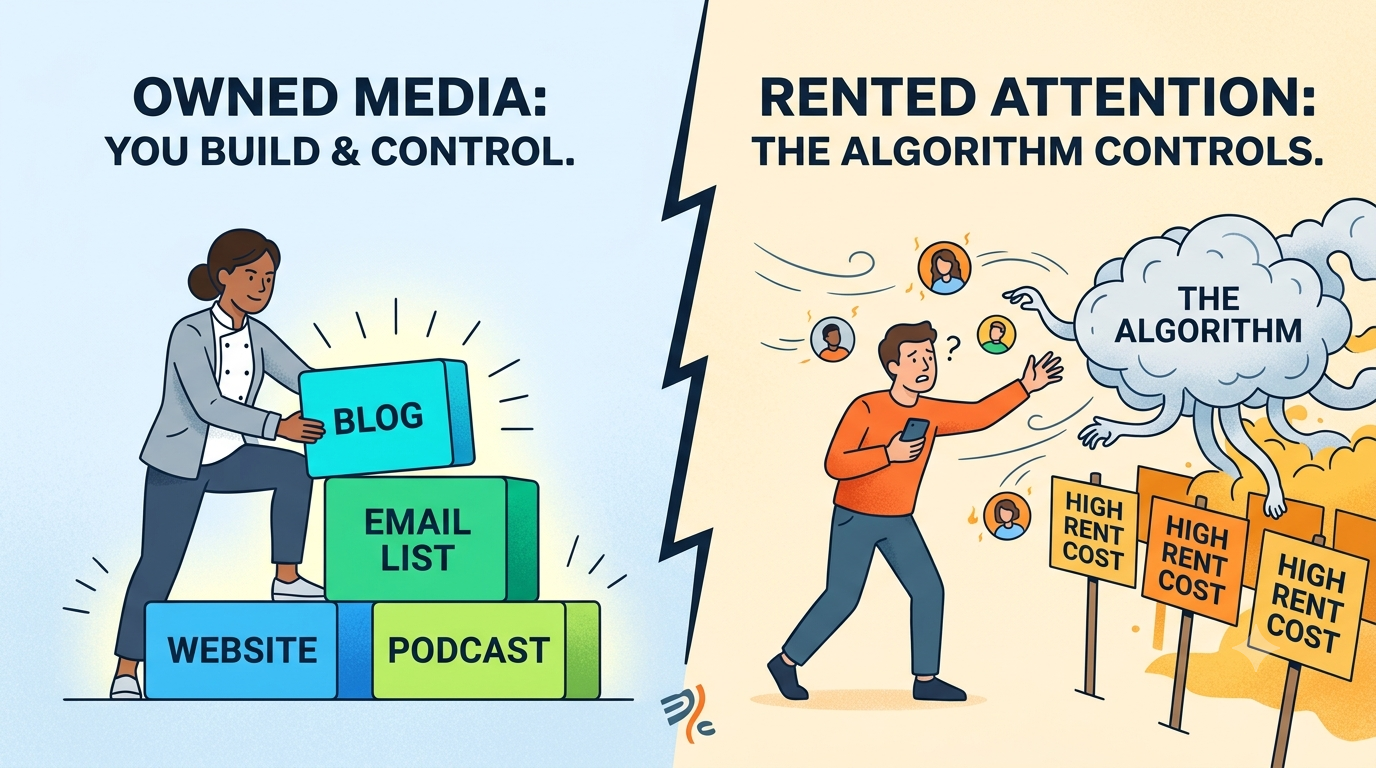
Owned media is any channel a brand controls outright. This includes blogs, emails, podcasts, and your website. Earned media is coverage others give you, and paid media is attention you rent by the impression.
The restaurant-tech brands that build owned media compound an audience they keep, while the ones leaning on social reach are renting attention from an algorithm that keeps raising the rent.
And that rented reach is collapsing. On most networks, a brand now reaches 1-2% of its own followers (which is crazy to think).
So what do you do instead? Build an owned media system that continues to compound and reach more people.
What counts as owned media?
Owned media is the set of channels you control end to end
-
The audience, the content, the distribution, and the data. Your blog, your newsletter, your podcast feed, and your website are owned. Nobody can throttle them, reprice them, or change the terms on you overnight.
Earned media is what other people say about you
-
A press mention, a repost, a guest spot on someone else's show. Paid media is reach you rent by the impression: ads, boosted posts, sponsorships. All 3 matter. Only 1 of them builds an asset you keep.
The thing that trips up restaurant-tech founders is treating a social following as owned. It isn't. A LinkedIn page, an Instagram account, and an X profile all sit on land you lease.
The platform sets the reach, rewrites the algorithm, and caps how many of your own followers ever see your post. When that share drops to 2%, there's no appeal and no refund.
Why is renting your audience a losing position?
The rent keeps climbing while the reach keeps dropping. Facebook organic reach for brand pages has fallen to 1-2%, down from 16% in 2012, per Hootsuite's tracking of organic reach. LinkedIn company-page posts now reach about 1.6% of their own followers, according to the Algorithm Insights 2025 analysis of 1.8 million posts, down from roughly 7% in 2021. Build a following of 10,000 and you get to speak to 160 of them.
That's the real tax on rented reach.
You did the work to earn the audience, then the platform installs itself between you and them and charges admission through ads. Every algorithm change is a rent increase you can't negotiate. A brand built entirely on someone else's platform is one policy update away from losing its distribution, and it never owned the customer relationship in the first place.
Why does owned media compound when rented reach doesn't?
Owned media reaches the same audience on your schedule with no auction in the middle, and consistency is the thing B2B buying rewards.
Only about 5% of B2B buyers are in the market to buy in any given quarter. The other 95% are out-of-market, per the Ehrenberg-Bass Institute and the LinkedIn B2B Institute. The restaurant-tech brand that shows up in the long stretch before an operator is ready to switch systems is the brand on the shortlist once they're ready.
Owned channels are how you stay present for that 95% without paying per impression every time. A weekly blog, a newsletter, and a founder posting on LinkedIn build familiarity week over week, and familiarity is what a busy operator converts into trust. Brand consistency correlates with a 23-33% revenue lift, a figure Paul unpacks in his pillar essay on why your buyers are already online. Paid reach resets to zero the day you stop spending. Owned reach carries forward.
What does owned media look like for a restaurant-tech brand?
It looks like a small stack of channels you control, feeding each other every week. A blog that answers the questions operators type into Google and ChatGPT. A newsletter that lands in an inbox you own, not a feed you rent. A podcast, the way Paul runs MSMR, which puts real operators and named systems on the record. A website that turns all of that attention into pipeline instead of letting it evaporate.
Distribution is where owned and rented meet in practice. Company pages barely reach anyone now, so the founder's personal profile carries the load, because personal profiles still get shown. The move is to publish on channels you own, then use the social account as a doorway back to them. Post the idea on LinkedIn, link the full argument on your blog, and pull the reader onto ground you control. The social platform becomes a distribution tool instead of the whole strategy.
How do you build owned media without a full content team?
You systematize it, because a 3-person content team isn't a realistic hire for most companies still in the early growth phase. A founder writing everything themselves burns 3-4 hours a week. That's not sustainable when things get busy. The path that holds is a repeatable engine: one source idea becomes a blog, a newsletter, and a week of channel-native social, all reviewed by someone who knows the category before it ships.
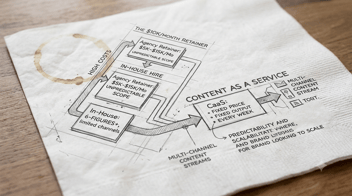
Owned media gets abandoned for a predictable reason. Founders rarely doubt that it works. They drop it because the weekly production load is real and the payoff compounds slowly. Solve the production problem and the compounding takes care of itself. Owned media only pays off if it gets made, every week, without your leadership becoming the bottleneck. For the model that makes weekly output sustainable, see how done-for-you content marketing works.
FAQ
What are owned, earned, and paid media?
-
Owned media is any channel you control fully, like your blog, newsletter, podcast, and website. Earned media is exposure others give you, such as press coverage or reposts. Paid media is reach you rent through ads and sponsorships, which stops the moment you stop paying. Owned is the only one of the 3 that builds an asset you keep.
Is a social media following owned media?
-
No. Your LinkedIn, Instagram, and X accounts live on platforms you don't control. Only a fraction of your followers see each post, and that share has dropped to 1-2% on most networks. A social following is rented reach, useful mainly as a doorway back to channels you own.
Why is owned media important for B2B and restaurant tech?
-
Because only about 5% of B2B buyers are in-market in any quarter, per the Ehrenberg-Bass Institute, so you need to stay present with the 95% who aren't ready yet. Owned channels reach that audience consistently without paying per impression, which is how a restaurant-tech brand earns a spot on the shortlist before an operator is ready to switch.
How do you start building owned media?
-
Start with one owned channel you can sustain weekly, usually a blog paired with an email list, then use social profiles to drive readers to it. The hard part is consistency, so build a repeatable production system before you build volume. One reviewed source idea a week, repurposed across channels, beats a burst you can't maintain.
Does owned media replace paid ads?
-
No, they do different jobs. Paid ads buy immediate reach and reset to zero when the budget ends. Owned media compounds an audience and a body of content that keep working over time. Most restaurant-tech brands are underweight on owned media, which is the one that builds a long-term pipeline rather than renting short-term attention.
Where Air Cover fits
Air Cover exists because the owned-media problem is (mostly) a production problem. You know you need to grow your reach, but the weekly load of creating blogs, newsletters, and social posts isn't always easy.
Air Cover is built specifically to solve that issue.
It drafts all your social assets every week plus blogs and newsletters, then experienced marketers review every piece before it ships.
Want to know whether an always-on content engine fits your brand? See how Air Cover works.