---
title: Your Buyers Are Online Right Now. Are You?
description: Discover how consistent, on-brand social content can transform restaurant tech companies, ensuring they engage online buyers effectively and boost revenue.
image: https://popcorngtm.com/hubfs/jumpers.png
---
[Skip to content](https://popcorngtm.com/blog/your-buyers-are-online-right-now.-are-you#main-content)


[](https://popcorngtm.com)


- [About Us](https://popcorngtm.com/about-us)
- [Marketing & GTM](https://popcorngtm.com/restaurant-technology-marketing)
Show submenu for Marketing & GTM
- [Fractional CMO](https://popcorngtm.com/fractional-cmo)
- [Marketing Playbooks](https://popcorngtm.com/restaurant-technology-marketing)
- [HubSpot CRM & Websites](https://popcorngtm.com/websites)
- [Franchise Intelligence](https://popcorngtm.com/frandata)
- Media Resources
Show submenu for Media Resources
- [Modern Solutions for Modern Restaurants™ Podcast](https://popcorngtm.com/podcasts)
- [Hot Takes on a Fresh Blog](https://popcorngtm.com/blog)
- [Restauromics Financial News](https://popcorngtm.com/restauromics)
- [Brand Archetype Primer](https://popcorngtm.com/brand-archetype-primer)
- [Air Cover](https://popcorngtm.com/aircover)
- [About Us](https://popcorngtm.com/about-us)
- [Marketing & GTM](https://popcorngtm.com/restaurant-technology-marketing)
Show submenu for Marketing & GTM
- [Fractional CMO](https://popcorngtm.com/fractional-cmo)
- [Marketing Playbooks](https://popcorngtm.com/restaurant-technology-marketing)
- [HubSpot CRM & Websites](https://popcorngtm.com/websites)
- [Franchise Intelligence](https://popcorngtm.com/frandata)
- Media Resources
Show submenu for Media Resources
- [Modern Solutions for Modern Restaurants™ Podcast](https://popcorngtm.com/podcasts)
- [Hot Takes on a Fresh Blog](https://popcorngtm.com/blog)
- [Restauromics Financial News](https://popcorngtm.com/restauromics)
- [Brand Archetype Primer](https://popcorngtm.com/brand-archetype-primer)
- [Air Cover](https://popcorngtm.com/aircover)
[BOOK TIME](https://popcorngtm.com/contact)
[Industry](https://popcorngtm.com/blog/tag/industry), [Marketing](https://popcorngtm.com/blog/tag/marketing)
# Your Buyers Are Online Right Now. Are You?
[By \- Popcorn GTM News,](https://popcorngtm.com/blog/author/popcorn-gtm-news) May 06, 2026

Here's what silence costs a restaurant tech company — and what consistent, on-brand social content actually does for the business.
There's a conversation happening right now in your market. Operators are asking questions. Investors are sizing up founders. Buyers are checking out vendors before they ever pick up the phone.
Most restaurant tech companies aren't in that conversation. Not because they don't have something worth saying, they do. They're out because showing up consistently on social takes time, creative bandwidth, and strategic discipline that most growth-stage teams simply don't have.
That's the gap [Air Cover](https://popcorngtm.com/aircover) was built to close.
But don't take our word for it. The data on what consistent, on-brand social content does for a B2B business is hard to argue with.
## The Problem With 95% of Buyers
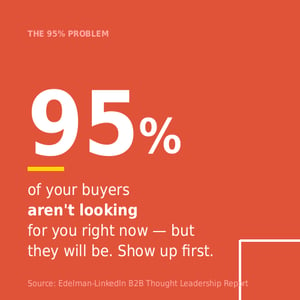Here's the stat that should stop you cold: at any given moment, a staggering 95% of your potential buyers are not actively seeking your product or service.[\[1\]](https://popcorngtm.com/blog/your-buyers-are-online-right-now.-are-you#r1) They're not in evaluation mode. They're not searching. They're just living their professional lives — scrolling, reading, absorbing content from vendors who show up in their feeds consistently.
When those buyers eventually enter buying mode — and they will — who do they call first? The brand they've been seeing for months. The one with the point of view. The one that made them think.
More than 75% of decision-makers said a compelling thought leadership piece prompted them to research a product or service they weren't originally considering.[\[2\]](https://popcorngtm.com/blog/your-buyers-are-online-right-now.-are-you#r2) That's not a vanity metric. That's pipeline you didn't know you had.
You can't generate that kind of inbound gravity with a quarterly blog post and a trade show booth. It requires a sustained drumbeat of social content — the kind that keeps your brand in the conversation even when buyers aren't actively looking.
## Showing Up Isn't Enough. Showing Up *As Yourself* Is.
Here's where most growth-stage restaurant tech companies get the social content problem only half right.
They know they need to post. They start posting. And then three months in, the feed is a mess — half of it sounds like a press release, some of it sounds like a trade show handout, and none of it sounds like the company the founder would actually describe in a room. The voice drifts. The message softens. The brand starts to blur.
That's not a cadence problem. That's a brand consistency problem. And it costs real money.
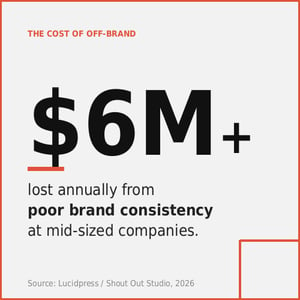52% of senior professionals at mid-sized and large businesses report that poor brand consistency costs their companies more than $6 million in lost revenue annually.[\[3\]](https://popcorngtm.com/blog/your-buyers-are-online-right-now.-are-you#r3)
That's not a rounding error. That's what happens when your LinkedIn post sounds like marketing, your Meta post sounds like a vendor, and your email sounds like a different company entirely.
###### The data on what consistency actually *buys* you is just as striking:
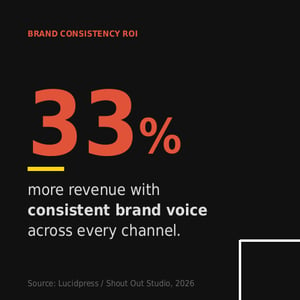
- Companies achieving brand consistency see 23–33% revenue increases, while inconsistent brands face higher media costs to achieve similar growth.[\[4\]](https://popcorngtm.com/blog/your-buyers-are-online-right-now.-are-you#r4)
- 68.3% of companies with documented brand consistency frameworks reported 10–20% revenue growth year-over-year, compared to just 29.1% among businesses operating without formal brand guidelines.[\[5\]](https://popcorngtm.com/blog/your-buyers-are-online-right-now.-are-you#r5)
- It takes 5 to 7 impressions for people to remember a brand — inconsistent voice means starting over each time.[\[6\]](https://popcorngtm.com/blog/your-buyers-are-online-right-now.-are-you#r6)
That last one hits different for restaurant tech companies. Your buyers are busy. They're seeing dozens of vendor touchpoints a week across trade publications, LinkedIn, and their inbox. The brands that break through aren't necessarily louder — they're more **recognizable**. They sound the same every time.
71% of businesses agree that inconsistent brand presentation leads to customer confusion[\[6\]](https://popcorngtm.com/blog/your-buyers-are-online-right-now.-are-you#r6) — yet it keeps happening because content creation is a team sport played without a playbook. A founder writes one post. A marketing contractor writes the next. An intern writes the one after that. By the time your buyer has seen all three, they don't know who you are.
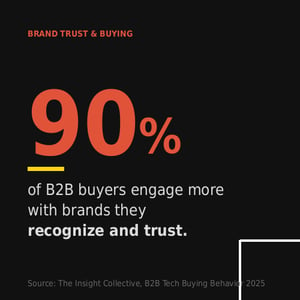
And here's the trust dimension that makes this even more consequential for B2B: 90% of B2B buyers either agree or strongly agree that they are more likely to engage with content from a brand or vendor they recognize and trust.[\[7\]](https://popcorngtm.com/blog/your-buyers-are-online-right-now.-are-you#r7) Brand voice is the mechanism that builds that recognition. Every post in your authentic voice is a deposit. Every off-brand piece of content is a withdrawal.
This is exactly what [Air Cover](https://popcorngtm.com/aircover) solves that a generic scheduling tool doesn't.
[Air Cover](https://popcorngtm.com/aircover) isn't just a content machine — it's a brand-voice engine. Posts are generated inside your defined tone, aligned to your positioning, and calibrated for the platform. Whether it's a punchy Meta post or a LinkedIn thought leadership take, your brand sounds like *you* — consistently, every time, without requiring a full-time content team to police every word.
95% of companies have brand guidelines, but only 25–30% actively enforce them[\[4\]](https://popcorngtm.com/blog/your-buyers-are-online-right-now.-are-you#r4) — because enforcement at the content creation level is hard. [Air Cover](https://popcorngtm.com/aircover) makes it automatic.
## Thought Leadership Isn't a Nice-to-Have
###### The Edelman-LinkedIn B2B Thought Leadership Impact Report has been tracking this for years. The 2024 findings are worth sitting with:
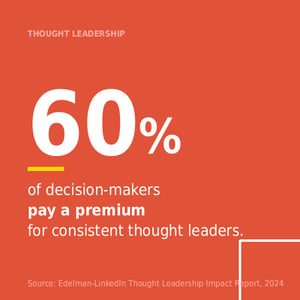
- 60% of decision-makers are willing to pay a premium to work with companies that demonstrate strong thought leadership.[\[8\]](https://popcorngtm.com/blog/your-buyers-are-online-right-now.-are-you#r8)
- 53% of buyers say thought leadership has directly influenced a purchasing decision.\[8\]
- 95% of hidden decision-makers say thought leadership makes them more open to sales outreach.[\[8\]](https://popcorngtm.com/blog/your-buyers-are-online-right-now.-are-you#r8)
That last one deserves a second read. The people who are already watching from the sidelines — the ones you can't get on a call — become receptive to your sales team when they've seen your content. Thought leadership doesn't just build brand awareness. It softens the room before your reps walk in.
Roughly 60% of decision-makers said good thought leadership content makes them more willing to pay a premium to a supplier.[\[2\]](https://popcorngtm.com/blog/your-buyers-are-online-right-now.-are-you#r2) In a market where restaurant tech vendors are competing on features and price, the brand that publishes a point of view creates pricing power that pure product differentiation can't buy.
## Social Is Where B2B Buyers Actually Live
The playbook for reaching restaurant tech buyers isn't that complicated — it just requires showing up in the right places with the right content, consistently.
58% of consumers report discovering new businesses via social media, outperforming traditional search and even TV in brand discovery.[\[9\]](https://popcorngtm.com/blog/your-buyers-are-online-right-now.-are-you#r9) Social isn't awareness-only anymore. It's where buyers find vendors.
83% of marketers say that social media has become their primary customer acquisition channel, with brands allocating more than 20% of their marketing budget to social reporting a 33% higher ROI compared to those investing less.[\[9\]](https://popcorngtm.com/blog/your-buyers-are-online-right-now.-are-you#r9)
And for B2B specifically: 62% of B2B marketers report LinkedIn delivers leads at twice the rate of other platforms.[\[10\]](https://popcorngtm.com/blog/your-buyers-are-online-right-now.-are-you#r10) Meta — where [Air Cover](https://popcorngtm.com/aircover) also operates — drives discovery, retargeting, and top-of-funnel awareness with a reach that LinkedIn can't match on its own.
The brands winning on social aren't publishing more. They're publishing smarter — consistently, on-brand, and tied to a clear market thesis.
## The Consistency Problem Is a Bandwidth Problem
Here's what we hear from restaurant tech founders and marketing leads: *we know we should be posting. We don't have time to do it well. So we don't do it at all.*
Social marketers who consistently post creative content are more likely to say they have a 'very positive' impact on the business than those who post creative content less frequently.[\[11\]](https://popcorngtm.com/blog/your-buyers-are-online-right-now.-are-you#r11)
The problem isn't belief in social content. The problem is execution. A sole-contributor marketing team at a Series A restaurant tech company is already managing the website, the trade show calendar, the sales deck, the email nurture sequence, and whatever their CEO just asked for this morning. Social content falls off the list — not because it's low priority, but because it's hard to do consistently without dedicated infrastructure.
67% of thought leaders plan to cut through the noise by leveraging AI for research and analysis.[\[12\]](https://popcorngtm.com/blog/your-buyers-are-online-right-now.-are-you#r12) The companies already using AI to systematize content production aren't doing it because it's trendy. They're doing it because it works — and because the alternative is silence.
[Air Cover](https://popcorngtm.com/aircover) is built for exactly this problem. It's not a scheduling tool. It's a social content engine — trained on your brand voice, dialed into the restaurant tech conversation, and designed to turn a brief into a post that actually sounds like you.
## What Consistent Social Content Actually Builds
**Short-term, it builds visibility.** You start showing up in feeds. People start recognizing the brand.
**Medium-term, it builds credibility.** 55% of decision-makers use thought leadership as part of their vetting process.[\[13\]](https://popcorngtm.com/blog/your-buyers-are-online-right-now.-are-you#r13) When a buyer is deciding which vendors to put on a shortlist, they're looking at your LinkedIn presence, your content, your POV. A thin social footprint is a trust signal — just not the kind you want.
**Long-term, it builds the category conversation.** The restaurant tech brands that own their category don't just have better products — they have better stories, told more consistently, in more places. Air Cover is the engine that makes that possible without burning out your team.
## The Bottom Line
Your buyers are online. Your competitors are posting. Your brand needs air cover — not because social is a checkbox, but because the data is clear: consistent, on-brand thought leadership opens doors, shortens sales cycles, and creates pricing power that feature sheets never will.
The difference between a post that moves the needle and a post that gets lost in the feed isn't just frequency. It's voice. It's recognition. It's a buyer seeing your content on Tuesday, again on Thursday, and thinking *these people know what they're talking about* — and that it always sounds like the same brand.
The question isn't whether restaurant tech companies need a consistent social presence. That debate is over.
The question is whether yours will sound like you.
Air Cover by Popcorn GTM
###### 
###### Ready to Sound Like Yourself?
Air Cover is the AI-powered social content engine built for restaurant technology brands that need to show up — consistently, on-brand, and without the overhead. Waitlist now open. [Join the Waitlist →](https://popcorngtm.com/aircover)
---
###### Article Research & Sources:
01 Edelman-LinkedIn B2B Thought Leadership Impact Report (2024) — The 95:5 rule and buyer readiness [edelman.com/expertise/Business-Marketing/2024-b2b-thought-leadership-report](https://www.edelman.com/expertise/Business-Marketing/2024-b2b-thought-leadership-report)
02 Column Content — 2026 Thought Leadership Statistics and Trends (citing 2024 Edelman-LinkedIn data) [columncontent.com/thought-leadership-statistics](https://columncontent.com/thought-leadership-statistics/)
03 Shout Out Studio — Brand Consistency Is Worth 33% More Revenue (Lucidpress data) [shoutoutstudio.com/brand-consistency-is-worth-33](https://www.shoutoutstudio.com/brand-consistency-is-worth-33/)
04 Envive.ai — 40 Brand Voice Consistency Statistics in eCommerce (2026) [envive.ai/post/brand-voice-consistency-statistics-in-ecommerce](https://www.envive.ai/post/brand-voice-consistency-statistics-in-ecommerce)
05 Amra & Elma — Top 20 Brand Consistency ROI Statistics 2026 (citing Forrester Research) [amraandelma.com/brand-consistency-roi-statistics](https://www.amraandelma.com/brand-consistency-roi-statistics/)
06 Vista Social — Brand Voice Guidelines: Why Consistency Matters [vistasocial.com/insights/brand-voice-guidelines-examples](https://vistasocial.com/insights/brand-voice-guidelines-examples/)
07 The Insight Collective — B2B Tech Buying Behavior 2025: 120+ Key Insights & Trends [theinsightcollective.com/insights/b2b-tech-buyer-behavior-stats](https://www.theinsightcollective.com/insights/b2b-tech-buyer-behavior-stats)
08 DSMN8 — 18 Thought Leadership Statistics You Should Know (citing Edelman-LinkedIn 2024 & 2025) [dsmn8.com/blog/thought-leadership-statistics-you-should-know](https://dsmn8.com/blog/thought-leadership-statistics-you-should-know/)
09 Sprinklr — Key Social Media Marketing Statistics for 2025 [sprinklr.com/blog/social-media-marketing-statistics](https://www.sprinklr.com/blog/social-media-marketing-statistics/)
10 SeoProfy — Top 74 B2B Marketing Statistics 2025–2026 [seoprofy.com/blog/b2b-marketing-statistics](https://seoprofy.com/blog/b2b-marketing-statistics/)
11 Hootsuite — Social Media Trends 2025 [hootsuite.com/research/social-trends](https://www.hootsuite.com/research/social-trends)
12 Thinkers360 — 2025 B2B Thought Leadership Outlook Report [thinkers360.com/2025-b2b-thought-leadership-outlook-report](https://www.thinkers360.com/2025-b2b-thought-leadership-outlook-report/)
13 DSMN8 — 26 B2B Social Media Statistics You Need to Know (citing Edelman x LinkedIn 2025) [dsmn8.com/blog/b2b-social-media-statistics](https://dsmn8.com/blog/b2b-social-media-statistics/)
14 Sprout Social — Social Media ROI Statistics for 2025 [sproutsocial.com/insights/social-media-marketing-roi-statistics](https://sproutsocial.com/insights/social-media-marketing-roi-statistics/)
15 HubSpot — 2026 Marketing Statistics, Trends & Data [hubspot.com/marketing-statistics](https://www.hubspot.com/marketing-statistics)
16 Sprinklr — Brand Voice Strategy: How to Build Brand Guidelines [sprinklr.com/blog/brand-voice](https://www.sprinklr.com/blog/brand-voice/)
###### Category
- [Industry](https://popcorngtm.com/blog/tag/industry)
- [Marketing](https://popcorngtm.com/blog/tag/marketing)
- [Hot Takes](https://popcorngtm.com/blog/tag/hot-takes)
- [GTM](https://popcorngtm.com/blog/tag/gtm)
- [Artificial Intelligence](https://popcorngtm.com/blog/tag/artificial-intelligence)
- [Podcast](https://popcorngtm.com/blog/tag/podcast)
- [News](https://popcorngtm.com/blog/tag/news)
- [Systems](https://popcorngtm.com/blog/tag/systems)
- [Web 3](https://popcorngtm.com/blog/tag/web-3)
- [Online Ordering](https://popcorngtm.com/blog/tag/online-ordering)
- [Search](https://popcorngtm.com/blog/tag/search)
### Similar Blogs
#### [Why Most Restaurant-Tech Marketing Copy Falls Flat](https://popcorngtm.com/blog/why-restaurant-tech-marketing-copy-falls-flat)
By [Jared Castronova](https://popcorngtm.com/blog/author/jared-castronova) 28 June 2026
Most restaurant-tech marketing copy falls flat for one reason: it's written for the one person who...
[READ MORE](https://popcorngtm.com/blog/why-restaurant-tech-marketing-copy-falls-flat)
#### [How to Market a Restaurant-Tech Company When Operators Don't Read Marketing](https://popcorngtm.com/blog/how-to-market-restaurant-tech-when-operators-dont-read)
By [Jared Castronova](https://popcorngtm.com/blog/author/jared-castronova) 8 July 2026
This probably won’t come as a surprise, but most restaurant operators don't have time to read much...
[READ MORE](https://popcorngtm.com/blog/how-to-market-restaurant-tech-when-operators-dont-read)

#### [AI Content vs. Human: What the 2026 Data Says About Trust and Rankings](https://popcorngtm.com/blog/ai-content-vs-human-2026-data)
By [Jared Castronova](https://popcorngtm.com/blog/author/jared-castronova) 30 June 2026
The 2026 data is consistent across rankings, citations, engagement, and trust: human and...
[READ MORE](https://popcorngtm.com/blog/ai-content-vs-human-2026-data)
[](https://popcorngtm.com)
Show Up. Every Week. Make it Pop.
---
- THE MENU
- [- Fractional CMO](https://popcorngtm.com/fractional-cmo)
- [- Marketing Playbooks](https://popcorngtm.com/restaurant-technology-marketing)
- [- Air Cover Content Marketing Engine](https://popcorngtm.com/aircover)
- [- Tech Enablement Services](https://popcorngtm.com/tech-enablement)
- [- Hot Takes, Fresh Blog](https://popcorngtm.com/blog)
- [- Restauromics Financial News](https://popcorngtm.com/restauromics)
- [- Book Time](https://popcorngtm.com/contact)
[](https://popcorngtm.com/podcasts)
COPYRIGHT © 2026 POPCORN MARKETING GROUP, LLC | POPCORN GTM IS A REGISTERED TRADEMARK, ALL RIGHTS RESERVED.
[DATA PRIVACY |](https://popcorngtm.com/privacy-policy) [TERMS & CONDITIONS](https://popcorngtm.com/privacy-policy)
```json
{
"@context" : "https://schema.org",
"@type" : "BlogPosting",
"author" : {
"@type" : "Person",
"name" : "Popcorn GTM News",
"url" : "https://popcorngtm.com/blog/author/popcorn-gtm-news"
},
"dateModified" : "2026-05-08T21:15:27.568Z",
"datePublished" : "2026-05-06T05:00:00.000Z",
"headline" : "Your Buyers Are Online Right Now. Are You?",
"image" : [ "https://popcorngtm.com/hubfs/jumpers.png" ],
"mainEntityOfPage" : {
"@id" : "https://popcorngtm.com/blog/your-buyers-are-online-right-now.-are-you",
"@type" : "WebPage"
},
"publisher" : {
"@type" : "Organization",
"logo" : {
"@type" : "ImageObject",
"url" : "https://popcorngtm.com/hubfs/Popcorn%20GTM%20LOGO%202026.png"
},
"name" : "Popcorn GTM "
}
}
```