
A restaurant-tech buyer opens ChatGPT, types "best KDS for a 40-unit fast casual with Toast," and reads a three-name shortlist before they've touched a single vendor site. If your company isn't in that answer, you're not just losing the deal, you're not in it.
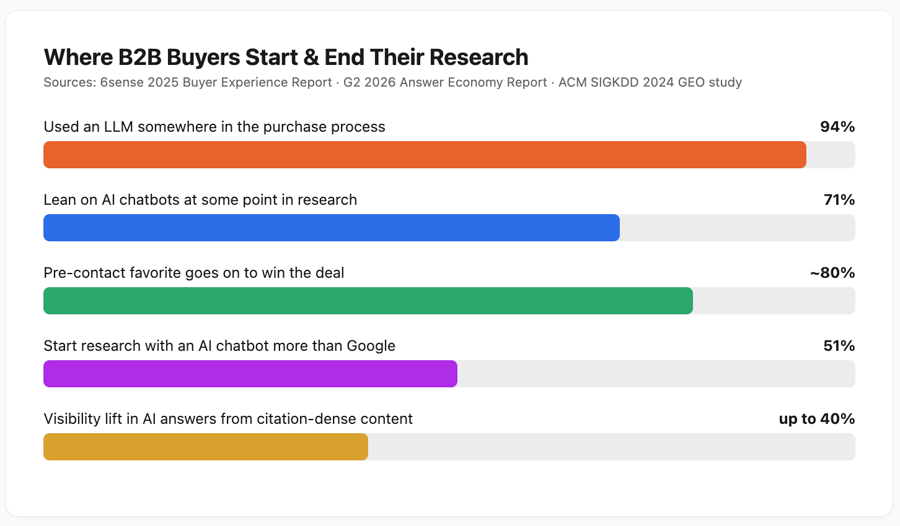
The consideration set now forms inside a language model, built from published specifics, months before a rep ever hears the buyer's name. 94% of B2B buyers used an LLM somewhere in their purchase process, per 6sense's 2025 Buyer Experience Report. Brands without citable, fact-dense content live aren't in a weak position for that shortlist. They're structurally absent from it.
If an AI model built a shortlist for my category today, would I show up?
Probably not, if your site is a feature list and a pile of vibes. A model assembling a restaurant-tech shortlist pulls names it can attach to concrete claims: what the product does, what it costs, what it integrates with, who uses it. Pages that state those things by name get quoted. Pages that say "purpose-built for modern operators" get skipped, because there's nothing in them a model can repeat with confidence.
This matters more than a missed ranking because of when the shortlist forms. The average B2B buying cycle ran 10.1 months in 2025, down from 11.3 the year before. That's the better part of a year during which a model forms, reinforces, and hardens a shortlist off whatever it can read. And the buyer's pre-contact favorite wins the deal roughly 80% of the time. The favorite gets chosen in a room your sales team never enters.
The status quo here looks like a healthy funnel with a quiet leak at the top. The reframe: you're not being outsold in the demo, you're being left off the list before the demo exists.
What is an AI model actually reading when it decides who to recommend?
It's reading the specifics, and it ignores the adjectives. Peer-reviewed work on generative engines settles what most SEO advice guesses at. In the GEO study presented at ACM SIGKDD 2024, content revised to add citations, direct quotations, and statistics raised its visibility in AI-generated answers by up to 40%. The model rewards pages that give it something quotable and checkable.
For a restaurant-tech brand, that translates into a short list of artifacts worth more than a redesigned homepage:
- Pricing detail. A stated range, a per-location number, a tier structure. "Contact us for pricing" is a dead end a model can't cite.
- Integration specifics named. Which POS, which payroll system, which loyalty stack, by name. This is what a buyer's query contains, so it's what the model matches against.
- Named comparisons. How your approach differs from the common alternative, described concretely enough to quote.
- Dated proof. A benchmark, a result, a customer named with a year attached. Recency and attribution both raise trust.
Generic copy is invisible to a model for the same reason it's invisible to a buyer on your site. We wrote about the flood of unattributed, machine-made filler in AI slop is killing brand trust, and the fix for slop is the same fix for citability: specifics a human and a model can both verify.
Why can't my SEO agency "do AI SEO" too?
Because getting cited by a model and ranking on Google reward different things, and most SEO playbooks optimize for the wrong one. Google ranks a page and sends a click. A model reads dozens of sources, extracts the facts it trusts, and synthesizes one answer with a handful of names in it. There's no page 2 to climb onto. You're either in the synthesized answer or you don't exist in that conversation.
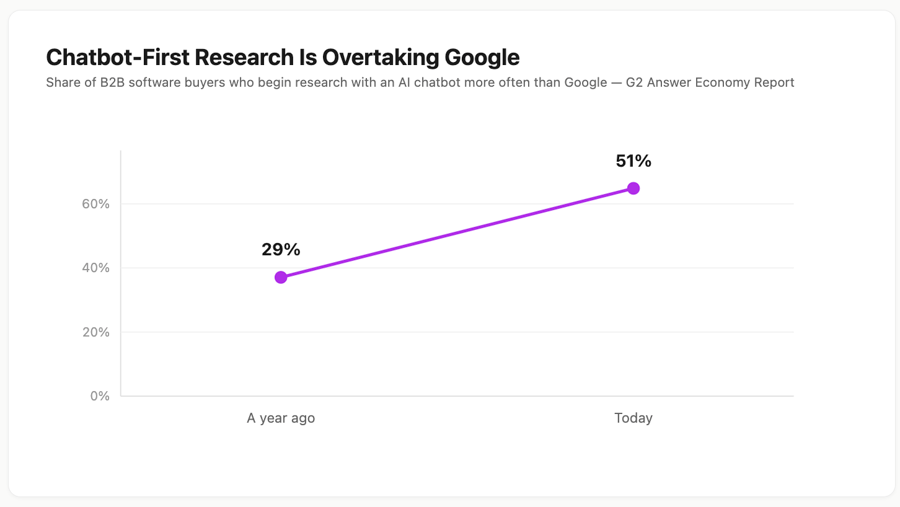
And the conversation is now where buyers start. 51% of B2B software buyers begin research with an AI chatbot more often than Google, per G2's 2026 Answer Economy report, up from 29% a year earlier. This isn't a top-of-funnel-only shift either. 71% of B2B software buyers lean on AI chatbots at some point in their research. A brand a model can't cite is missing at every stage, not just the first search.
The old keyword tactics still matter for the pages that survive to a click. The new work is publishing content dense enough with facts that a model will repeat it. That's a content problem before it's a technical one, which is why "add AI SEO to the retainer" usually produces more thin pages, not more citations. We laid out the economics of that shift in content as a service, the model replacing the $10K/month retainer.
What should a restaurant-tech brand publish first this month?
Publish the pages that answer the exact question your buyer types into the chatbot, with named specifics on every line. Start with the comparison and integration content, because that's what a restaurant-tech query actually contains: a POS, a unit count, a use case, a competitor.
Here's the order that gets you cited fastest.
|
Publish this |
Why a model pulls it |
Buyer query it matches |
|
Integration pages named by system |
Matches the exact tools in the query |
"works with [POS]" |
|
A pricing page with real ranges |
Citable, checkable, quotable |
"how much does [category] cost" |
|
Named comparison content |
Gives the model a distinction to repeat |
"[you] vs the alternative" |
|
Dated customer proof |
Recency plus attribution raise trust |
"who uses [category] and what happened" |
This content also does double duty as owned media you control forever. A model can cite a page you own. It can't cite the reach you rented on someone else's channel. We made that case in why restaurant-tech brands can't rent their audience, and it holds harder now that the search box itself is someone else's product.
The instinct to keep pricing and comparisons vague to "keep buyers talking to sales" is exactly backward. The reframe: vagueness doesn't route the buyer to your rep, it routes the model to a competitor who published the number.
FAQ
How do I know if I'm already losing deals to this without any data telling me so?
-
Run your own top three buyer queries through ChatGPT and Gemini and see whose names come back. If you're not in the answer, that's your data. The signal in your CRM shows up as longer, more opaque cycles and prospects arriving with a favorite already picked, which matches the 10.1-month average and the roughly 80% pre-contact-favorite win rate 6sense reported.
Since cycles run months, have I already missed my window?
-
No, because a shortlist that forms over 10 months also re-forms over 10 months as new content gets published and indexed. The vendors sitting in today's answers earned it by being citable first. Publishing dense, dated content now puts you in the next round of shortlists, which are being assembled right now for deals that close in 2027.
Does this replace my Google SEO work?
-
No. It sits alongside it. Ranking still matters for the buyer who clicks through, and citable content tends to rank well anyway. The new requirement is that your pages carry enough named facts for a model to quote, not just enough keywords to rank.
Isn't AI-generated content the fast way to produce all this?
-
Only if it's specific and verified. Generic AI filler is the exact thing models learn to distrust and buyers learn to ignore. The GEO research is clear that citations, quotes, and statistics drive visibility, and those don't come from a thin prompt.
Where Air Cover fits
The shortlist forms whether or not you feed it, so the question is whether you're publishing enough citable content every week to be in the answer when it’s created. Air Cover is Popcorn's done-for-you content engine built to get your brand out into the market and turn awareness into pipeline.
Want to see how it works? Book some time to learn more.