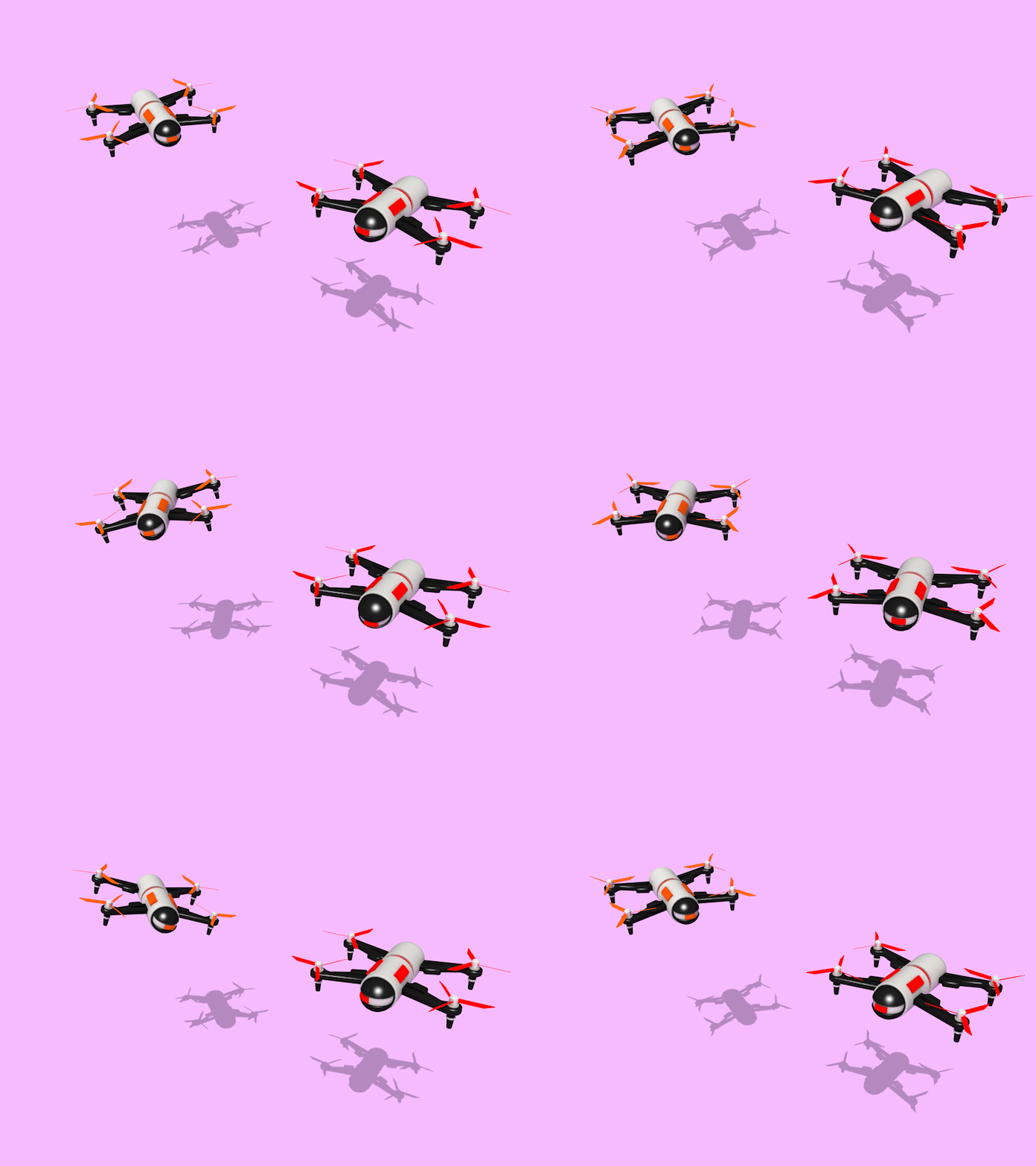
Jeff Bezos promised in 2015 that delivery drones would be as common as mail trucks. A decade later, they're buzzing over a handful of Dallas suburbs, dropping off Wendy's orders at 150 deliveries a day from a hub approved for 1,000. That gap — between promise and performance — is exactly what this episode of MSMR is about.
Drone delivery is happening. DoorDash, Uber Eats, and Grubhub are all in. Chipotle, Wendy's, Panera, and Papa John's have signed on. But the question the industry isn't asking loudly enough is: Is this actually good for restaurant operators? Or is it just another expensive intermediary dressed up in rotors?
If drone delivery costs more than the 25–30% take rate operators are already bleeding to DoorDash and Uber Eats, this is a novelty act. Full stop.
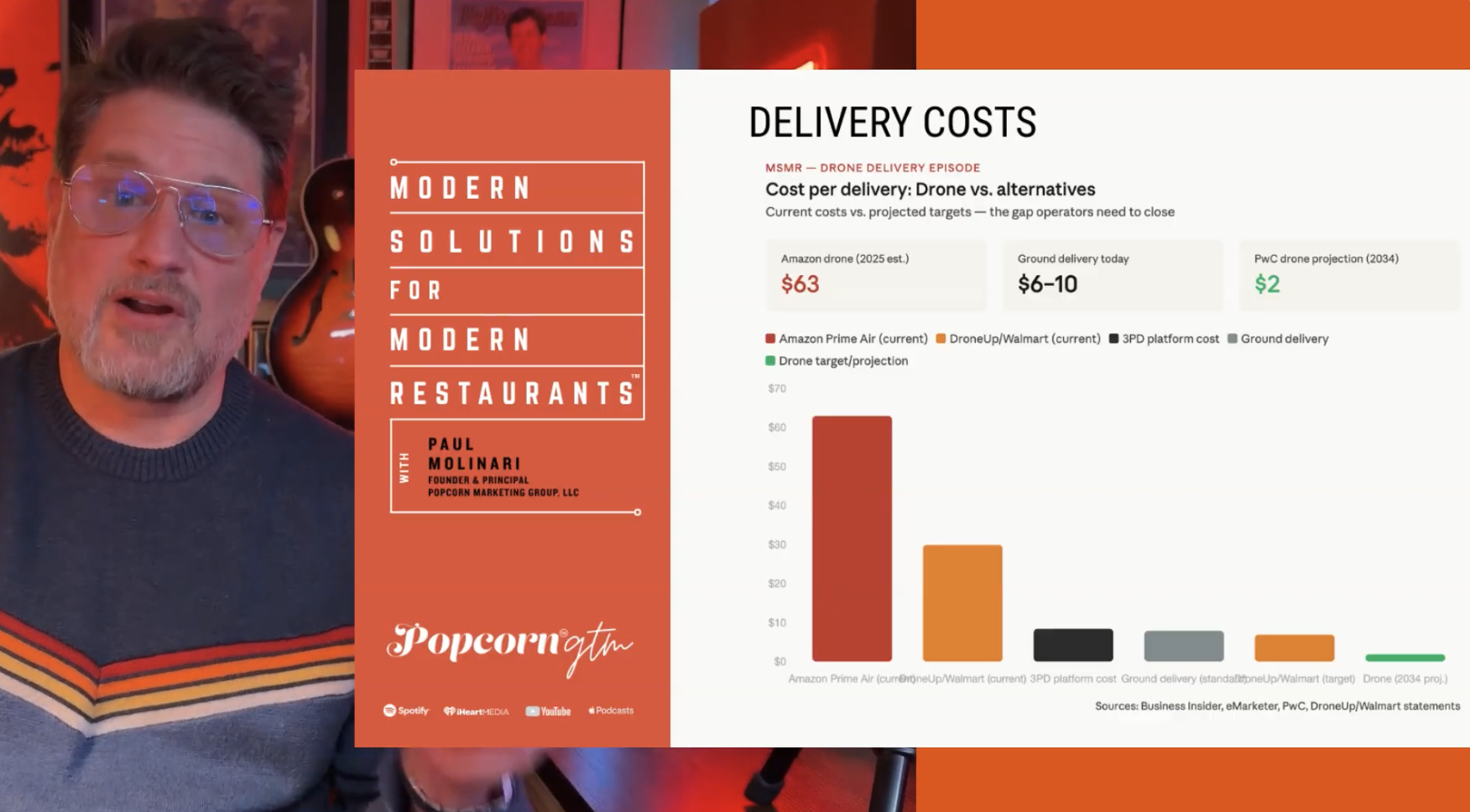
This post is the companion piece to the MSMR episode. I'm going to walk through the economics, the consumer reality, the regulatory landscape, the geographic ceiling, and the uncomfortable truth about who this technology actually serves right now.
🎙️ Prefer to listen? This topic is covered in full on the Modern Solutions for Modern Restaurants podcast — including research callouts, production cues, and segment-by-segment breakdowns for restaurant tech leaders.
The Report Card: Who's Flying, Where, and With What
Let's orient ourselves. Four companies hold FAA Part 135 and BVLOS certification in the U.S. — meaning they can operate autonomously beyond the pilot's line of sight, which is the prerequisite for scalable commercial delivery. Here's how the competitive field breaks down:
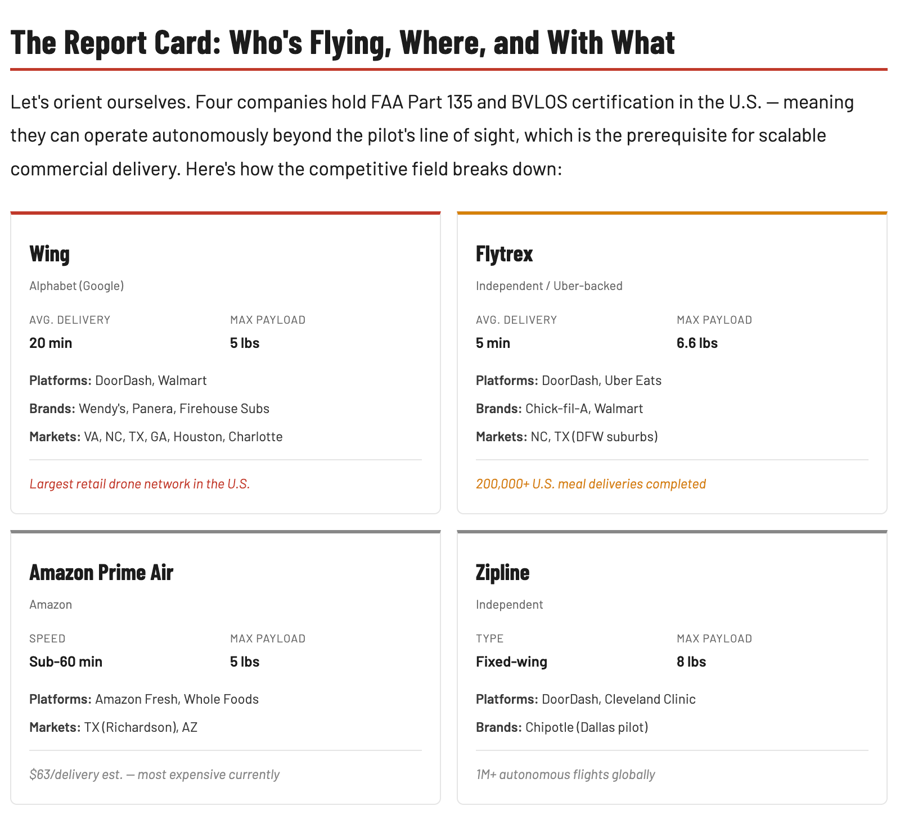
Notice something? Almost every active commercial market is in Texas. Suburban Texas, specifically. That's not a coincidence — we'll get to the geographic ceiling shortly. But first, the math.
The Math Doesn't Lie (Yet)
If you're a restaurant operator, you already feel the third-party delivery math in your gut. DoorDash, Uber Eats, Grubhub take 15 to 30 percent of every order. On a $15 meal, you might net $9 after fees. Add labor, food cost, and packaging, and you're delivering losses with extra steps. Now here comes drone delivery. The promise: cheaper, faster, better. The reality: complicated.
The Cost Chasm
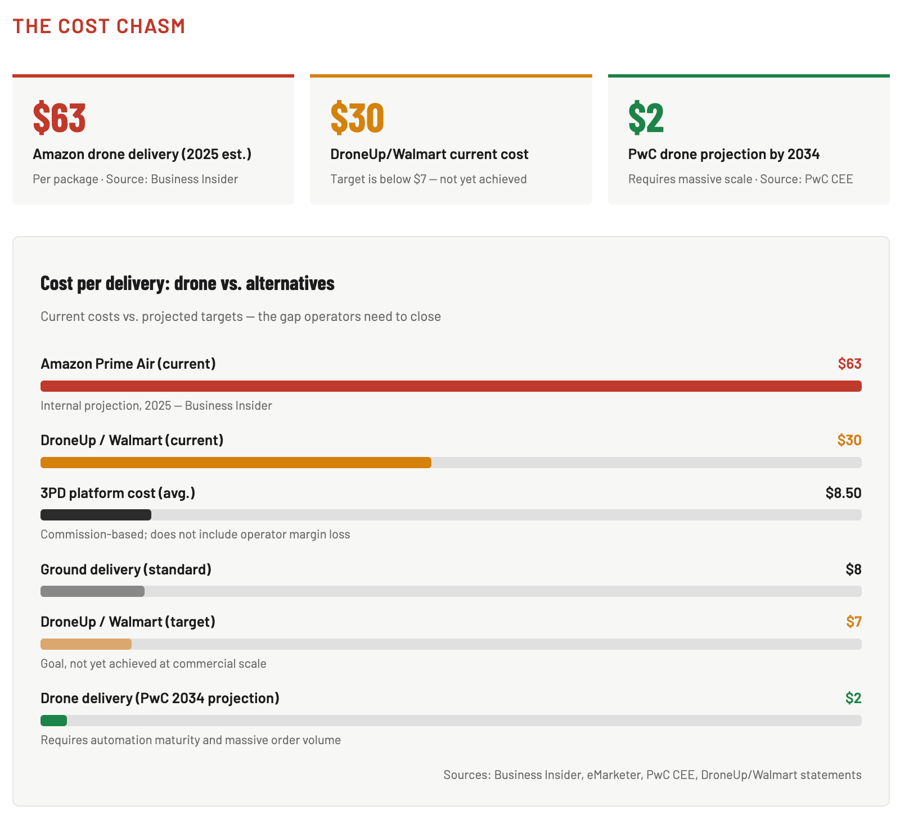
Let that breathe for a second. Amazon is spending $63 to deliver a package that might be a bag of french fries. The entire premise of drone delivery for restaurants depends on collapsing that number by 90 percent. Can it happen? PwC says yes, by 2034. But getting from $63 to $2 requires scale that doesn't exist yet — and in the meantime, somebody's footing the bill.
The One Consumer-Friendly Angle
Here's the economics argument the industry loves to promote: drone deliveries eliminate tipping. No driver, no tip. If a Wendy's order on Wing costs $2 in delivery fees with no tip versus $8 on DoorDash with a $3 tip, the checkout math flips for the consumer. That's real. But the critical question for operators: who captures that savings? If platforms absorb it into their fee structure, operators see nothing.
Tailwinds and Headwinds: The Regulatory Story
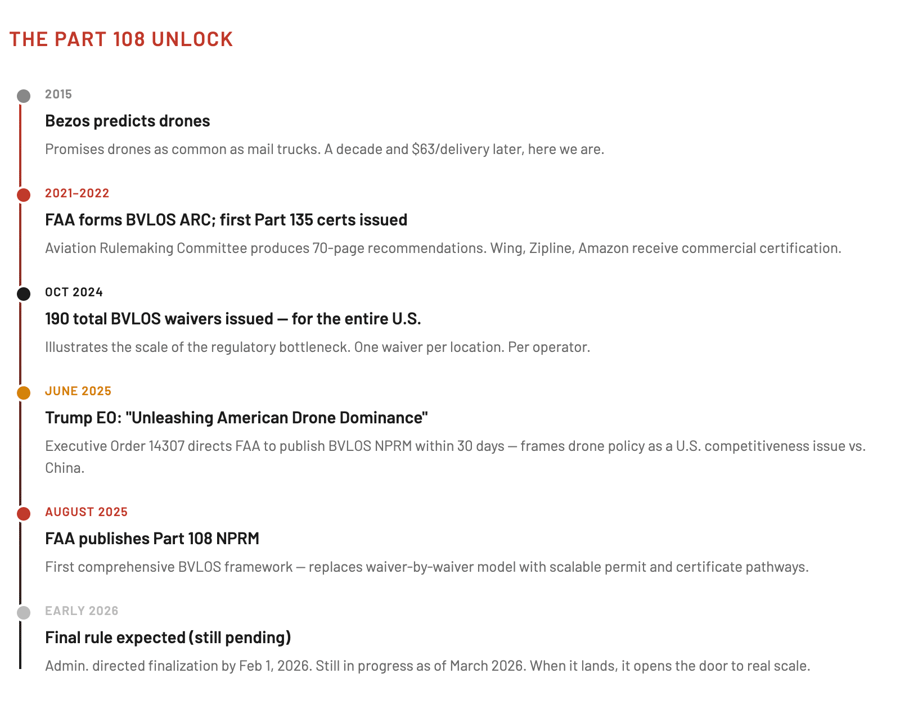
The regulatory story in 2025–2026 is arguably the most significant development in drone delivery's history. Before this year, every operator needed an individual FAA waiver for every location. There were exactly 190 total BVLOS waivers issued through October 2024. For the entire country. That's the bottleneck in one number.
Part 108 NPRM Unlocks Access
The Geography Problem
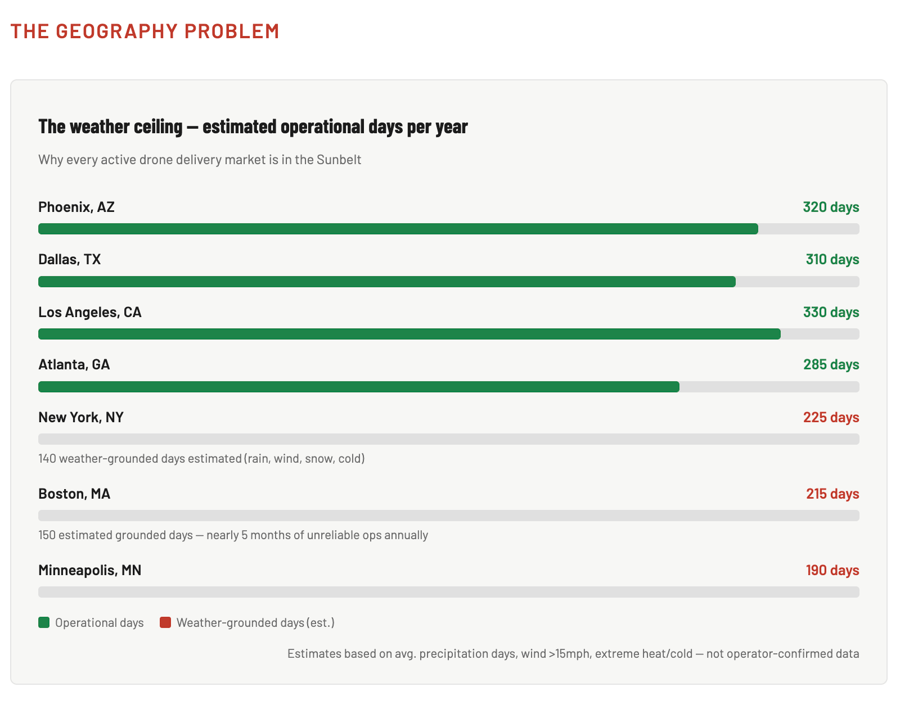
Current drones are grounded by: temperatures above 104°F (Amazon's fleet), sustained winds over 15–20 mph, rain, and snow/ice. Boston, Chicago, Minneapolis, Seattle — these are massive restaurant markets that would have an operational calendar roughly equivalent to a seasonal ice cream stand for a significant portion of the year.
The Richardson, TX Wake-Up Call
This story broke in March 2026 and it's a preview of what's coming nationally. Amazon's drone hub in Richardson, Texas is generating noise complaints. The drones operate from 7 a.m. to 10 p.m., and residents near the fulfillment site report hearing them multiple times per hour. The city council has demanded an updated noise study, alternative routes, and stronger privacy protections — and wielded the threat of blocking the program entirely as their leverage against Amazon.
The Richardson case illustrates a dynamic that will repeat in every market: tech-friendly suburban locations that look ideal on paper become battlegrounds once the buzz becomes daily ambient noise.
Consumer Court: Who Actually Wants This?
Consumer acceptance of drone delivery isn't monolithic. It's layered, regional, and deeply influenced by whether the person answering the survey is the one getting the burrito or the one watching a drone hover over their backyard.
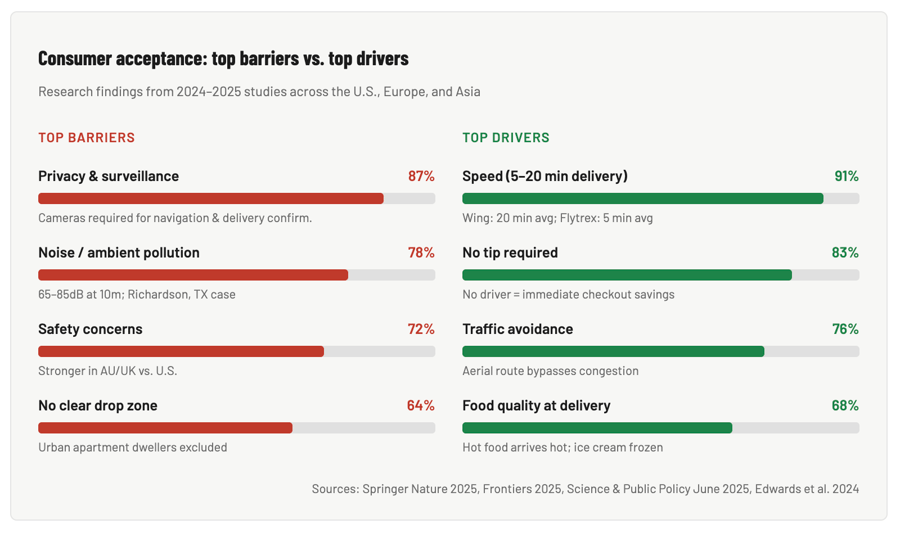 The consumer segments most enthusiastic about drone delivery: suburban homeowners with backyards, rural and semi-rural consumers underserved by traditional last-mile delivery, and tech-forward early adopters. The least interested: urban apartment dwellers with no drop zone, privacy-conscious consumers, and anyone in a market where weather grounds the fleet for months at a time.
The Verdict
Drone delivery is real. The technology works. The regulatory runway is opening. The major platforms are all in. But for restaurant operators watching from the sideline — which is most of you — this is not your problem to solve right now.
The unit economics, as of March 2026, do not support broad adoption. Amazon is spending $63 to deliver a package that costs $10 to send by truck. The only world in which drone delivery transforms the restaurant industry is the world where costs fall below the current 3PD floor.
Watch for: the FAA Part 108 final rule. When it passes, it opens the door to real scale in suburban America. Weather and geography constraints are real ceilings — Sunbelt markets will lead, Northern markets will lag by years. Noise and privacy will generate community pushback that slows rollouts.
If you're a restaurant tech company building infrastructure for the next generation of delivery — pay close attention. The window is opening. The question is whether the economics follow the ambition. On that, the jury is still very much in the air.
🎙️ Hear the full episode on MSMR
This post is adapted from a full-length MSMR episode with sourced research, data callouts, and segment-by-segment breakdowns. If you work in restaurant technology, this episode is required listening.
Listen to Modern Solutions for Modern Restaurants →Need a sharper marketing strategy for your restaurant tech brand?
Popcorn GTM is a fractional go-to-market agency built specifically for restaurant technology companies. We help founders and revenue leaders sharpen positioning, build demand, and bring their story to market with real commercial momentum.
Explore Fractional CMO Services →Sources & Research
- eMarketer: "FAQ on Drone Delivery: What Retailers Need to Know in 2026" — January 27, 2026
- QSR Magazine: "How Drones Are Reshaping Restaurant Delivery" — September 3, 2025
- Restaurant Dive: "Uber Invests in Flytrex to Scale Drone Delivery" — September 18, 2025
- Flying Magazine / CBS News: "Grubhub to Trial Drone Delivery, Joining DoorDash and Uber Eats" — March 2026
- Dallas Observer: "Richardson Cracks Down on Drone Delivery Following Noise Complaints" — March 9, 2026
- FAA / TSA Federal Register: "Normalizing UAS Beyond Visual Line of Sight Operations" (Part 108 NPRM) — August 7, 2025
- Crowell & Moring LLP: "Landmark Proposed Rule May Open American Skies" — 2025
- PwC CEE: "Drone Deliveries: Taking Retail and Logistics to New Heights"
- Mordor Intelligence: "Delivery Drones Market" — January 2026
- Springer Nature / Future Business Journal: "Aerial Pathways to Resilience" — May 2025
- Frontiers in Built Environment: "Public Attitudes Toward AI-Enabled Drone Delivery" — October 2025
- Science & Public Policy: "We Need Time: An Expert Survey on Societal Acceptance of Urban Drones" — June 2025