A few days ago, the National Restaurant Association sent a letter to Congress about weed.
Let that sentence sit there for a second. If you'd told me five years ago that the most buttoned-up trade group in our industry, the people who lobby on tip credits, swipe fees, and OSHA rules, would be writing Capitol Hill asking them to protect THC drinks, I wouldn't have believed you.
But that's exactly what happened. On June 17th, the NRA asked Congress for a two-year delay on a federal ban set to wipe out what they're calling a $1.6 billion market opportunity for restaurants.
So let's talk about weed in restaurants. What's actually going on, what's real versus the hype, and whether there's a technology play hiding inside all of this. Because I think there is, and I think most of the restaurant tech world hasn't even noticed yet.
I'm breaking this down into three parts: the clock, the money, and the gap.
The Clock
There's one thing about this story that I don't think people are framing correctly. It's not a trend story. It's a deadline story.
Go back to 2018. Congress passes the Farm Bill, and buried inside it is a definition of hemp: any cannabis plant with less than 0.3% delta-9 THC. Sounds narrow. It was anything but, because that definition only named one specific molecule, delta-9. It didn't account for delta-8, THCA, HHC, and a dozen other ways to get someone high using hemp instead of marijuana.
That gap became known as the hemp loophole. For almost eight years, it quietly built a multi-billion dollar industry of gas station vapes, gummies, and eventually drinks. Legal nationwide, even in states where actual cannabis was still illegal.
Then, last November 12th, Congress closed it. Buried in the bill that ended the government shutdown was language that redefines hemp using total THC, not just delta-9, and caps any container at four-tenths of a milligram of THC, total, per container.
To put that in context, a standard low-dose hemp beverage on shelves right now runs somewhere between two and a half and ten milligrams. That new federal limit isn't a haircut. It's a completely different category.
And here's what makes this a ticking clock instead of a trend piece: that rule takes effect November 12, 2026. Five months from now.
That's exactly why the NRA wrote that letter. They're not asking for the ban to go away. They're asking for two years and a real regulatory framework: age verification, quality testing, dosing disclosure, labeling standards, the stuff you'd expect from any product served to the public. Their argument is simple. Give the industry rules to follow instead of pulling the rug out six to eight months into sales.
The NRA backed it up with their own numbers. Five percent of restaurants that serve alcohol are already pouring hemp THC drinks today. Twenty-six percent of all restaurants say they'd offer them if there was a clear framework to do it under. That's not niche. That's a quarter of the industry raising their hand.
So that's the clock. Five months. Now let's talk about why operators are racing against it.
The Money
I want you to sit with one number from that NRA letter, because I think it's the real story here, more than the cannabis angle itself. Full-service restaurant margins fell from 4% in 2019 to 2.8% in 2024. Forty-two percent of operators didn't turn a profit at all last year.
When margins are that thin, operators don't add a product to the menu because it's trendy. They add it because the math works. And for THC beverages, the math works.
Minnesota is the cleanest example in the country right now. They've built an actual on-premise framework: hemp THC drinks served legally in bars and restaurants, even on tap, since mid-2024. That market is close to $200 million, with around 4,000 registered retailers. This isn't a few bars in Minneapolis experimenting. It's real infrastructure.
Closer to my home, Massachusetts approved consumption lounge regulations last December, effective earlier this year, although I haven't seen any open yet. As far as I know, we're the only state in New England doing this. There are three license types: supplemental licenses for existing dispensaries, hospitality licenses for standalone venues (even yoga studios, apparently), and event organizer licenses for one-offs. Lounges have to file rideshare plans, no alcohol is allowed in the room, and food and water are required. It's a real regulatory structure, even if it's still finding its shape.
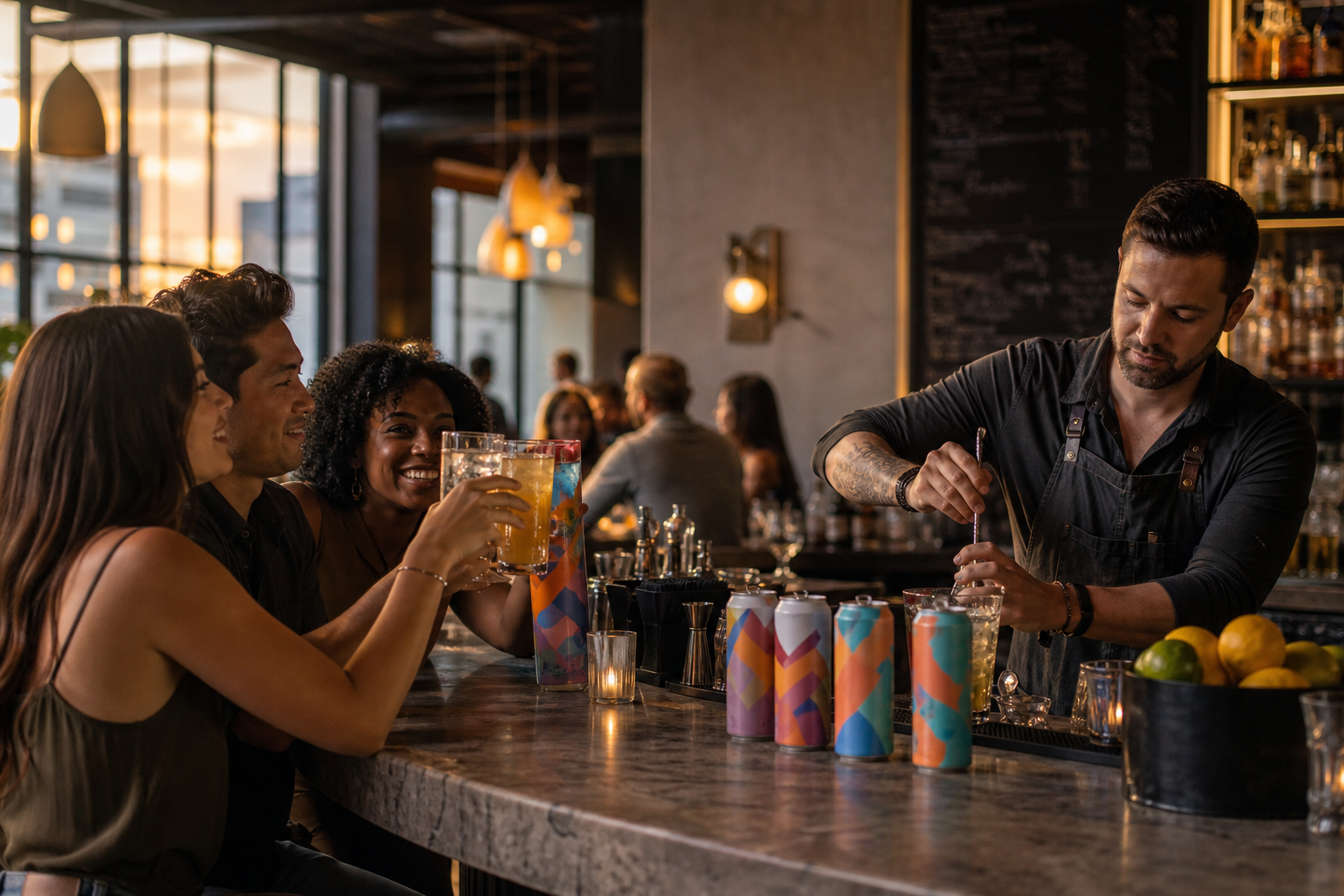
But here's what actually matters for your restaurant, whether you're in Massachusetts, Minnesota, or Mississippi: most of this isn't about lounges. It's about the can in the cooler next to the seltzer.
Low-dose THC beverages, in that two-and-a-half to ten-milligram range, are showing up on menus as the alcohol alternative. This isn't a stoner edible. It's a drink that behaves like a drink: same ritual, same social occasion, different ingredient.
The why behind it is straightforward. Younger diners are drinking less, and that's not a hot take, it's been showing up in the data for years. But they still want the social ritual of ordering something at the bar. THC drinks let an operator capture that guest without them ordering a Diet Coke and feeling like they're missing out.
So the operator logic is airtight on paper: thin margins, a beverage category growing nationally while alcohol shrinks, a guest base actively looking for alcohol alternatives, and a product that slides right next to the existing bar program.
There's just one problem. The product they're building that program around might not be legal in five months. And even before we get to November, there's a second problem almost nobody is solving for yet.
The Gap
Let's talk about the part of this story that's actually about technology, because this is where I think the opportunity is hiding, and it's strong.
Look at the cannabis industry's own tech stack: dispensary point-of-sale systems, ID scanners, seed-to-sale tracking, companies like Cova, Treez, WebJoint. It's a fairly mature stack, built specifically to handle age verification, purchase limits, and compliance reporting for a regulated product.
Now look at Toast. Look at Square. Look at whatever you're running behind your bar right now. None of it has a category for this. There's no built-in THC milligram tracker. There's no age-gate flag that's separate and distinct from the alcohol check. There's no compliance reporting module for a product that isn't alcohol but absolutely behaves like one from a risk standpoint.
Operators serving these drinks today are doing it the way our industry solves most new problems: manually. A line on a checklist. A verbal reminder at the pre-shift. Hope that the server remembers.
That's the gap, and it's not small, because the liability question is just as unsettled as the technology.
We already have a mature legal structure for alcohol. Dram shop laws exist in roughly 42 to 44 states, depending on who's counting, and they hold an establishment responsible when an over-served guest causes harm after leaving. Insurance carriers know how to underwrite that risk. There's a whole liquor liability product built around it.
THC has no equivalent yet. No settled case law, no standard underwriting model, no agreed-upon definition of what "over-served" even means with a beverage that doesn't hit the same way alcohol does. That's not a reason to avoid the category, though it is a little scary. It's a reason somebody needs to build the infrastructure before a court does it for them.
So here's the technology play, as I see it. I think it's actually three plays stacked on top of each other:
-
One. POS and menu systems that can flag, track, and report THC beverage sales the way they already do for alcohol, age verification included, built into the same workflow staff already use, not a second system bolted on the side.
-
Two. Compliance and labeling tools that can adapt fast. This regulatory picture is going to keep moving, state by state and possibly federally, for years. Whoever builds the system that updates itself instead of asking the restaurant group to manually chase fifty different state rules is going to win a lot of business.
-
Three, and this is the one almost nobody's talking about yet: insurance and risk products built specifically for restaurants serving THC beverages. The liquor liability model exists as a blueprint. Somebody has to build the cannabis-beverage equivalent before the lawsuits force the issue.
None of this requires the restaurant industry to win the federal fight. It requires someone to build for the world the NRA is actually describing in their letter: a regulated, professionalized, low-dose THC beverage category that behaves a lot like the alcohol category already does.
Where This Leaves Us
The clock is real. November 12th is coming whether Congress acts or not. The money is real. Operators are already serving this, and a quarter of the industry has raised its hand to join them. And the gap is real. The technology and the liability infrastructure haven't caught up to either of those facts yet.
If you're an operator, the move right now is patience with eyes wide open. Watch what Congress does with that NRA letter over the next few months before you build a beverage program around a product that might not exist in its current form by Thanksgiving.
If you're in restaurant tech, the move is to stop waiting for the lounges to become the story. The story is already happening at the bar, in a can, next to the seltzer. Whoever builds the boring stuff first, the age gate, the milligram tracker, the compliance report, is going to own a category before most of the industry even knows it needs one.
That's what's going on with weed in restaurants. The clock is ticking, there's clearly money on the table, and there's a real gap in the technology built to support it. Let's get after it.
This is Modern Solutions for Modern Restaurants. For more on go-to-market strategy for restaurant technology brands, visit PopcornGTM.com. Connect with me on LinkedIn.
Until next time, keep building modern solutions for modern restaurants.
— Paul Molinari