
.png?width=1232&height=928&name=popcorngtm_a_mix_of_characters_that_tell_a_story_colors_are_b_c309ca4b-2dee-4bd3-b34a-e9cdc22f2c92_3%20(1).png)
TL;DR. Generic AI tools produce content that sounds the same across every brand because they run on prompts, and a prompt has no memory of your brand. The fix is anchoring every generation to a brand archetype document. Mark and Pearson's 12-archetype framework is the most durable way to do that for B2B brands.
People are getting really good at spotting AI-written content from across the room.
And the reason every AI output sounds the same is not that AI is bad at writing. It's that AI without a brand foundation has no reason to sound any particular way.
A generic prompt gives you one shot at a brand voice and forgets it the next session. The next 50 brands using the same tool get the same output. It's all very forgettable. But for brands, standing out is more important than ever.
For starters, brand consistency drives revenue. Paul Molinari's essay on showing up consistently online shows 23-33% revenue increases for companies that achieve brand consistency. The hard part is making the consistency stick when AI is doing most of the writing.
Why does AI content sound generic?
Two reasons.
The training data flattens voice. LLMs are trained on a few trillion tokens of internet text. The content that survives tends to sound like a mashup of things. Educated, professional, hedged, mildly enthusiastic. When you prompt for a LinkedIn post, the default voice is that center of gravity. It's fine but it's also indistinguishable from what your competitors are saying.
The prompt has no memory. ChatGPT has no idea what you posted last week. It doesn't know your founder's voice. It doesn't know which words your team has banned. It writes from scratch every session, then forgets. The result is content that drifts and never compounds into a recognizable brand.
.png?width=900&height=678&name=popcorngtm_a_mix_of_characters_that_tell_a_story_colors_are_b_c309ca4b-2dee-4bd3-b34a-e9cdc22f2c92_3%20(1).png)
What is a brand archetype?
A brand archetype is a recurring character pattern that gives a brand a recognizable voice and emotional posture.
The framework most B2B brands use comes from Margaret Mark and Carol S. Pearson's 2001 book *The Hero and the Outlaw* (Harvard Business Review Press). They identified 12 distinct archetypes, each with a different motivation, voice, and emotional register.
|
Archetype |
Motivation |
What it sounds like |
|
Rebel |
Disruption, change |
Provocative. Direct. Challenges convention. |
|
Sage |
Truth, understanding |
Authoritative. Cited. Slow to claim. |
|
Hero |
Mastery, achievement |
Confident. Bold. Action-oriented. |
|
Everyman |
Establishment |
Round edges, conformity, expected |
|
Magician |
Transformation |
Visionary. Possibility-focused. |
|
Caregiver |
Service, protection |
Warm. Reassuring. Patient. |
|
Creator |
Innovation, expression |
Original. Unconventional. Ideas-first. |
|
Lover |
Connection, intimacy |
Emotional. Sensory. Detailed. |
|
Jester |
Joy, irreverence |
Playful. Self-aware. Subversive humor. |
|
Innocent |
Purity, simplicity |
Hopeful. Clean. Optimistic. |
|
Explorer |
Freedom, discovery |
Curious. Forward-leaning. Restless. |
|
Ruler |
Order, control |
Composed. Premium. Authoritative. |
Patagonia is a Rebel + Explorer brand. Apple is a Creator + Magician brand. Mailchimp is a Jester + Creator brand. Their voices aren't random. It's the archetype that has been applied consistently for years.
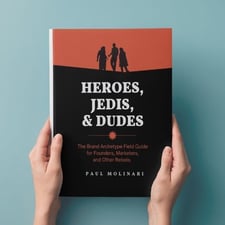 For example: Popcorn GTM is a Rebel + Explorer brand. Direct, confident, curious, forward-leaning, punchy, memorable. Want to deep dive on this topic, check out our book: Heroes, Jedis, and Dudes: The Brand Archetype Field Guide for Founders, Marketers, and Other Rebels
What does brand archetype-anchored AI content look like?
Same prompt: "Write a LinkedIn post about why restaurant tech founders should care about brand consistency."
Generic AI tool returns:
Brand consistency is essential for building trust and recognition with your audience. Restaurant tech founders should focus on maintaining a unified voice across all marketing channels to drive long-term success.
Zzzz….
Air Cover, anchored to a Rebel + Explorer archetype, returns:
Restaurant tech founders are losing deals to competitors with worse products. The reason is rarely the feature set. It's the silence. Your buyers are forming opinions about your stability before they ever talk to your sales team. If your channels are quiet for a quarter, you are giving the buyer permission to assume the worst.
Same prompt. Different archetype. Different voice. The second version sounds like a brand with a real POV. The first sounds like AI.
Context is king here, and so the more information AI has about your brand, the better the outcomes will be.
How Air Cover applies this in practice
Three steps.
-
Onboarding. Every Air Cover client starts with a 90-minute structured interview. We document the archetype, messaging pillars, banned words, words the founder uses naturally, proof points, and topics in or out of bounds. This becomes the brand's permanent foundation document.
-
Brand Anchors. The brand foundation loads as the first context window every Air Cover agent reads. The system cannot produce a draft that ignores it, because the foundation is the first input.
-
Multi-layer quality control. Every output is scored against the brand voice rules, banned words, banned sentence structures, and archetype. Drafts that drift get rewritten before a human ever sees them.
The result is content that sounds like the brand told you it wanted to sound. Not like AI. Not like the brand next door using the same tools.
.png?width=900&height=678&name=popcorngtm_a_mix_of_characters_that_tell_a_story_colors_are_b_9a2c15b4-cfbb-4716-97b3-6808a05c555d_0%20(1).png)
FAQs
Can I tell ChatGPT my archetype every time?
You can. You'll spend 5-10 minutes per prompt re-establishing the archetype, banned words, and topics. You'll still produce inconsistent output because the model has no memory and no quality control loop. The compounding cost over a year is enormous. The fix is to embed the archetype in a system that loads it automatically every run, which is the structural difference between a prompt and a pipeline.
How long does it take to build a brand archetype document?
Most brands complete a usable archetype foundation in a 90-minute structured interview. Refining it through pilot content takes another 2-3 weeks. Air Cover ships a working draft within 48 hours of the interview and tunes it through two revision cycles in the first month.
Are there cases where generic AI works?
For one-off internal documents, yes. For consistent public-facing content over months and years, no. The lack of an archetype shows up as voice drift. The reader can't articulate why your content stopped feeling like you, only that it did.
Why does Mark & Pearson's framework specifically work for B2B?
The 12 archetypes map to differentiated commercial postures. Most B2B brands cluster in three or four archetypes (Sage, Ruler, Hero, Caregiver). Picking one forces the brand to sound different from competitors clustered around the same archetypes. The framework gives you a vocabulary for "how should we sound" that's more durable than "professional but human."


.png)
Join the Air Cover waitlist
If your AI content sounds like everyone else's, the fix is not better prompts. It's a brand foundation that loads on every run.
Join the waitlist for early access plus pilot pricing locked in flat rates that won't be available after public launch.